 By st20113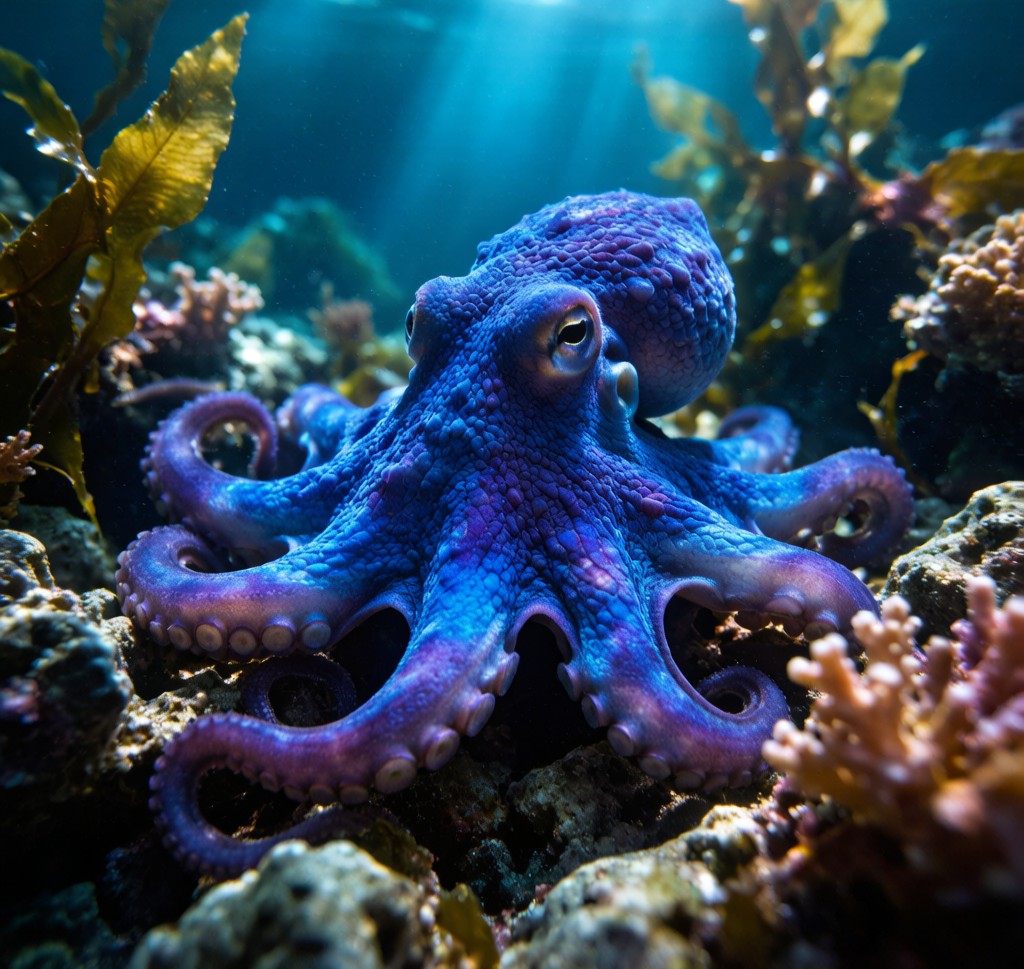
The common octopus (Octopus vulgaris) is the most studied and widely distributed of all octopus species and one of the most remarkable and intelligence of all invertebrates. Found in tropical and temperate oceans worldwide, from the shallow coastal waters of the Mediterranean and the Atlantic to the rocky reefs of the Pacific and Indian Oceans, the common octopus is a master of disguise, a tool user, a problem solver, and an escape artist that has baffled marine biologists and aquarists alike with its remarkable behavioural repertoire. With its three hearts, blue blood, boneless body, eight sucker-lined arms each containing hundreds of individually controlled suckers, and a brain that wraps around its oesophagus, the octopus represents a completely independent evolutionary experiment in high intelligence — a lineage that diverged from the vertebrate line over 500 million years ago and arrived at intelligence through a radically different anatomical and neural architecture. Each of the octopus’s arms contains a significant concentration of neural ganglia, giving it a degree of semi-autonomous intelligence and sensory capability that allows it to taste and smell through its suckers, make decisions without consulting the central brain, and even regenerate an entire arm if lost to a predator attack.
## Physical Characteristics
The common octopus has a soft, bulbous mantle — the sac-like body that contains all the internal organs — that measures approximately 25 centimetres in length in a typical adult, with a pair of large, highly developed eyes that are structurally similar to vertebrate eyes, remarkable for their independent evolutionary origin and their sophisticated image-forming capability. Eight muscular arms, each approximately 80 to 100 centimetres long in a large adult, radiate from the base of the mantle, and each arm bears two rows of suckers along its inner surface — between 100 and 200 suckers per arm — that are equipped with chemoreceptors that allow the octopus to taste and smell anything its arms contact. The skin is equipped with specialised cells called chromatophores that contain pigment sacs of different colours and can be expanded or contracted by surrounding muscle cells to change the colour, pattern, and texture of the skin within milliseconds, enabling the octopus to blend seamlessly into any background, signal to other octopuses, or adopt warning displays. The third heart — two branchial hearts that pump blood to the gills, and one systemic heart that pumps blood to the body — beats to circulate haemocyanin, a copper-based oxygen-carrying molecule that turns the blood blue.
## Habitat and Distribution
The common octopus is found throughout the tropical and temperate oceans of the world, from shallow tidal pools and coral reefs to depths of at least 200 metres, and possibly considerably deeper. Its range includes the entire Mediterranean Sea and the Atlantic Ocean from the British Isles to South Africa, the Indian Ocean from East Africa to Japan, and the Pacific Ocean from southern California to Chile and from Japan to New Zealand and Australia. The species inhabits a wide range of benthic (bottom-dwelling) environments including rocky reefs, seagrass beds, sandy and muddy substrates, coral reefs, and artificial structures such as shipwrecks, docks, and oil platforms. Octopuses are territorial and maintain a home range centred on a den — typically a crevice, hollow rock, or burrow — which they decorate with the shells and fragments of their prey to create a defensive barrier at the entrance. Home ranges vary from approximately 1,500 to over 50,000 square metres depending on habitat quality and prey availability.
## Diet and Behavior
The common octopus is a carnivorous predator that feeds primarily on crustaceans (crabs, lobsters, and shrimp), bivalves (clams, mussels, and oysters), and small fish. The hunting strategy varies with prey type: for active prey such as crabs and small fish, the octopus uses a rapid burst of speed to seize the prey in its arms and delivers a paralysing bite with its beak-like jaws (the rostrum), injecting a paralysing toxin from the salivary glands; for shelled prey such as bivalves, the octopus uses patient, methodical techniques including forcing the shell open by wedging it between the arms and the substrate, and drilling a small hole through the shell with its radula (a ribbon of tiny teeth) and injecting a paralyzing toxin to weaken the adductor muscle. Tool use in octopuses has been documented: the veined octopus (Amphioctopus marginatus) — a close relative of the common octopus — collects coconut shell halves and carries them to a new location to use as portable shelters, the first documented example of tool-carrying for future use in an invertebrate. Octopuses are highly intelligent and have demonstrated learning, memory, problem-solving, and play behaviour in laboratory studies.
## Conservation
The common octopus is currently classified as Least Concern on the IUCN Red List, with a global population that appears to be stable and potentially expanding in some regions as a result of climate change and the warming of ocean temperatures, which may be extending the species’ range northward. The common octopus is one of the most important commercial fisheries species globally, with annual catches exceeding 100,000 tonnes and a market value of several hundred million dollars. Overfishing of octopus populations can disrupt benthic marine ecosystem dynamics, as the removal of a significant predator of crustaceans and bivalves can trigger trophic cascades that alter the structure and function of the seafloor community.
[…] predators and prey alike. Despite its name, the cuttlefish is not a fish but a close cousin of the octopus, sharing its soft body, keen intelligence, and boneless anatomy. Its intelligence ranks among the […]
[…] octopus shares comparable ocean habitats with this […]