 By Iris
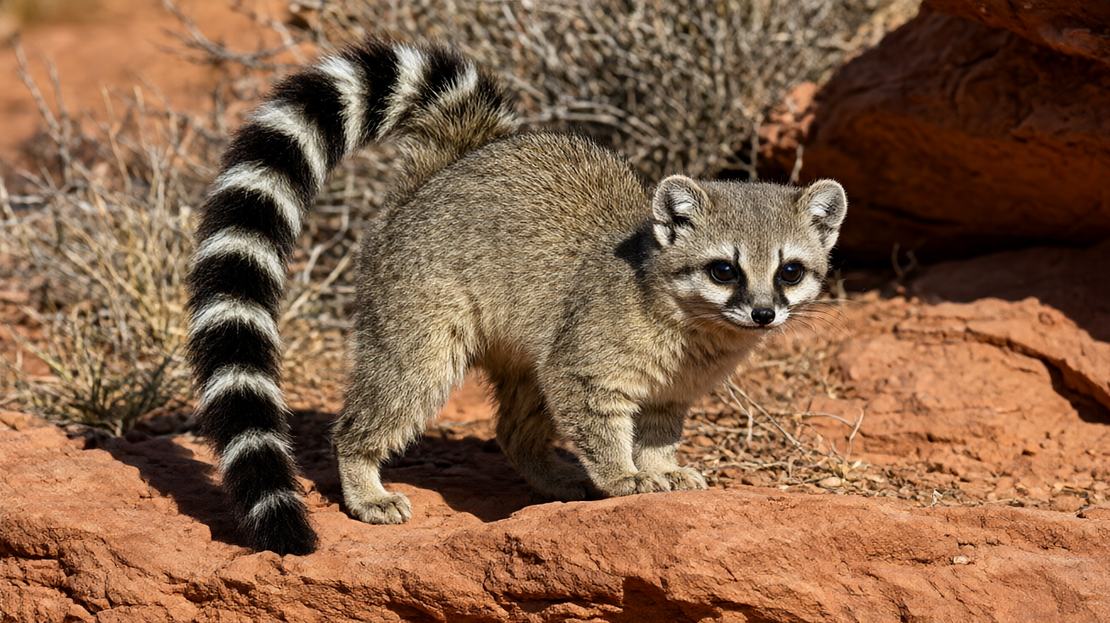
Bassariscus astutus | Ringtail
Species Profile · Procyonidae
Ringtail
A canyon climber with a banded tail and ankles that turn backward.
Least Concern
Body
Tail
Weight
Ankle turn
Litter
Rating
A kilo of balance
A tail with sixteen rings
A small animal with a long banded tail steps along a canyon ledge in the dark. It moves with the confidence of a creature that has never fallen. A ringtail weighs about 1 kg and measures roughly 35 cm in the body, with a tail almost as long again. Fourteen to sixteen black rings circle that tail.
Large dark eyes sit in a face framed by pale fur and white eye rings. It belongs to the raccoon family, although it looks like a small fox crossed with a squirrel. Nobody would guess that from the name, since a ringtail is not a cat. Its climbing ability has few equals among mammals.
Rock walls, narrow cracks and sloping trunks all serve as paths. Each hind foot turns outward by 180 degrees, so the animal can grip while it runs down a face. That trick lets it descend head first. Most climbers must back down.
Family tree
Procyonidae, the raccoon family
Two species fill the genus Bassariscus, and both live in the Americas. This one ranges through the south west of the United States and far into Mexico. Its cousin, the cacomistle, keeps to wetter forest further south. Older texts lumped the two together, and the names still get mixed in popular books.
The family also holds the Raccoon, the coati and the kinkajou. All of them share a short face, mobile fingers and a taste for varied food. Raccoons split from the group several million years ago, and the ringtail line is older still. Fossils place the family in North America before the ice ages.
A ringtail is a poor name for a fox, and an even worse one for a cat. Miner’s cat became another label, since miners once kept the animals for pest control. The name stuck long after the mines closed.
A procyonid, not a cat
How to tell one
Fur is soft and dense, buff grey above and paler below. The tail carries alternating black and white rings, and it acts as a balance beam. Hind feet rotate outward, which allows a head-first descent. Claws are sharp and partly retractable.
Fingers move independently, which helps in tight cracks. Eyes face forward, and each one carries a reflective layer that lifts light at night. Ears are short and rounded, and they turn toward small sounds. Whiskers are long and stiff.
Males grow slightly larger than females. Body length runs 30 to 42 cm, and the tail adds another 31 to 44 cm. Weight stays between 0.7 and 1.5 kg, although well fed animals run heavier. Winter brings a thicker coat, although the animal does not truly hibernate.
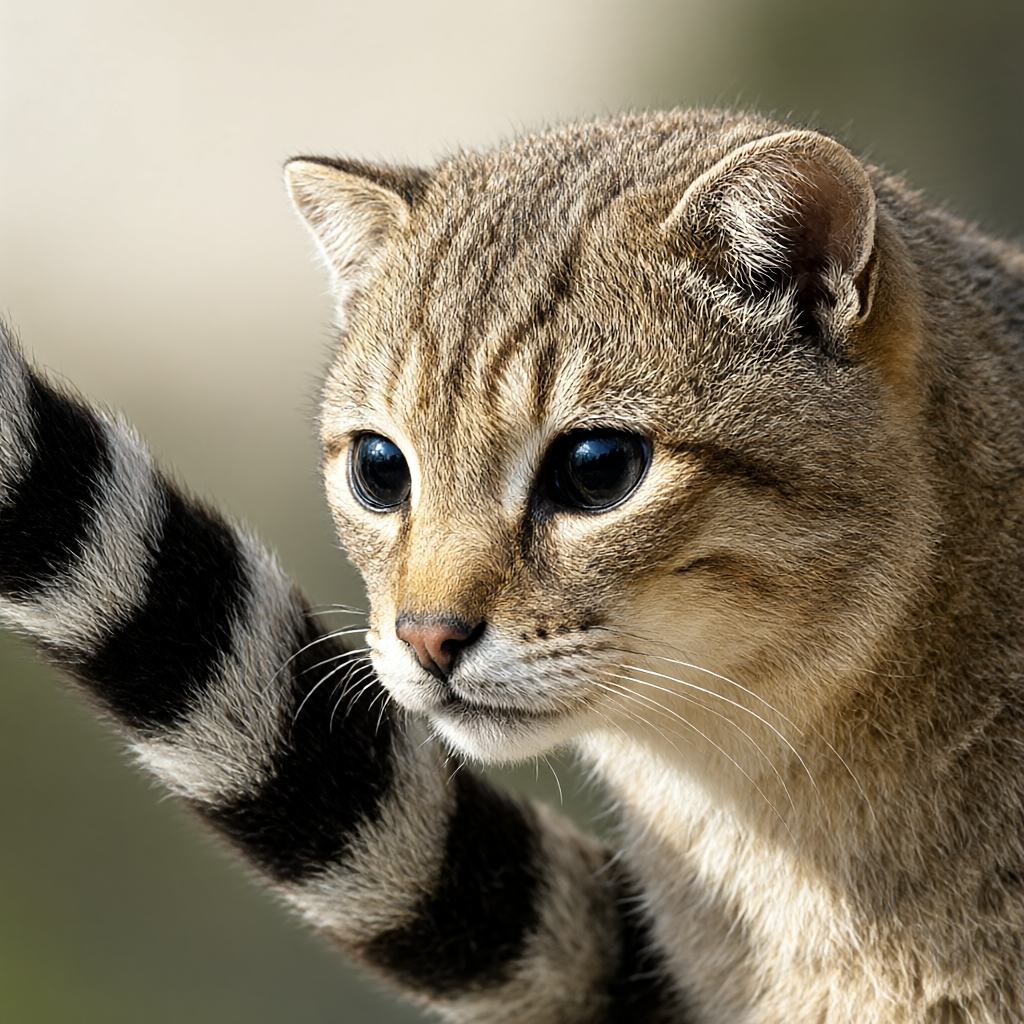
1
2
3
Ankles that turn outward
Where it lives
Rocky canyon country suits the species best. Dry scrub, juniper woodland and pine forest all hold animals, as long as water sits nearby. Cliffs give dens, and talus slopes give cover. Streams also draw it, since prey gathers along the water.
Caves and hollow trees serve as daytime retreats. Buildings replace cliffs in some districts, and ringtails then den in attics and barns. Dense forest holds fewer animals, since the canopy offers little rock. Cold winters push the animal toward lower ground.
Desert heat pushes it toward water. Range maps show a patchy pattern, since suitable rock is scattered across the region. The species adapts well to human settlement. Gardens with fruit trees attract it.
Canyons with water nearby
What it eats
Ringtails eat almost anything they can catch or reach. Mice, woodrats and small birds form a large part of the diet. Insects, lizards, snakes and frogs also get taken. Fruit and seeds fill the rest of the diet, and the animal eats juniper berries through the cold winter months.
A ringtail hunts on the ground and in trees. Long fingers pull prey from cracks. A quick bite to the back of the neck ends the chase. Caching has been reported, although few people have watched it happen.
Water comes from streams and from juicy fruit. Captive animals take meat, fruit and insects with equal interest, though they favour fruit first. Feeding peaks after dusk. An animal may travel a kilometre in a night, and it rarely uses the same route twice.
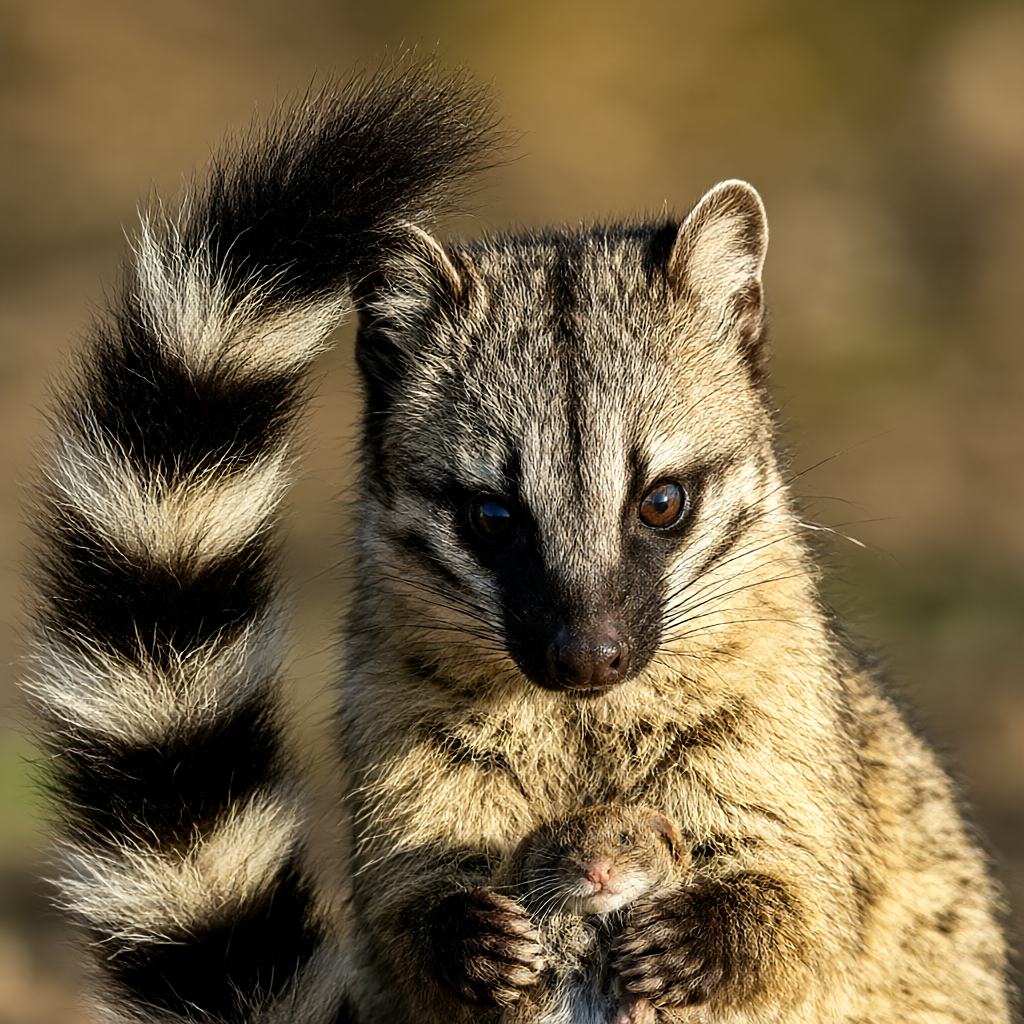
Almost anything it catches
The breeding cycle
Nights belong to the ringtail, and days pass in a den. Adults live alone for most of the year. Scent marks on rocks tell neighbours who passed, and the marks last for weeks. Calls include a chattering bark and a thin scream.
Mating happens in spring, from February into May. Pregnancy runs about 50 days. Two to four young are born in a den, and they open their eyes at about a month. The father often stays near the den, which is unusual for a member of this family.
Young animals start climbing at two months. Independence comes at about four months, when the young animal starts to travel alone. Females may breed in their first year, while males take longer. Captive animals have lived past 15 years, and wild ones probably manage less.
Least Concern, and settled
Conservation
The IUCN lists this species as Least Concern. Its range is wide, and the animal tolerates people well enough to live in suburbs and in farm buildings. Habitat loss still removes canyon country, since towns spread into the hills. Roads kill animals at night, since ringtails cross open ground after dark.
Historic trapping for fur took heavy numbers across the west, although the trade has since ended. Rodent control once brought the animal into mines and barns, and that habit continues. Pesticides reduce prey in farming districts, and the animal then turns to fruit and to stored grain. Parks and reserves cover much of the range.
No count exists, so the true state remains unclear, although the trend looks stable. Little help is needed, since the animal breeds well and adapts fast. Rocky ground with water and cover keeps it in place, and that mix of features survives across most of its range.
Side by side
How It Compares
| Trait | Ringtail | Raccoon |
|---|---|---|
| Body | 30 to 42 cm, plus a 31 to 44 cm tail | 40 to 70 cm, plus a 20 to 40 cm tail |
| Weight | 0.7 to 1.5 kg | 3.5 to 9 kg |
| Tail | 14 to 16 black rings | five to seven dark rings |
| Den | cracks, caves and attics | hollow trees and burrows |
| Home | canyons and dry scrub with water nearby | woodland, marsh and city edges |
| Rating | Least Concern | Least Concern |
Common misreadings
What People Get Wrong
- Many people take the animal for a cat, yet the name has nothing to do with one.
- A popular claim says it hibernates, although it stays active through the winter.
- Some guides say it needs dense forest, yet it does best on rocky canyon ground.
Going further
Sources and Further Reading
Quick hits
Five things to remember
- A ringtail is not a cat.
- The tail carries up to sixteen black rings.
- Hind feet turn outward for head-first descent.
- It is the state mammal of Arizona.
- One litter holds two to four young.