 By st20113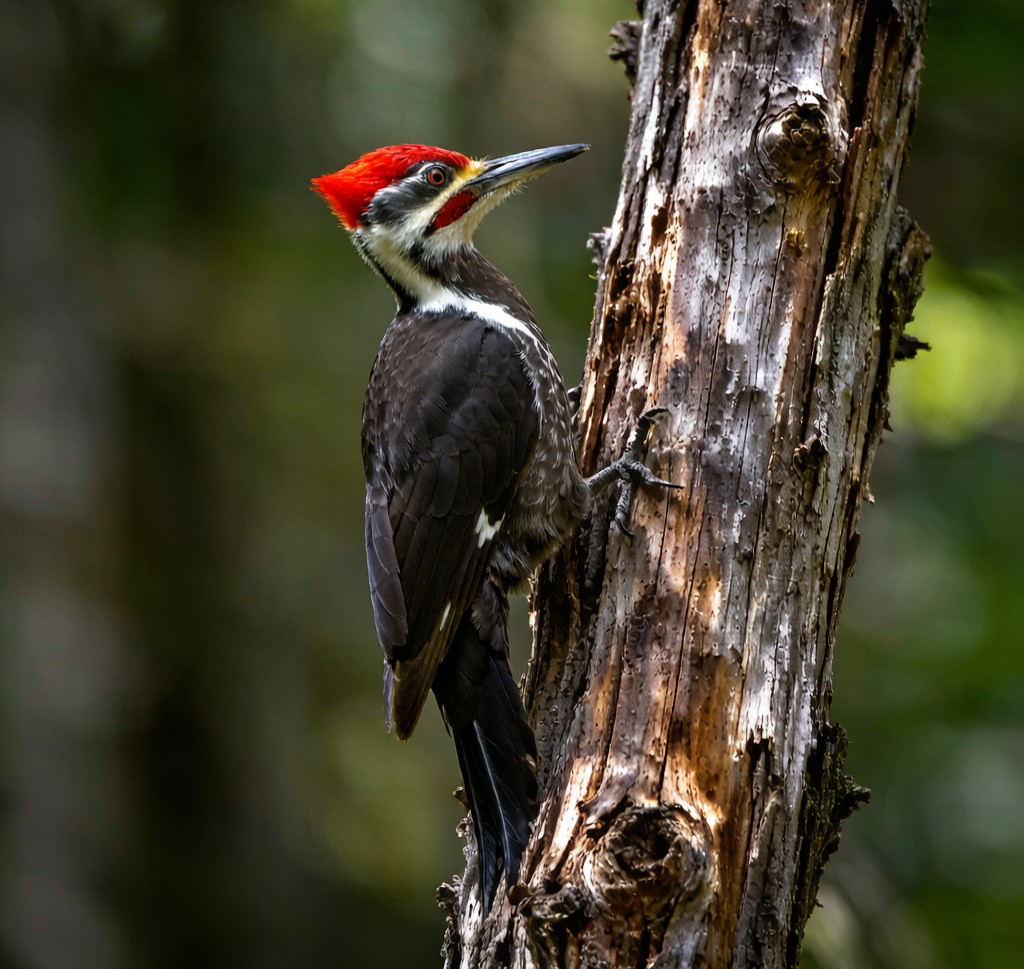
The pileated woodpecker (Dryocopus pileatus) is one of the largest, most striking, and most ecologically significant woodpeckers in North America. Roughly the size of a crow, it measures 40 to 49 centimeters (16 to 19 inches) in length with a wingspan of 66 to 75 centimeters. Its English name derives from the Latin pileatus, meaning “capped,” referring to the conspicuous red crest that adorns its head.
The pileated woodpecker is predominantly black, with bold white stripes on the face and neck and a prominent red crest. Males have a red forehead and a red stripe from the bill to the throat, while females have a black forehead and throat. In flight, large white wing patches are visible. The bill is strong and chisel-shaped, adapted for excavating wood.
This species inhabits mature deciduous and mixed forests across much of Canada, the eastern United States, and parts of the Pacific Northwest. It requires large tracts of forest with abundant dead and dying trees, which provide both foraging substrate and nesting cavities.
The pileated woodpecker’s primary food is carpenter ants, which it extracts from dead wood by excavating large, rectangular holes. A single pileated woodpecker can consume 2,000 to 3,000 carpenter ants per day during the breeding season, making it one of the most effective natural controllers of these destructive insects.
Its drumming – a rapid, loud series of strikes on resonant dead wood – serves as a territorial display, audible up to 0.8 kilometers (0.5 miles) away. Unlike songbirds, the pileated woodpecker does not sing; instead, it relies on this drumming pattern to communicate with rivals and mates.
Perhaps the pileated woodpecker’s most significant ecological contribution is its creation of nesting cavities. These excavations are among the largest of any North American woodpecker, and once abandoned, they are used by a remarkable array of secondary cavity nesters including ducks, owls, hawks, bats, squirrels, and raccoons.
The pileated woodpecker is classified as Least Concern and has benefited from the conservation of mature forests. Its populations have expanded northward and into urban and suburban areas where large trees and dead wood are retained.