 By Iris
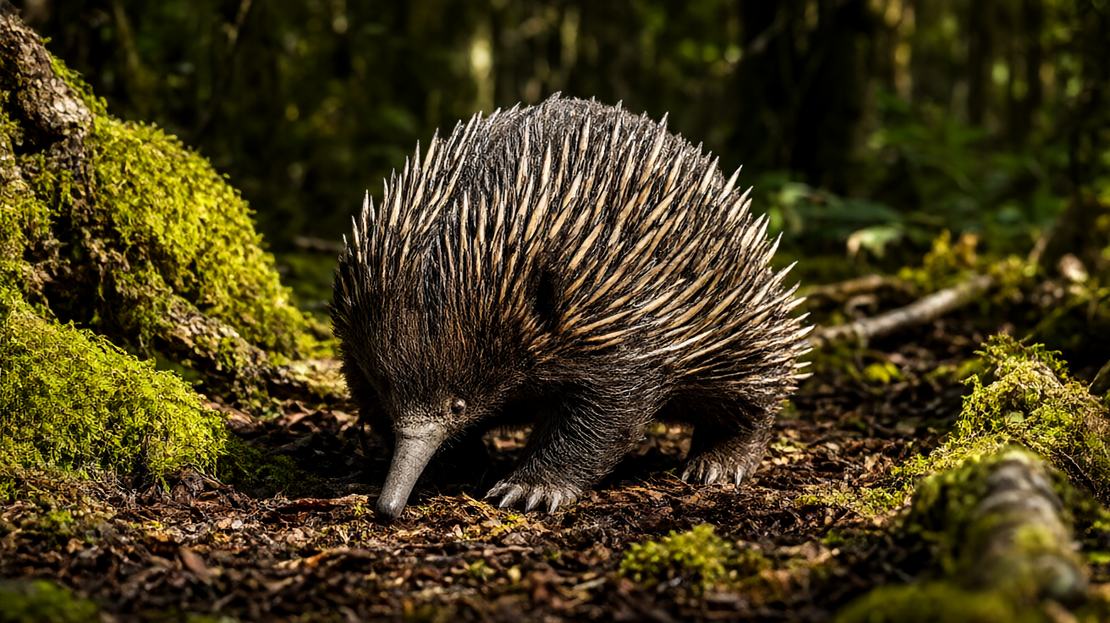
Zaglossus bruijnii | Western Long-beaked Echidna
Species Profile · Tachyglossidae
Western Long-beaked Echidna
An egg laying mammal with a hooked snout, and almost no witnesses.
Critically Endangered
Length
Weight
Snout
Egg
Lifespan
Rating
Ten kilos of spines
A mammal that lays an egg
A spiny animal the size of a small dog pushes its long snout into wet leaf litter on a New Guinea ridge. That snout bends downward at the tip. It probes the soil for worms, which form almost the whole diet. This is one of the few mammals that lays eggs. Only the platypus and the echidnas share that habit.
Long-beaked echidnas once lived across much of New Guinea, and they still hold on in the highlands. Most people have never seen one. Echidnas are shy, slow and mostly active at night. Even field teams go years between sightings. Hunting dogs find them faster than scientists do.
One animal can feed a family, so the species fades near villages. Spines give little protection against a trained dog. Few young are born, so every loss counts. Numbers fall quietly.
Family tree
Tachyglossidae, the echidnas
Echidnas sit in the monotreme group, and that line split from all other mammals very early. Four species survive today, and one of them is the Platypus. Three long-beaked echidnas fill the genus Zaglossus, and all of them are limited to New Guinea. This species carries the name bruijnii, given for a Dutch trader who collected in the region.
Its snout is longer and more curved than the snout of the short-beaked echidna in Australia. Long-beaked forms also grow larger, and they carry fewer spines on the back. Field records rest on skulls, because the three species look much alike alive. A specimen said to come from north west Australia in 1901 remains disputed.
Recent work suggests deep splits between mountain ranges. Each range may hold its own form, although the naming stays unsettled. Monotremes show how varied mammal breeding can be, since the group kept laying eggs while others stopped.
One of four egg layers
How to tell one
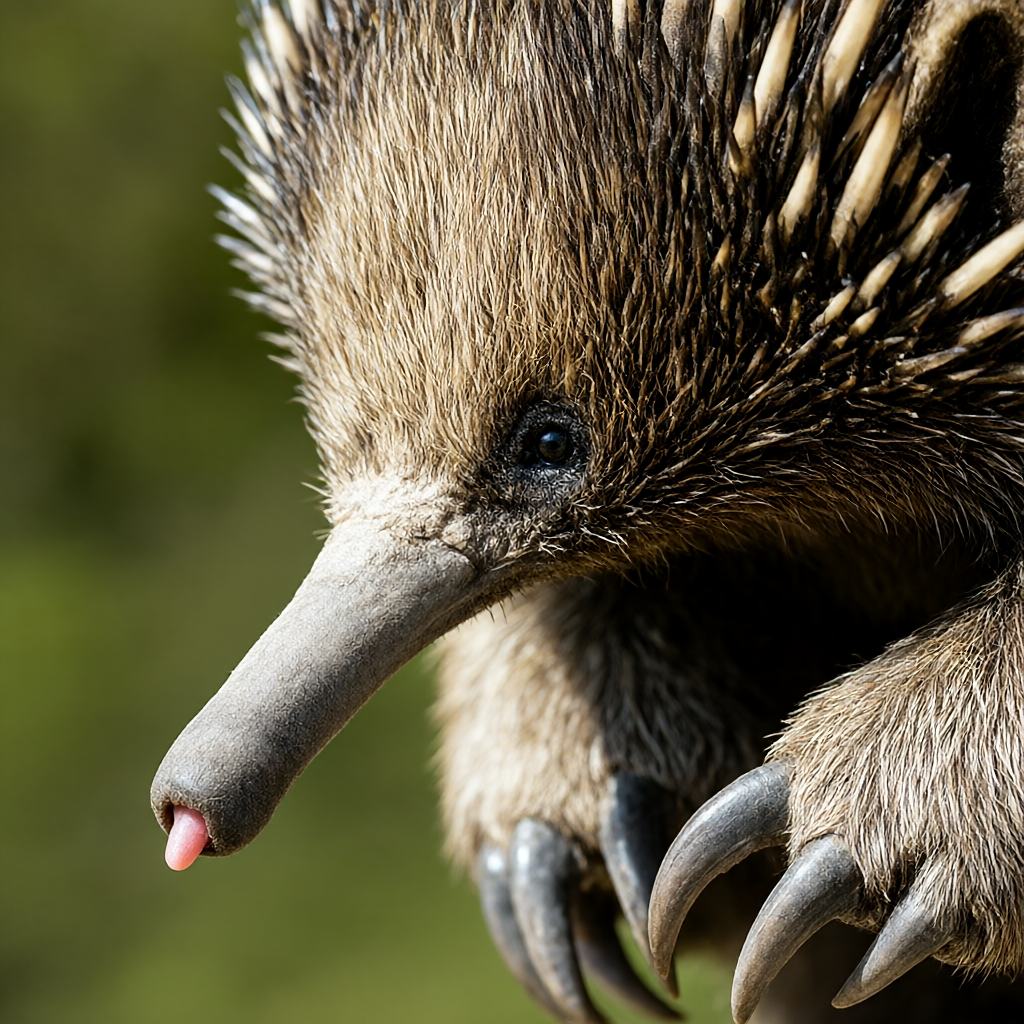
Adults reach 60 to 100 cm and weigh 5 to 10 kg. Large males can pass that upper figure. Coarse fur covers the body, and short thick spines poke out through the fur along the whole back. Spines on the back lie flatter than those of the Australian echidna, since the coat hides them. A snout takes about a third of the head, and it bends down like a hook.
Skin on that snout carries thousands of tiny sensors that pick up weak electric fields around prey. Front feet carry three strong claws, and the animals use those claws to break open rotten logs in the forest. Hind feet point backward, which suits a body built for digging. Tongues are long, thin and coated with sticky mucus. Eyes are small, and sight plays little part in finding food.
Bodies run cool for a mammal, often near 30 °C. That slow engine suits a cold, wet forest, since the animal burns little fuel. Males carry a spur on each hind leg, as the platypus does.
1
2
3
A snout full of sensors
Where it lives
Montane forest in the Bird’s Head region of western New Guinea holds the best known groups. Records run from about 1,300 m up to the tree line. Moss-covered ground suits the animals, since worms stay near the surface in damp soil. Fallen logs and deep litter give both food and shelter.
Forest here stays wet through the year, and nights are cool. Echidnas dig short burrows in banks and under roots. Each animal uses several of them, and it moves between burrows through the year. Nests are lined with leaves and twigs, which keep the single egg warm in cold weather.
Lowland forest also holds animals in places, although records there remain thin. Farmland and open ground hold none, although animals cross such ground at night. Clearance removes both cover and food, so the animals retreat upslope as the forest comes down. Ridge tops matter, because each range keeps its own group apart.
Mossy montane forest
What it eats
Worms form the main food, and the animals take them at every chance. A long snout reaches deep into soil and rotten wood. Claws break open a log first, and the snout probes inside after that. Sensors pick up the weak field around a worm, which helps in the dark.
Larvae get eaten too. Few stomachs held worms and little else. Feeding takes place slowly, and an animal may spend hours at one log. The tongue comes out fast, and it takes the worm before the worm can pull back.
An echidna eats a lot for its size, since worms offer little energy and the body burns fuel slowly. Water comes from food and from dew, although the animals also drink. A cool body slows digestion, so meals last a long time, although the animal still feeds often.
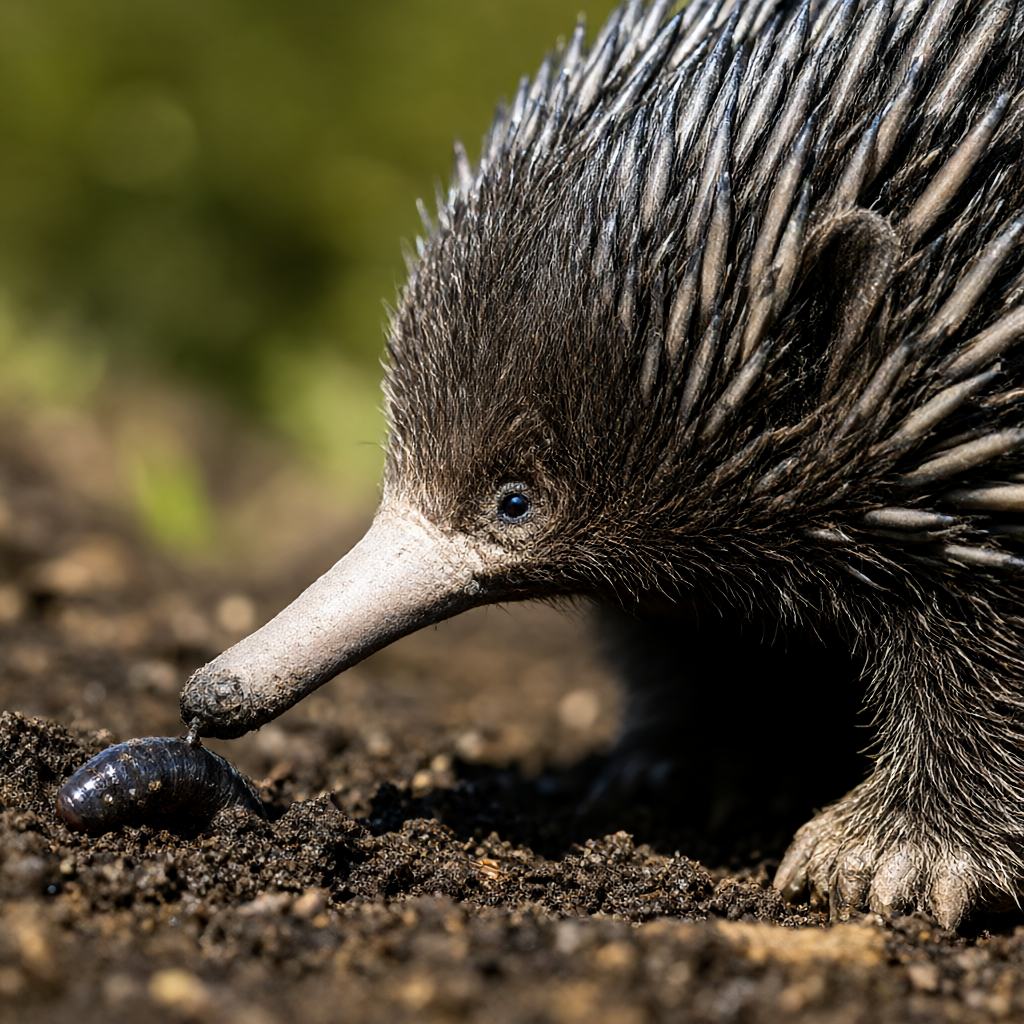
Worms from rotten wood
The breeding cycle
Most activity happens at night, and the animals move slowly. Threat brings a tight roll into a spiny ball, yet the animal would rather dig away. The animal can also dig straight down, leaving only spines above ground. Males fight in a circle, pushing each other with their heads.
Mating itself has rarely been seen, and no observer has followed a full courtship from start to finish. The female lays a single egg, and it measures about 15 mm. That egg moves to a pouch on her belly, and it hatches about ten days later. Young stay in the pouch for weeks, then move to a burrow.
A mother feeds the young for months, which keeps the birth rate low. Females probably breed once every few years. Captive animals have lived past 30 years, so the animals may simply take their time. How long they live in the wild remains unknown, yet the slow pace fits a forest with few enemies.
Critically Endangered, and hunted
Conservation
The IUCN lists this species as Critically Endangered. Hunting drives most of the decline, since dogs find echidnas faster than people do. Hunting has gone on for thousands of years, and it worked while numbers stayed high. Roads and logging now open new ground to hunters.
Loss of forest adds to the pressure. Parks cover part of the range, although patrols are few and roads reach most valleys. Camera traps have found the species in districts where nobody had seen one for years. A related species was filmed in the Cyclops Mountains in 2023, which shows what surveys can still find.
No captive pair has produced young. One young every few years cannot replace heavy losses. Protection now depends on working with villages, since hunters know the ground best. Some villages have agreed to stop hunting in return for support, and those areas keep animals.
Side by side
How It Compares
| Trait | Western Long-beaked Echidna | Platypus |
|---|---|---|
| Length | 60 to 100 cm | about 50 cm, with a flat tail |
| Weight | 5 to 10 kg | under 2 kg |
| Snout | long, curved down, with sensors | flat and rubbery, with electric sensors |
| Spines | short and thick, under the fur | none |
| Home | mossy montane forest in New Guinea | streams of eastern Australia |
| Rating | Critically Endangered | Least Concern |
Common misreadings
What People Get Wrong
- Many people assume only the platypus lays eggs, yet four echidnas do the same.
- A common claim says the snout is a nose, although it mainly holds electric sensors.
- Some books call the animal secure, yet no more than a few thousand remain.
Going further
Sources and Further Reading
Quick hits
Five things to remember
- The species lays eggs.
- It probes soil with a hooked snout.
- Sensors on the snout detect prey.
- The animal often rolls into a spiny ball.
- Females probably breed once every few years.