 By Iris
Pantodon buchholzi | Freshwater Butterflyfish
Species Profile · Pantodontidae
Freshwater Butterflyfish
A surface fish with wings for fins, and a habit of leaving the water.
Least Concern
Length
Fins
Glide
Water
Range
Rating
Twelve centimetres of wing
A fish that hangs at the film
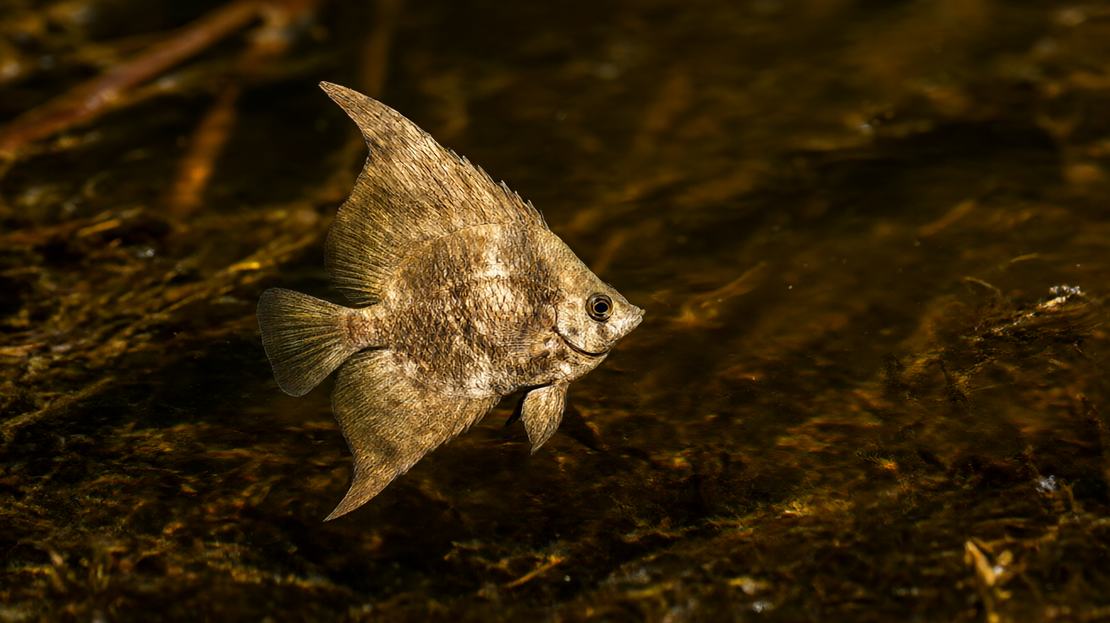
A small brown fish hangs just under the surface of a still creek, with two wide fins spread like wings. That pose explains the common name. It looks ready to lift off. Sometimes it does. A frightened butterflyfish can leap clear of the water and glide for a few metres before it drops back.
Most of the time it simply drifts, head up, watching the surface film. Adults reach about 12 cm. Females grow fuller in the body, while males stay lean. Warm, slow water across west and central Africa holds the species. It prefers backwaters where the current almost stops.
Floating plants shade those pools, and the water turns brown with tannins. Few other fish can use the surface in quite this way, since most of them feed lower down. No other fish carries quite this outline.
Family tree
Pantodontidae, a family of one
This fish is the only living member of its family, and it is the only species in its genus. Its nearest relatives are the bonytongues, a group that also holds the arowanas and the elephantfish. That link surprises many people, because the butterflyfish looks nothing like those giants. Field guides have used the same label for a large family of reef fish.
Reef butterflyfish sit in a different order entirely, and they have nothing in common with this animal beyond a flat, round outline. Pantodon buchholzi was described in 1879 from West African material. No races are named today, although some fish look darker. Fish from the Congo basin look slightly darker than those from the Niger delta, although the two groups are treated as one species.
Scale counts and fin ray numbers stay stable across the range. Gene work on the family remains thin, so the picture may change. For now, the single species stands alone.
Wings above the water line
How to tell one
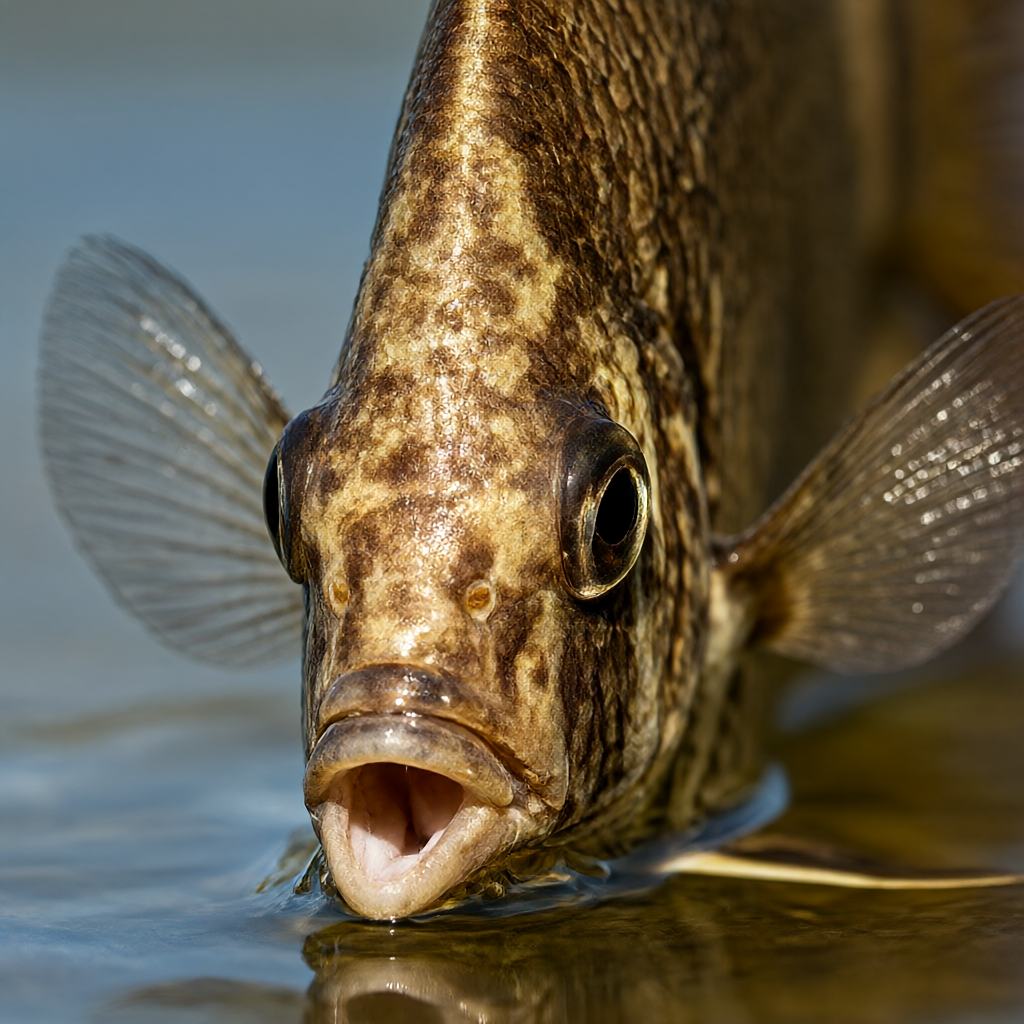
Both pectoral fins are enormous for the size of the fish, and each one spreads into a rounded wing. Those fins carry long rays with a wide membrane between them. Both eyes sit high on the head, close together, and they point upward. A small upturned mouth opens at the very top of the snout.
That arrangement suits a hunter that never leaves the surface layer. Body colour runs from olive brown to a mottled tan, with darker blotches across the back. Dark blotches break the outline, so a still fish looks like a floating leaf. Fins carry fine dark bands.
Males grow a longer, thicker anal fin, and the front rays of that fin bend into a short tube. Gas held high in the body helps the fish keep its place at the surface. Scales are small and smooth. Nothing about the fish suggests speed, yet the wings give it a fast, jerky escape.
1
2
3
Still, warm, plant covered pools
Where it lives
Slow rivers, swamps and flooded forest hold the species across a wide belt of Africa. Water stays between about 23 and 30 °C in those places, since the pools sit in full sun for months. Soft, slightly acidic water suits it, while hard water soon makes it sick. Floating plants matter more than depth, because cover comes from above.
Roots and stems give the fish places to hang beside. Weak light suits it well. Open, sunlit water offers little, so the fish keeps to shaded edges. Drainage destroys such pools fast, although flooded forest regrows after the rains.
Small creeks also hold fish, although most of them dry to a few pools each year. Fish survive those months in the deepest holes. Floods then spread them back across the plain. Few surveys cover the whole range, and large parts of the Congo basin remain unrecorded.
Insects taken at the film
What it eats
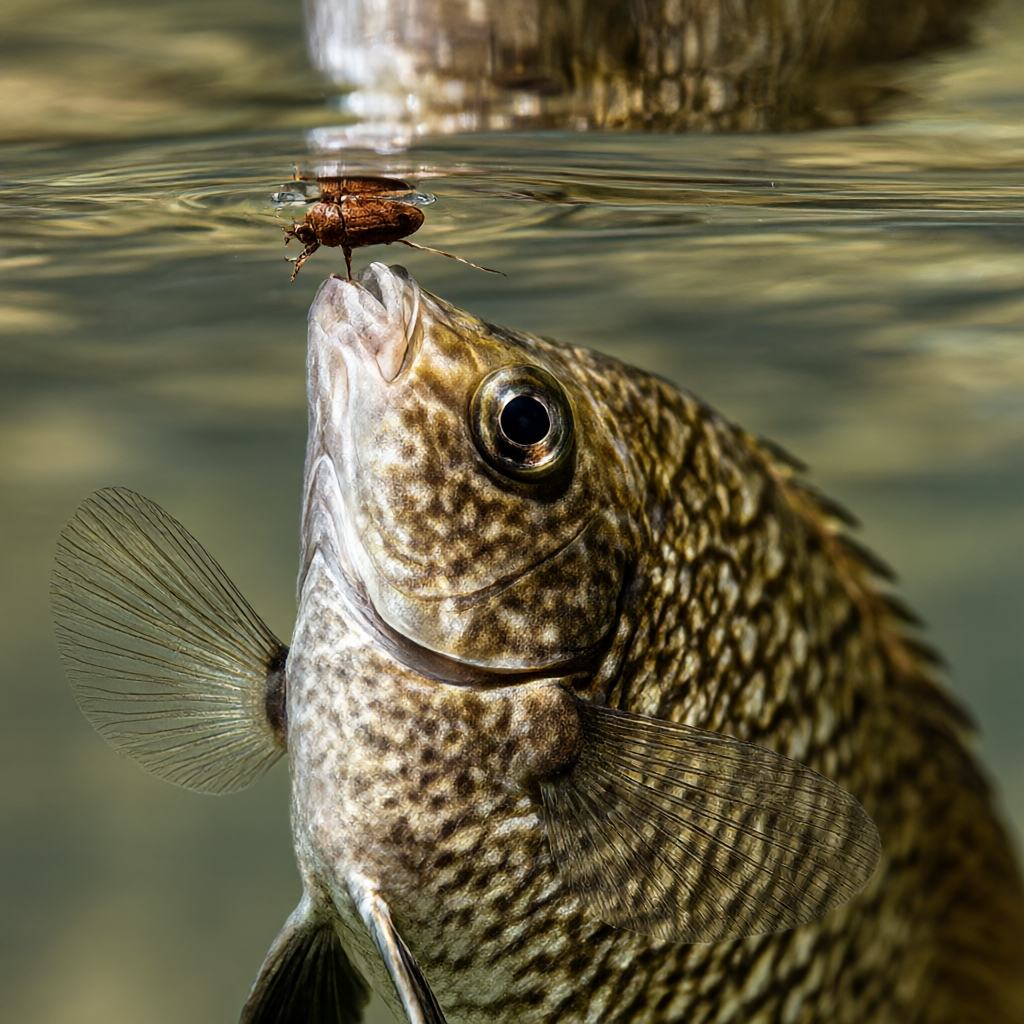
Insects form the main food, taken at the surface or just below it. Shrimps, fish fry and water mites fill out the rest, though insects still dominate. Falling ants, beetles and flies never last long. Hunting means holding station under open water until something lands.
When prey touches the surface, the fish lunges upward and takes it from below. At that moment the upturned mouth works like a scoop. Large prey gets worked down with several gulps. Feeding peaks at dawn and again at dusk, when insects move.
Captive fish take flakes and small live food without fuss. Stomach contents from wild fish show a narrow range, mostly surface insects. That narrow diet ties the species to water with steady insect input. Polluted water loses those insects first, and the fish then goes hungry.
Scattered floating eggs
The breeding cycle
Most hunting happens in the top few centimetres of water. A resting fish hangs almost motionless, with the wings spread and the tail slightly bent. Disturbance brings a jump rather than a dash. Strong tail beats start the leap, and the wings then carry the fish through the air. Glides usually cover 1 to 2 m, a shorter hop than a Flying Fish makes over open sea.
Some reports describe longer flights over floating plants. Landing is clumsy, yet the fish usually escapes. Breeding takes place among plants near the surface. Sperm passes through a tube at the front of the male anal fin. Eggs are scattered, and they float.
No parent guards the eggs or the young. Fry hatch within two or three days and stay at the surface from the start. Young fish look like small adults, with the wings already in place.
Least Concern, and traded
Conservation
The IUCN rates the species as Least Concern, since no big decline has been recorded. Its range is large, and many populations sit far from roads. Drainage and farm runoff still remove local pools. Collecting for the pet trade takes fish in large numbers, although the species breeds well in captivity.
Those two pressures rarely overlap, since trade fish come from a few districts. Wetland parks cover part of the range, yet many pools sit outside them. Counts are almost absent, so the true state of the species remains uncertain. Fish also live in farm ponds and flooded fields, which adds some safety.
Climate shifts may alter rainfall, and the dry season could lengthen. Short dry spells are survivable. Long ones are not, since the pools hold little water. Connected wetland keeps the species alive, because isolated pools lose fish over time.
Side by side
How It Compares
| Trait | Freshwater Butterflyfish | Flying Fish |
|---|---|---|
| Length | about 12 cm | up to 30 cm, with a few larger |
| Fins | wing shaped pectorals, spread at rest | long pectorals held wide in the air |
| Glide | 1 to 2 m over still water | often 50 m in a series of hops |
| Home | warm, slow, plant covered creeks | open warm ocean far from land |
| Food | insects taken at the surface | plankton and small fish |
| Rating | Least Concern | Least Concern |
Common misreadings
What People Get Wrong
- Many people assume the fish is a reef butterflyfish, yet it sits in a family of its own.
- A common claim puts the species in fast rivers, although it keeps to water that barely moves.
- People often call it a sea glider, yet its leaps cover a metre or two at most.
Going further
Sources and Further Reading
Quick hits
Five things to remember
- The species is the only member of its family.
- Its closest relatives are the arowanas.
- A startled fish can glide a metre or more.
- The eyes sit on top of the head.
- Eggs float among surface plants.