 By st20113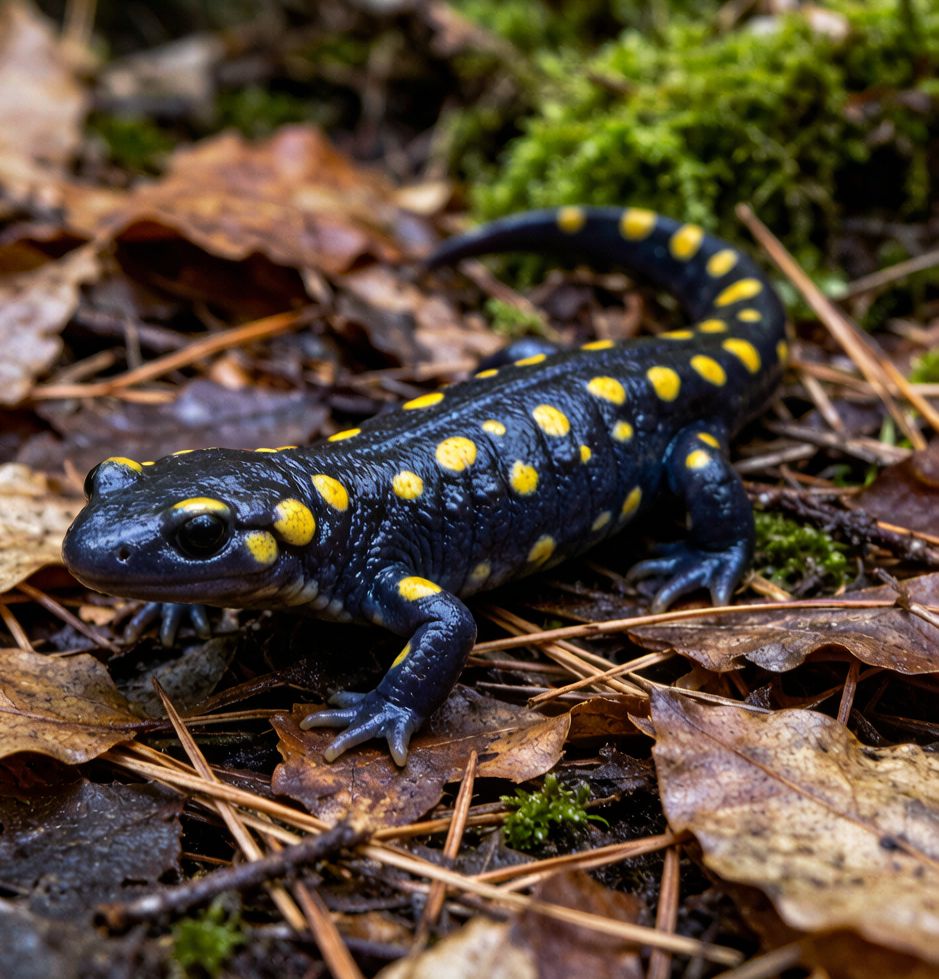
Introduction
The Spotted Salamander is a strikingly patterned mole salamander of the deciduous forests of eastern North America. Reaching up to twenty-five centimetres, it is best known for the two irregular rows of bright yellow or orange spots that decorate its dark back. Secretive and mostly underground, it emerges en masse on the first warm, rainy nights of spring to breed in woodland ponds, one of the great spectacles of the amphibian world and a sign that winter has truly ended.
Taxonomy
Ambystoma maculatum is a member of the family Ambystomatidae, the mole salamanders, the same family as the fire salamander of Europe and the newt of North America. It is a close relative of the tiger and axolotl salamanders within the genus Ambystoma, a group celebrated for dramatic metamorphosis and, in some members, the retention of larval traits. The spotted salamander’s genus name refers to its broad, flattened head, and its species name maculatum means “spotted,” describing its vivid markings.
Physical Characteristics
Adults are stout, with a broad head, small eyes and a long tail, typically fifteen to twenty-five centimetres long. The ground colour is deep blue-black or dark brown, set off by two rows of round yellow or orange spots running from head to tail; some individuals show orange on the snout. The skin is smooth and moist. Like all salamanders they lack scales and breathe partly through the skin, supplementing with lungs as adults. Their short but strong limbs end in small toes, and the tail is rounded and used for balance and swimming in the breeding pond.
Habitat
Spotted salamanders spend most of the year in underground burrows, often those abandoned by small mammals, in mature deciduous and mixed woodlands near fish-free ponds. They are rarely seen except on warm, wet nights when they forage above ground or during the spring breeding migration to vernal pools and small lakes. They require clean, temporary wetlands for their aquatic larvae to survive, because fish readily eat the soft-bodied young before they can transform and leave the water for the forest floor.
Diet
Adults are voracious predators of invertebrates such as earthworms, insects, slugs and snails, and will take small vertebrates including tadpoles when the opportunity arises. Larvae are equally predatory, eating aquatic insects, crustaceans and small prey in the pond. Their broad diet and appetite make them effective controllers of soil and pond invertebrates, linking them to the newt and other amphibian predators that share the same woodlands and wetlands through the spring and summer breeding season each year.
Reproduction
Breeding takes place on rainy nights in early spring when adults migrate to ponds. Females lay clumps of up to two hundred eggs attached to submerged sticks or plants below the surface. The eggs are notable for often hosting a symbiotic green alga inside their jelly, which may supply oxygen to the developing embryo. Larvae hatch with gills and a finned tail, metamorphosing into terrestrial adults after a few months before leaving the water to begin their secretive lives beneath the leaves.
Conservation
The spotted salamander is listed as Least Concern and remains common across much of its extensive range, though local populations are threatened by woodland clearing, wetland drainage, pollution and road mortality during the breeding migration. Several states protect it, and the species is unusually tolerant of suburban woodland remnants. Conservation of seasonal ponds and the surrounding forest is vital, since the animals depend on both the water for breeding and the leaf litter for the rest of their lives.
Fun Facts
A spotted salamander can live for twenty years or more in the wild, most of it hidden underground. Its eggs sometimes glow with a green alga that lives inside them and helps the embryo breathe. The spring migration can see hundreds of salamanders cross a single forest road on one rainy night. They return to the very pond where they were born to breed. Despite their bright spots, they are harmless to humans and prefer to flee rather than bite.