 By st20113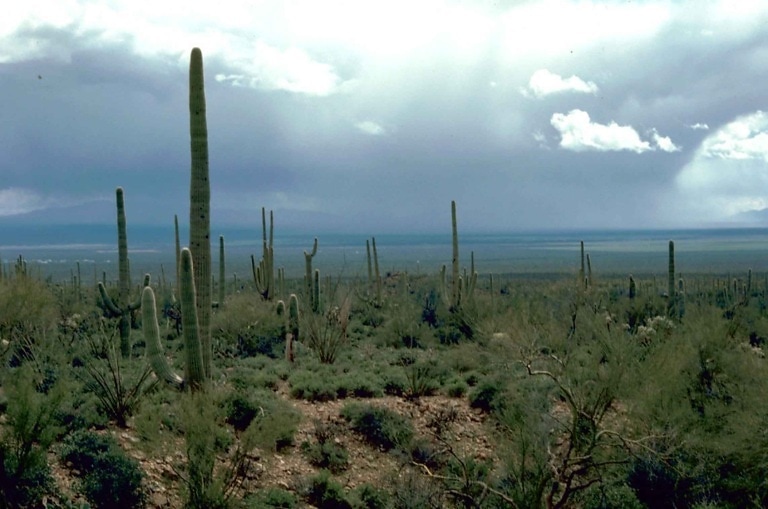
The Saguaro Cactus (Carnegiea gigantea) is the iconic giant of the Sonoran Desert, rising dramatically from the desert floor to heights exceeding 15 meters. This slow-growing cactus can live for more than 200 years and serves as a keystone species in one of Earth’s most biodiverse deserts.
Physical Characteristics
Saguaros are columnar cacti with a thick central trunk and multiple arms that typically curve upward. Young Saguaros (under 30 years old) lack arms entirely, appearing as smooth, club-shaped plants. Arms begin to develop when the cactus reaches 6 to 7 meters in height, which may take 75 to 100 years under favorable conditions.
The cactus’s pleated exterior allows it to expand and contract dramatically as it absorbs and loses water. During wet periods, a large Saguaro can store up to 760 liters of water. The ribs of the cactus are protected by a waxy cuticle that minimizes water loss through evaporation.
White, tubular, nocturnal flowers bloom at the crown and arm tips between April and June. These flowers, Arizona’s state flower, are primarily pollinated by bats, lesser long-nosed bats, and migratory nectar-feeding birds. The resulting fruit ripens in June and July, opening to reveal bright red pulp and small black seeds.
Habitat and Distribution
Saguaros are restricted to the Sonoran Desert, which spans southern Arizona, southeastern California, and northwestern Mexico. They require specific elevation zones (400 to 1,200 meters) with winter freezing tolerance and summer moisture patterns. They are not found in the hotter, drier deserts of the eastern Americas.
The Saguaro’s relationship with nurse plants like the Palo Verde tree is critical for seedling survival – young Saguaros cannot survive direct desert sun and must germinate in the shade of larger shrubs that provide shelter and retain moisture.
Ecological Role
Saguaros are foundational to the Sonoran Desert Ecosystem. Gila Woodpeckers and Elf Owls excavate nest holes in the soft flesh of Saguaros, which harden into permanent cavities over time. These nest sites are reused by many species across generations, creating a biological apartment complex within the cactus.
Conservation
Saguaros grow extremely slowly – as little as 1 to 2.5 centimeters per year – and face threats from rising temperatures, drought, disease (Saguaro Cactus disease), and illegal theft for landscaping. They are protected by law in Arizona, where it is illegal to remove them from both private and public lands.