 By Iris
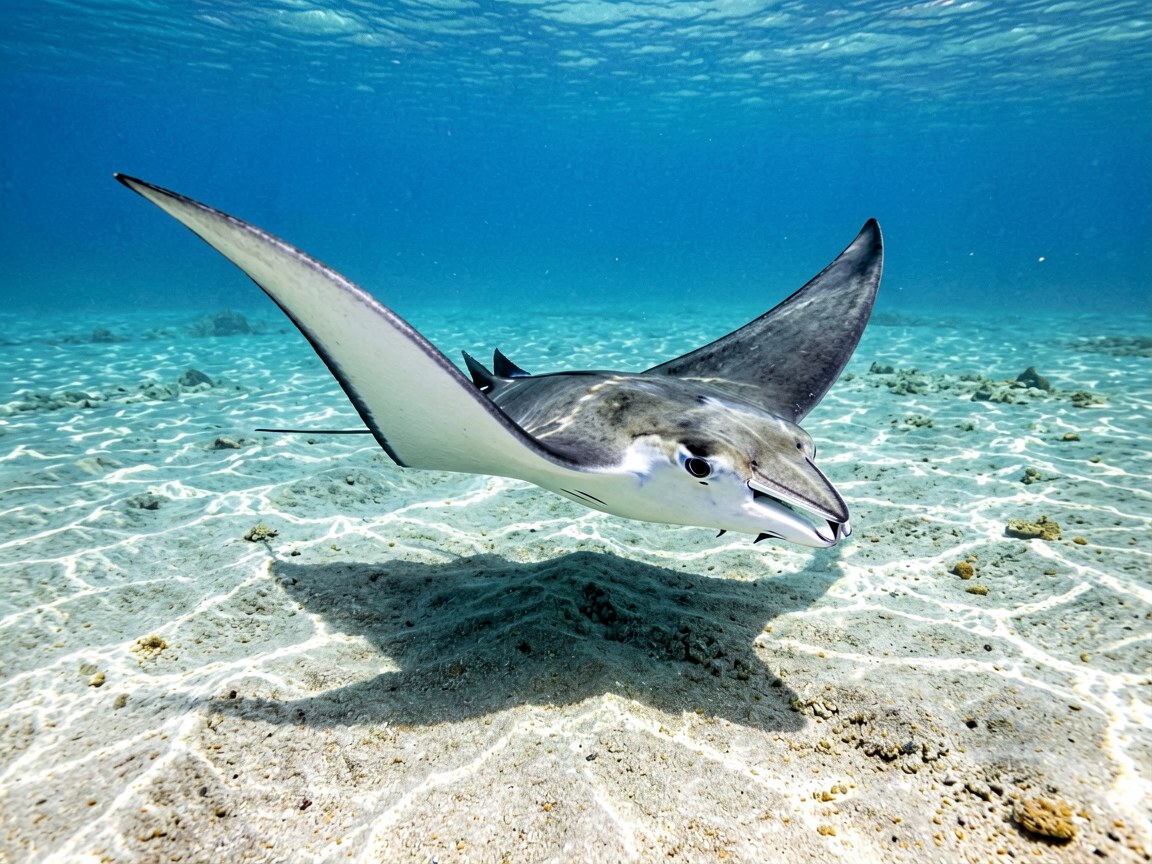
Rhinoptera bonasus | Cownose Ray
Introduction
The cownose ray, Rhinoptera bonasus, is a migratory eagle ray of the western Atlantic, the Caribbean, and the Gulf of Mexico. Named for the paired head lobes that resemble a cow’s nostrils, it forms some of the largest fish aggregations known, with schools of thousands on migration. Cownose rays are strong swimmers that flap their large pectoral fins like wings, gliding just under the surface in loose formations. They are benthic feeders, using plate-like teeth to crush clams, oysters, and other mollusks. Although they carry a long, serrated venomous tail spine, they are docile and threaten people only with a painful barb wound. In recent decades the species has become a flashpoint in fisheries and conservation debates, especially in the Chesapeake Bay, where its taste for oysters has drawn scrutiny from watermen and scientists.
Taxonomy
Rhinoptera bonasus belongs to the family Rhinopteridae, the cownose rays, within the order Myliobatiformes, the eagle rays. The genus Rhinoptera means nose wing and includes several similar warm-water species; the cownose ray is the western Atlantic form. The epithet bonasus is a Latinized old name for a bison or wild ox, referring to the broad, bull-like head. Among eagle rays, cownose rays differ from the larger mantas and mobulids in their smaller size, bottom habits, and well-developed caudal spine. They share Myliobatiformes with spotted eagle rays, southern stingrays, and the giant devil ray. Like the [Blue Shark](https://www.gloencyc.com/prionace-glauca-blue-shark/), which also makes long open-water migrations in schools, the cownose ray relies on coordinated movement and seasonal cues to exploit shifting food across vast seascapes, though the two fill very different niches. Cuvier first described the species in 1829, and genetic work still refines its boundaries with related Pacific forms.
Physical Characteristics
Cownose rays have a diamond disc formed by the fused pectoral fins, its width about equal to or a bit more than the body length without the tail. Adults typically reach 0.7 to 1.1 meters disc width, occasionally 1.8 in large females, weighing 12 to 27 kilograms and exceptionally over 50. The upper surface is olive to brownish, often faintly mottled, fading to pale cream or white below. A defining trait is the pair of cephalic lobes projecting forward, giving the cownose look and helping channel food to the mouth. The eyes sit atop the head, with broad spiracles behind them drawing breathing water. The long whip tail bears one or sometimes two serrated venomous spines about a third along its length; these are shed and regrown. The mouth holds strong, pavement-like tooth plates in rows, ideal for crushing shells. Males show claspers from the pelvic fins, and both sexes have a slender, pointed disc compared with broader relatives. Females are typically heavier and broader than males at the same disc width, and the bronze sheen on the back tends to intensify in animals from clearer, warmer water.
Habitat
Cownose rays range the western Atlantic from New England and the Gulf of Mexico south to Brazil, including the Caribbean. They favor warm temperate and tropical coastal waters over sand, estuaries, bays, and reef edges, from the intertidal to about 70 meters. In spring and summer they gather in huge schools that migrate north along the Atlantic coast and into the Chesapeake Bay, arriving in late spring to feed the rich estuaries. In autumn they return south to deeper, warmer water off Florida and the Gulf. They tolerate wide salinities and often appear in brackish bays where oysters and clams concentrate. Pupping and nursery use occur in warm southern waters, with shallow bays serving juveniles. Tagging and acoustics show some individuals travel over a thousand kilometers in a season, moving as groups that may number tens of thousands at peak aggregation.
Diet
The cownose ray is a specialist benthic mollusk feeder, using its wing fins to excavate buried prey and its tooth plates to crush shells. Main foods are oysters, clams, scallops, and other bivalves, plus crustaceans such as shrimp and crabs and occasionally small fish. In the Chesapeake, one ray can eat several kilograms of clams and oysters a week, flapping to expose prey and using the head lobes to maneuver it into the mouth. The plates grind shells to fragments; soft tissue is digested and hard bits expelled. Feeding is largely daytime on sandy or muddy bottoms where mollusk beds thrive. Because their diet centers on valuable shellfish, cownose rays have been blamed for damaging oyster aquaculture and reefs, yet studies suggest their natural predation on oysters predates and is smaller than human harvest. Prey abundance drives their migration, as rays follow bivalve spawning along the coast.
Reproduction
Cownose rays are ovoviviparous, with internal fertilization by the male’s claspers. A notable feature is histotrophy: the mother supplies nutrient-rich uterine fluid the embryo absorbs through special extensions of the pelvic fins called uterine milk. After about eleven to twelve months’ gestation, females bear a single well-formed pup, occasionally two, measuring 35 to 45 centimeters across. Births occur in late spring to summer in warm southern and estuarine nurseries, coinciding with the migratory aggregations. Newborns are independent with no further care. Males mature at about two to three years and near 0.6 meters disc width; females mature a bit later, around three to four years. Lifespan in the wild is roughly fifteen to twenty years. The low rate of one pup per year, with delayed maturity, makes recovery slow and the species sensitive to sudden fishing increases or nursery habitat loss.
Conservation
The cownose ray is listed as Least Concern by the IUCN globally, but regional populations face localized pressure and contested management. Long harvested for meat and wings in parts of Asia and the Americas, it has in places been targeted by wingshooting and bowfishing derbies that kill thousands at once, raising welfare and sustainability concerns. Since females produce only one pup a year, such intensive removal can outpace replacement. Gillnet and trawl bycatch, loss of oyster reefs and seagrass, and coastal development add further stress. In the United States the species is managed as a fishery resource but lacks species-specific federal protection, and debate continues over whether numbers are stable, falling, or rising. Some states have curbed targeted killing events, while groups promote ecotourism around the great migratory schools. Better stock assessments and international coordination are needed, since the rays cross many jurisdictions on their annual migrations. For example, Virginia and Maryland have at times imposed seasonal restrictions during the peak spring migration to cut kills, while federal surveys now track abundance to guide future limits.
Fun Facts
- Cownose rays migrate in schools that can number tens of thousands, among the largest fish aggregations in the sea.
- They are named for the fleshy head lobes that look like a cow’s nostrils or snout.
- Like many rays, they have a venomous barbed tail spine that is shed and regrown over time.
- A female usually bears just one pup a year after nearly a year of pregnancy.
- They flap their pectoral fins like wings, gliding gracefully and even flying near the surface.