 By Iris
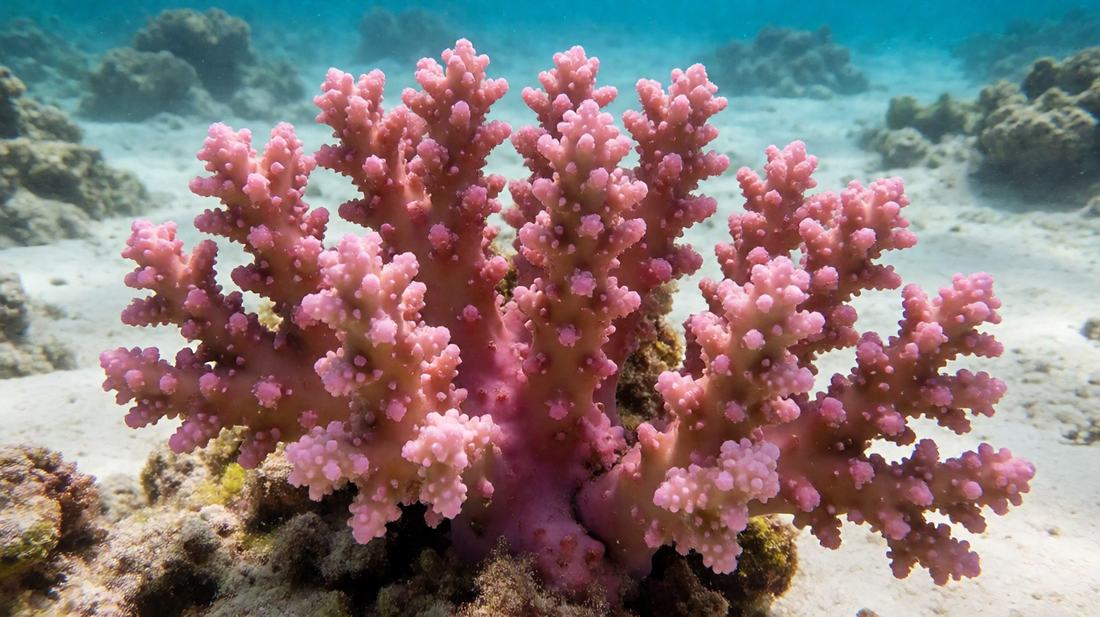
Pocillopora damicornis | Cauliflower Coral
Species Profile · Pocilloporidae
Cauliflower Coral
A branching reef coral that survives bleaching better than its neighbours, and still lost ground in the 2023 global review.
Endangered (2023) 2023 assessment
Colony
Corallites
Depth
Larval drift
Algae partners
Rating
The Cauliflower Coral
A coral that shrugs off bleaching
This coral builds bushy pink groups on warm reefs. Knob-like bumps cover every branch. The species grows from the Red Sea to Panama. A group may span 30 cm.
Tiny polyps sit inside the bumps. Each polyp holds algae that make food from sunlight. Because the polyps farm their own algae, the coral can grow in clear, poor water where few other animals thrive. Bleaching strips the algae away.
This species survives bleaching better than most. However, a new threat has appeared.
Family tree
Pocilloporidae, the cauliflower corals
Linnaeus named the species in 1758. It sits in a small coral family. This genus holds more than 20 living species.
Workers long struggled to tell them apart. Shape changes with depth and wave action. Because one species can look like another on a different reef, scientists now rely on genes to sort the group out.
A distant relative, the Staghorn Coral, builds the same kind of branching frame in the same warm seas. Both grow fast for corals, although neither lives long by coral standards.
Bumps and branches
How to tell one
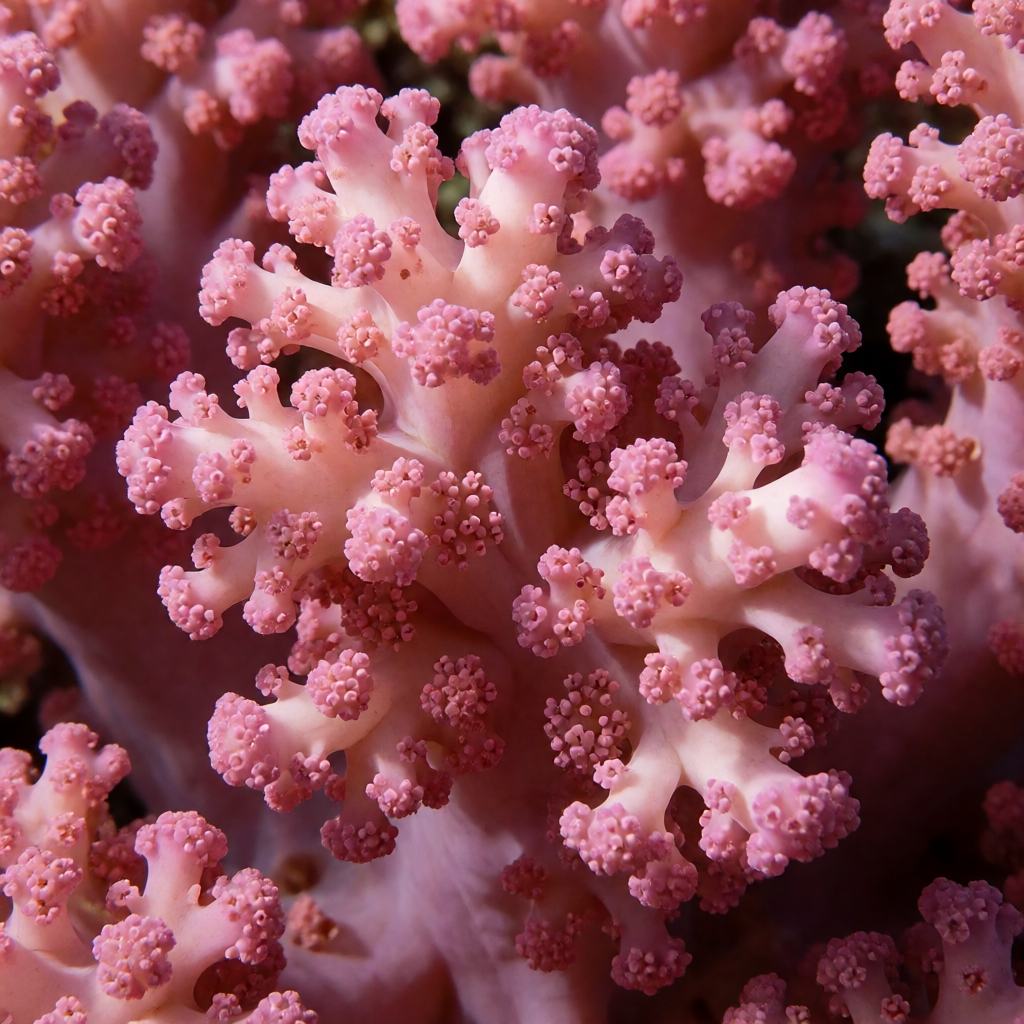
A group spans about 30 cm. Branches stay thick and short. Small bumps sit along each branch.
Each cup measures less than 1 mm. Colour runs from pink to brown. Branches grow thicker in rough water.
Deep, calm water gives thin, brittle branches. Polyps open at night. Because the shape shifts with depth and current, two groups of the same species can look like two different animals.
1
2
3
Lagoons and walls
Where it lives
Shallow lagoon and reef flat are the main home. Groups occur from the surface down to 26 m, although the densest growth sits above 10 m. The coral also grows on wharf piles and mangrove roots.
Steady water movement therefore matters. In fact, silt and low salt levels are tolerated. Because the species can live in muddy lagoons and on harbour walls, it often survives where soft reef corals die.
Warm water still hurts it in the end. A severe heat wave can bleach a whole lagoon.
Algae and plankton
What it eats
The algae inside the polyps make most of the food. Small drifting animals supply the rest. Tentacles catch the prey at night. Each polyp then pulls the food into its mouth, since it has no other way to feed.
Because the deal with algae covers most of the cost, it needs only a little extra food from the water around it. Therefore, growth slows in poor light. As a result, deep groups lean more on captured prey.
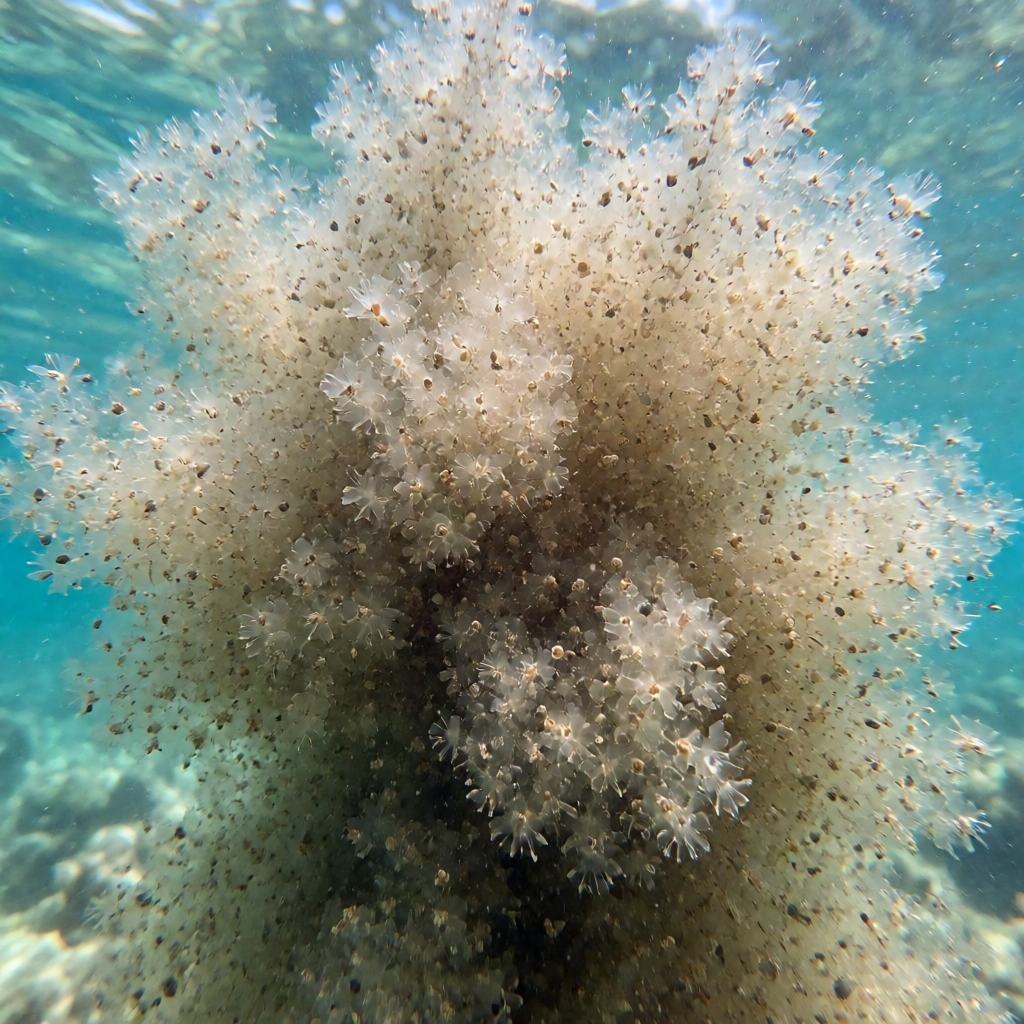
Larvae at the new moon
The breeding cycle
Both sexes sit in one polyp. Each polyp makes both eggs and sperm. Larvae develop inside the parent.
They are released near the new moon. Because the larvae can drift for as long as 100 days, they can cross wide stretches of open ocean. Settling follows on bare rock.
A young group grows fast. Some reefs also spawn in the open water.
Endangered in 2023
Conservation
The IUCN long listed the species as Least Concern. A 2023 global review moved it to Endangered. Bleaching is the main cause. Meanwhile, groups are mined for cement in some regions.
The aquarium trade takes a further share. Because reefs face warming, acid seas and waste at the same time, a coral that shrugs off one blow can still lose to the next. However, trade in all corals is watched under a world rule.
Side by side
How It Compares
| Trait | Cauliflower Coral | Staghorn Coral |
|---|---|---|
| Growth form | short knobbly branches | long straight branches |
| Surface bumps | on every branch | absent |
| Depth | 0 to 26 m | 0 to 20 m |
| Bleaching | relatively resistant | highly sensitive |
| Larvae | brooded, drift up to 100 days | released after mass spawning |
| Main cover | lagoons and harbour walls | reef slopes and crests |
Common misreadings
What People Get Wrong
- Coral is said to be a rock. It is a colony of animals that build a stone skeleton.
- Every coral is said to die when the water warms. This species often recovers.
- The algae are said to steal food. They supply most of the energy the coral needs.
Going further
Sources and Further Reading
- IUCN Red List, Pocillopora damicornis
- Hoeksema, B. W., Rogers, A. & Quibilan, M. C. 2014. Pocillopora damicornis. The IUCN Red List of Threatened Species.
- Veron, J. E. N. 2000. Corals of the World. Australian Institute of Marine Science.
- GBIF Backbone Taxonomy. Pocillopora damicornis (Linnaeus, 1758).
Quick hits
Five things to remember
- Its larvae can drift for 100 days.
- Groups are mined for cement.
- It lives with 30 kinds of algae.
- Branches grow thick in rough water.
- Bumps cover every branch.