 By st20113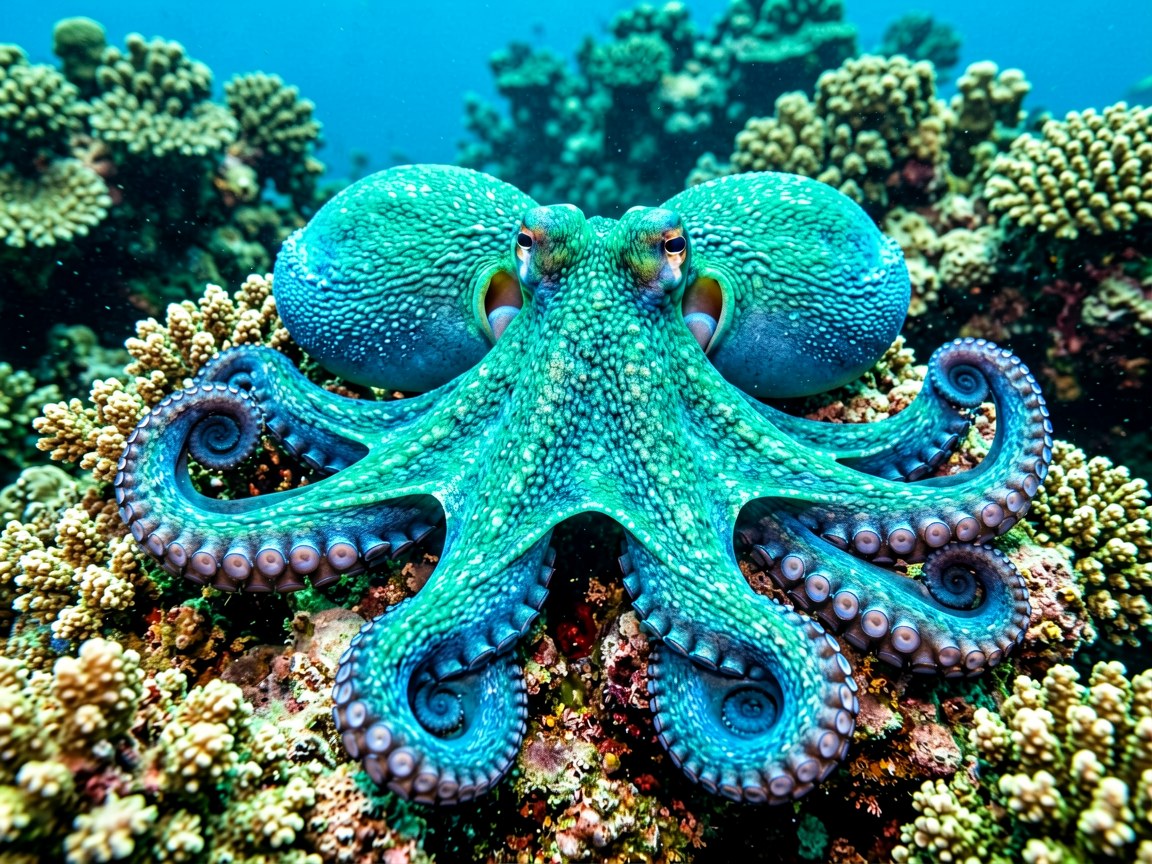
Octopus cyanea | Big Blue Octopus
Introduction
Octopus cyanea, commonly known as the big blue octopus or the day octopus, is one of the most active and visually striking cephalopods of the tropical Indo-Pacific. Ranging from the Red Sea across the Indian and Pacific oceans to Hawaii, it hunts by day along coral reefs, rubble slopes, and seagrass beds, a habit unusual among octopuses that are more often nocturnal. Adults are large and powerfully built, capable of dramatic colour shifts from mottled brown to vivid blue-green as they move or signal. Like all octopuses, it is a master of camouflage, jet propulsion, and escape, with a soft body, eight muscular arms lined with sensitive suckers, and a problem-solving brain that ranks among the largest relative to body size of any invertebrate. The big blue octopus is a favourite of divers and reef photographers, not only for its beauty but because it can be watched hunting in daylight, stalking crabs and fishes among the corals. Its life is, however, brief and risky, lived at speed in one of the ocean’s busiest neighbourhoods, and it remains closely related to the better-known common octopus.
Taxonomy
Octopus cyanea sits in the family Octopodidae, the typical octopuses, within the class Cephalopoda — the squid, cuttlefish, and nautilus relatives. The genus Octopus is large and widespread, and O. cyanea is one of its bigger, reef-dwelling members. The species name cyanea means “dark blue,” referencing the glowing blue tones it can flash across its skin. It is a close relative of the [common octopus profiled elsewhere](https://www.gloencyc.com/octopus-octopus-vulgaris/), sharing the classic eight-armed body plan of the reef octopuses. It was long confused with similar day-active octopuses in the Pacific, and the name “day octopus” reflects its diurnal habits. Cephalopods as a whole are molluscs, more closely related to snails and clams than to fish, yet they have evolved the most complex nervous systems of any invertebrate group. The big blue octopus shares the basic octopod body plan — a rounded mantle, a parrot-like beak, and eight arms — with its widespread relative, and molecular work places it firmly among the tropical reef octopuses that diversified across the Indo-Pacific as coral reefs themselves expanded.
Physical Characteristics
The big blue octopus has a rounded, sack-like mantle that can reach 20 centimetres or more in length, with arms spanning well over a metre in large adults. Its skin is richly supplied with chromatophores — pigment sacs controlled by muscles and nerves — plus reflective cells that let it shift in seconds from sand-brown to a rippling blue-green and back. Two large, horizontally slit pupils give it keen vision, and each of its eight arms carries a double row of suckers used for grasping, tasting, and manipulating. The body is almost entirely soft, with only a small internal shell remnant (the stylet) and a parrot-like beak of chitin as hard structures, which is why an octopus can squeeze through gaps barely larger than its eye. A siphon beneath the mantle powers jet propulsion for rapid escapes, and the animal can also crawl on its arms with remarkable dexterity. When threatened, it can release a cloud of dark ink to confuse predators and slip away.
Habitat
Octopus cyanea inhabits the shallow tropical waters of the Indo-Pacific, from depths of a few metres down to about 30, favouring coral reefs, rocky rubble, seagrass meadows, and reef flats exposed at low tide. It needs complex substrate with ample cracks, burrows, and fallen coral in which to hide by day and from which to launch hunts. Unlike many secretive octopuses, it is often seen moving openly across the reef during daylight, pausing to probe crevices with an arm. It tolerates a range of salinities and is commonly found in lagoons as well as on outer reef slopes, provided there is cover nearby. The species is sensitive to habitat degradation: blast fishing, trawling, and the outright loss of coral structure remove the refuges and hunting grounds it depends on, and it is absent from heavily silted or barren bottoms where neither prey nor shelter remains.
Diet
The big blue octopus is an active carnivore that preys on crabs, shrimp, fishes, and a variety of molluscs including clams and small gastropods. Hunting by day, it uses sight and touch to locate prey in crevices, then extends an arm to probe and seize. Crustaceans are subdued with a bite that delivers paralyzing saliva, after which the octopus may drag the catch to a lair to eat at leisure, often leaving a tell-tale pile of crushed shells at the den entrance. Hard-shelled molluscs are opened with the beak and, if necessary, drilled with the rasping radula after the octopus has positioned the shell against a rocky anvil. With its large brain and keen senses, O. cyanea is an efficient predator that can learn the layout of its home range and the locations of productive hunting spots. Its position as a mid-level reef predator helps control crab and mollusc numbers, and it in turn feeds a range of larger predators, linking the reef’s smaller invertebrates to the fish and sharks above.
Reproduction
Reproduction in the big blue octopus follows the typical cephalopod pattern of a single, terminal reproductive effort. A male transfers sperm packets to the female using a specialised arm, the hectocotylus, and the female then lays dozens to hundreds of small eggs, which she attaches in strings inside a secure den and guards continuously. During the brooding period she foregoes feeding, aerating the eggs with jets of water and keeping them clean until they hatch into tiny planktonic larvae that drift and grow before settling on the reef. The female dies soon after the eggs hatch, as do most octopuses, making her a single-brood parent. Males likewise senesce and die after mating. This semelparous life history — one burst of reproduction followed by death — means populations are sustained by each generation’s offspring rather than by long-lived adults, so heavy fishing on breeding-size animals can sharply reduce recruitment in the following year.
Conservation
Octopus cyanea is taken across much of its range by artisanal and recreational fishers, and it is also collected for the aquarium trade and as bycatch in some net fisheries. Because it lives in shallow, accessible reef habitats, it is among the more easily caught octopuses, and in some localities repeated heavy take has reduced average sizes. It is not currently listed as globally threatened, but its short life span and single reproductive event make it vulnerable to overfishing if breeding adults are removed faster than they can be replaced. Management that helps most is size limits, seasonal closures during peak breeding, and protection of reef habitat so that dens and nursery crevices persist. As a species sensitive to reef health, its abundance serves as a useful indicator of the condition of the coral and rubble habitats it depends on, and reef restoration that rebuilds structure indirectly supports healthier octopus populations.
Fun Facts
- It hunts in broad daylight, unlike the many octopuses that are strictly nocturnal.
- Its skin can flash from brown to glowing blue-green in seconds using colour cells controlled by its nervous system.
- Despite a bulbous body, it can squeeze through any gap wider than its hard beak and eye.
- It can jet backward at speed by forcing water through its siphon to escape predators.
- Like other octopuses, it dies after a single brood, making each generation’s offspring the future of the population.