 By st20113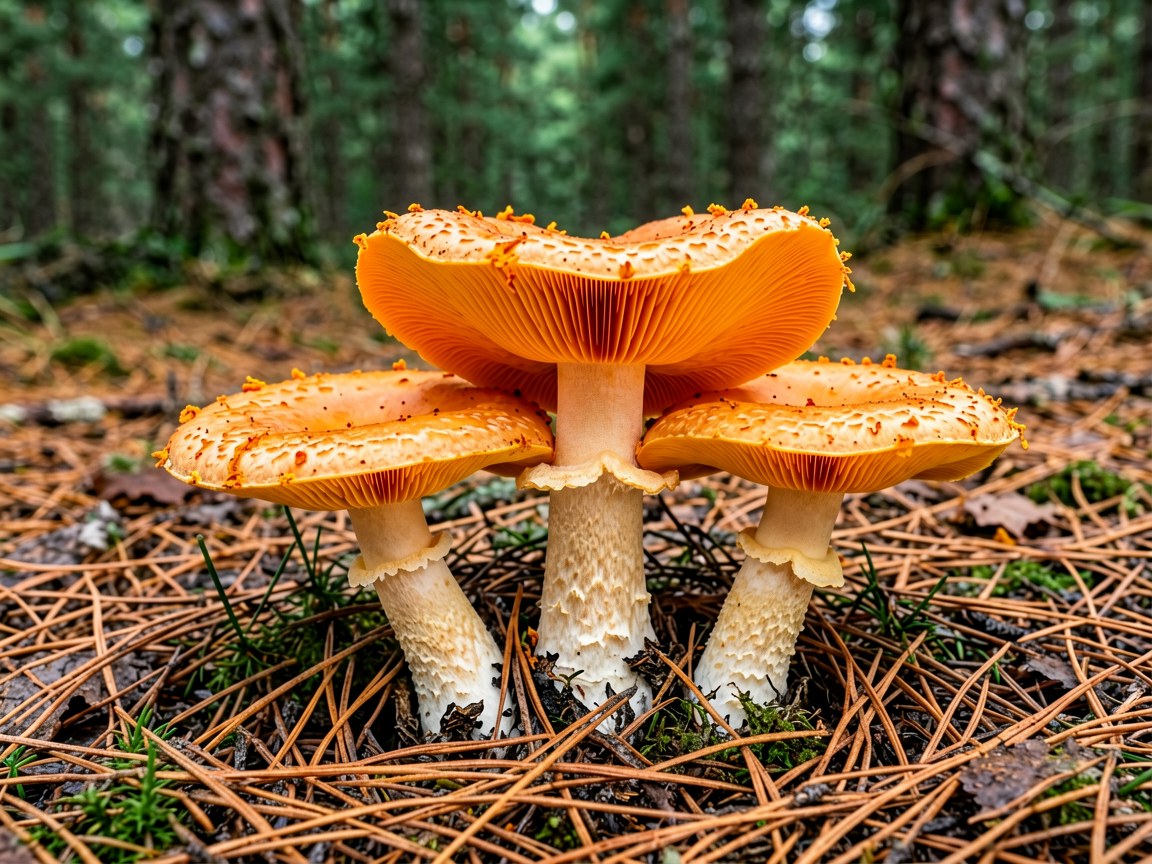
Lactarius deliciosus | Saffron Milkcap
Introduction
The saffron milkcap (Lactarius deliciosus) is a large, vividly orange wild mushroom of pine woods, named for the carrot-colored latex that oozes from its gills when cut. It is one of the most eagerly gathered edible fungi in the Mediterranean and across Europe, appearing in late summer and autumn beneath pine trees. Its concentric orange zoning and the way its “milk” slowly turns green make it one of the easiest milkcaps to identify with confidence.
Taxonomy
Lactarius deliciosus belongs to the family Russulaceae within the order Russulales, in the phylum Basidiomycota—the same broad fungal group that includes Amanita muscaria (Fly Agaric). The genus name Lactarius means “milky,” referring to the latex that all members exude when damaged. The species epithet deliciosus means “delicious,” a direct nod to its culinary reputation.
Physical Characteristics
The cap is 4–14 cm across, at first convex with a rolled-in margin, later flattening and becoming funnel-shaped. Its surface is bright orange to carrot-colored, marked with deeper orange concentric zones and often stained greenish with age or handling. The gills are crowded, decurrent, and orange, bruising green. The stout stem is orange with darker, shallow pits called scrobiculi. When cut, the firm flesh exudes abundant carrot-orange latex that slowly turns dark green on exposure to air—the single most useful identification feature.
Habitat
This species is ectomycorrhizal, forming a mutually beneficial partnership with pine trees, especially Scots pine and Mediterranean pines. It fruits on the ground in pine woods, plantations, and parkland on sandy, well-drained, often acidic soils. Because it depends on living pine roots, it cannot be cultivated commercially and is found only where its tree hosts grow. Fruiting bodies appear from late summer into late autumn.
Diet
Like other ectomycorrhizal fungi, the saffron milkcap does not feed on dead matter directly. It receives sugars from its host pine through the root partnership, and in return supplies the tree with water and mineral nutrients—particularly nitrogen and phosphorus—foraged from the soil by its fine fungal threads. This exchange is one of the quiet foundations of a healthy pine woodland.
Reproduction
The visible mushroom is only the fruiting body of a much larger fungal network living in the soil. Spores are produced on the gills and released into the air to be dispersed by wind. A successful spore must meet a compatible pine root to form a new mycorrhizal partnership; without a host, the fungus cannot complete its life cycle. The mycelium can then persist for years, fruiting whenever conditions allow.
Conservation
The saffron milkcap is widespread and not threatened, and picking the fruiting bodies does not harm the underground mycelium. Local pressures include habitat loss where pine woods are cleared, and soil damage from vehicles and intensive forestry. In parts of Europe it is so heavily collected that local rules limit the quantity that may be gathered, and foragers are advised to leave very young or damaged specimens.
Fun Facts
- Its orange “milk” turns green when exposed to air, which is why the mushroom is sometimes confusingly called the red pine mushroom.
- It is a celebrated ingredient in Catalan cuisine, where it is known as rovelló and is grilled simply with olive oil and garlic.
- Because it needs living pine roots, it has resisted all attempts at commercial cultivation.
- The species epithet deliciosus is Latin for “delicious”—an unusually direct compliment for a scientific name.
- Older specimens often develop green staining, which is normal and not a sign of spoilage.