 By Iris
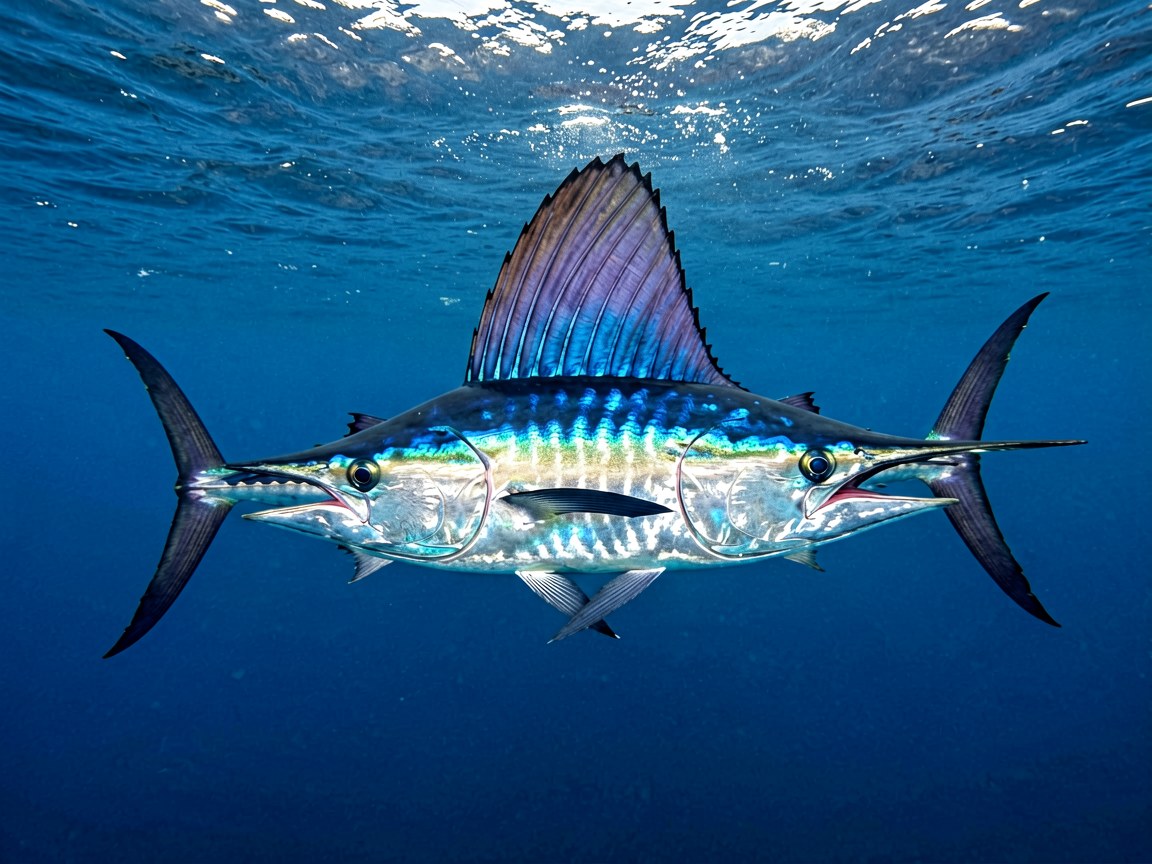
Istiophorus platypterus | Indo-Pacific Sailfish
Introduction
The Indo-Pacific sailfish, Istiophorus platypterus, is widely called the fastest fish in the ocean and among the most striking billfish for its enormous sail-like dorsal fin running nearly the full back. Inhabiting the warm Indian and Pacific Oceans, it is a supremely adapted pelagic predator blending blistering speed with a tall, retractable sail used in herding and display. Sailfish migrate across whole basins after schooling prey and are central to both commercial fisheries and catch-and-release sportfishing. Their streamlined bodies, rigid bills, and crescent tails show evolutionary refinement for high-speed pursuit. Though abundant in parts of their range, they face the bycatch and overfishing pressures common to large pelagic fishes, and their biology draws study of speed mechanics and sail function.
Taxonomy
Istiophorus platypterus belongs to the family Istiophoridae, the billfishes, alongside marlins and spearfish, within the order Perciformes and the scombroid suborder. The genus name joins Greek words for sail and bearing, a direct nod to the tall dorsal fin; the epithet platypterus means broad fin. The Atlantic and Indo-Pacific sailfish were once one species but are now usually two, the Indo-Pacific as I. platypterus and the Atlantic as I. albicans. Like the [Yellowfin Tuna](https://www.gloencyc.com/tuna-thunnus-albacares/), a fast scombroid sharing the sailfish’s tropical pelagic range and schooling-prey diet across the Indo-Pacific, the sailfish is a high-performance migrant built to chase dispersed prey, though it carries the distinctive sail tunas lack. Lesueur described it in 1821. Molecular and morphological work keeps refining billfish genera, but the sailfish’s unique fin makes it unmistakable within Istiophoridae. Its closest kin are the marlins and shortbill spearfish.
Physical Characteristics
The Indo-Pacific sailfish is a slender, elongate billfish with a body made for speed and a dorsal fin of extraordinary size. The sail, on long spines, is taller than the body is deep and runs most of the back; it can be raised or lowered and folded into a groove at speed. Adults typically measure 1.2 to 3.4 meters and weigh 20 to 100 kilograms, the largest over 3.4 meters and 100 kilograms, with exceptional fish near 4 meters. The upper jaw extends into a long rounded bill. Color is brilliant metallic blue to gray above with a silvery white belly, and the sail often shows rows of bluish spots and a dark cobalt edge. Like other billfish, the sailfish can flash its colors, used in communication. The body bears embedded elongated scales, a single lateral line, and a narrow rigid crescent tail. The first dorsal is the sail; the second dorsal and anal are small and retractable; the pelvics are long and slender. A counter-current heat exchanger warms the brain and eyes, sharpening vision on cool-water hunts.
Habitat
The Indo-Pacific sailfish occupies tropical and warm temperate Indian and Pacific waters from about 40 degrees north to 40 degrees south, including the Red Sea, Persian Gulf, East Africa, South Asia, the Malay Archipelago, Australia, and the central and eastern Pacific to the Americas. It is an epipelagic oceanic species mainly beyond the shelf in 21 to 28 degrees Celsius, yet readily enters coasts, lagoons, and nearshore areas where prey schools gather. It ranges the upper 200 meters and occasionally dives deeper to forage or thermoregulate. Seasonal moves follow warm currents and prey: in the Pacific it tracks the equatorial currents and the Kuroshio and East Australian Currents; in the Indian Ocean it shifts with the monsoons. Tagging shows moves of hundreds to thousands of kilometers across basins. They gather at floating objects, upwelling fronts, and temperature breaks where baitfish bunch. Sailfish rarely enter water cooler than about 20 degrees Celsius and are most abundant where temperature and prey align, making them signals of ocean change.
Diet
The Indo-Pacific sailfish is a voracious predator of schooling epipelagic fishes and squids, eating sardines, anchovies, mackerels, sauries, flyingfish, and squid. Its hunting is collaborative and spectacular: small groups herd baitfish into tight surface balls, then take turns slashing with their bills to stun prey before swallowing them whole. The tall sail likely helps herd, making the fish look larger and corralling scattered schools, though it is also used in displays. As with marlins, the bill is a slashing weapon, not a skewer. Feeding is visual and occurs mainly in the upper water at dawn and dusk when schools are densest. Sailfish can accelerate from rest to over 100 kilometers per hour in seconds when striking, aided by their streamlined shape and retractable fins. Their diet overlaps tunas, dolphins, and seabirds, and prey shifts drive migrations. Juveniles eat smaller planktonic organisms and tiny fish before taking schooling fishes. In the Indian Ocean, spawning peaks coincide with the southwest monsoon, when upwelling fuels the plankton blooms that support both the sailfish and the tunas they follow.
Reproduction
The Indo-Pacific sailfish is oviparous, shedding buoyant eggs into the open ocean where fertilization is external, typical of pelagic scombroids. Spawning occurs in warm water, with several batches released through the warmer months; major nursery and spawning areas include the equatorial Indian Ocean, the South China Sea, and parts of the western Pacific above about 24 to 26 degrees Celsius. A single female produces a very large number of eggs a season, perhaps millions, offsetting extreme mortality among the tiny transparent larvae drifting in the plankton. There is no parental care. Males mature earlier and smaller, often within one to two years at 1.2 to 1.5 meters, while females mature a bit later. Growth is rapid in the first years. Because sailfish produce vast eggs, the population can rebound from low adult numbers if spawning and prey hold, but it stays dependent on enough larvae surviving to recruit, making it sensitive to spawning-habitat loss and climate-driven productivity change.
Conservation
The Indo-Pacific sailfish is assessed as Least Concern by the IUCN globally, reflecting a broad range and relatively high productivity next to slow-breeding sharks, though regional stocks are poorly known and some likely decline. Main threats are bycatch in industrial purse seines and longlines for tuna, directed commercial and artisanal catches for meat, and recreational take. In many areas it is a top game fish, and catch-and-release is widely promoted to cut mortality, though survival depends on handling and hook placement. Regional fisheries bodies set limits and push measures like circle hooks and live-release rules to improve survival. Because sailfish migrate widely, conservation needs international cooperation across Indian and Pacific governance. Emerging pressures include climate change, which may shift sailfish and prey ranges and move spawning grounds, and growth of illegal, unreported, and unregulated fishing. Monitoring, ecosystem-based management, and bycatch reduction remain the best tools for healthy populations.
Fun Facts
- The Indo-Pacific sailfish is often called the fastest fish, with bursts over one hundred kilometers per hour.
- Its towering sail can be raised to herd prey or lowered and tucked away when swimming fast.
- Sailfish often hunt in teams, cooperating to corral baitfish into tight balls before striking.
- Their bodies can flash brilliant blue and silver, probably to communicate or confuse prey.
- A female releases millions of eggs each season, offsetting the huge losses among tiny larvae.