 By Iris
Tockus leucomelas | Southern Yellow-billed Hornbill
Species Profile · Bucerotidae
Southern Yellow-billed Hornbill
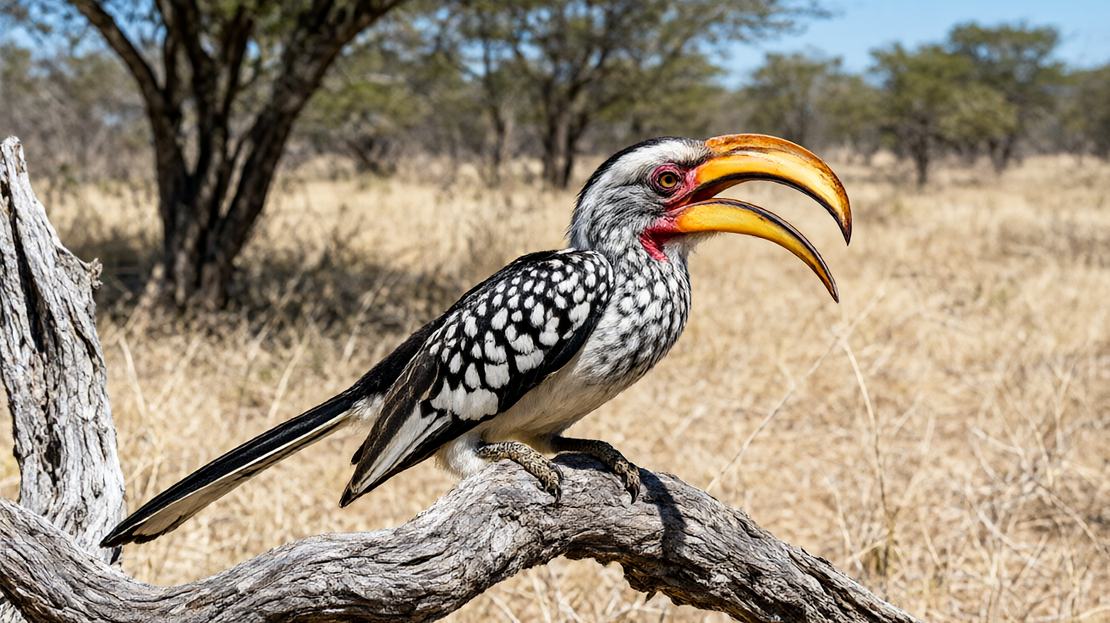
A hornbill sits on a dead branch with a long yellow bill and a low casque over it.
Least Concern
Length
Weight
Eggs
Hatch
Bill
Rating
The Southern Yellow-billed Hornbill
The bill that gave it a nickname
A grey bird hops down a dead branch and lands on bare sand. A long yellow bill takes up a third of the body. That bill curves down at the tip. Bare red skin around each eye stands out against grey plumage.
Because the bird feeds on the ground, it walks rather than hops across open patches. Flight comes in short glides between thorn trees, and the wings flash white spots. Its English name comes from that bill, and the bill carries the colour of ripe maize.
Family tree
Bucerotidae, the small African hornbills
Its proper name is Tockus leucomelas, one of the small African hornbills. Its family holds about sixty species, and the largest of them live in forest. A Rhinoceros Hornbill carries a casque above the bill, and both birds seal the nest hole before the eggs arrive.
Because the small hornbills split from the large ones long ago, the casque shrank away to a low ridge. Two subspecies are named, and they differ in the shade of the bare skin. Early writers grouped every yellow billed bird together, which later work corrected.
Bill, casque and spots
How to tell one
Adults reach 40 cm from bill to tail tip. Weight falls between 165 and 250 g. Its bill runs long and yellow, and it carries a low ridge along the top.
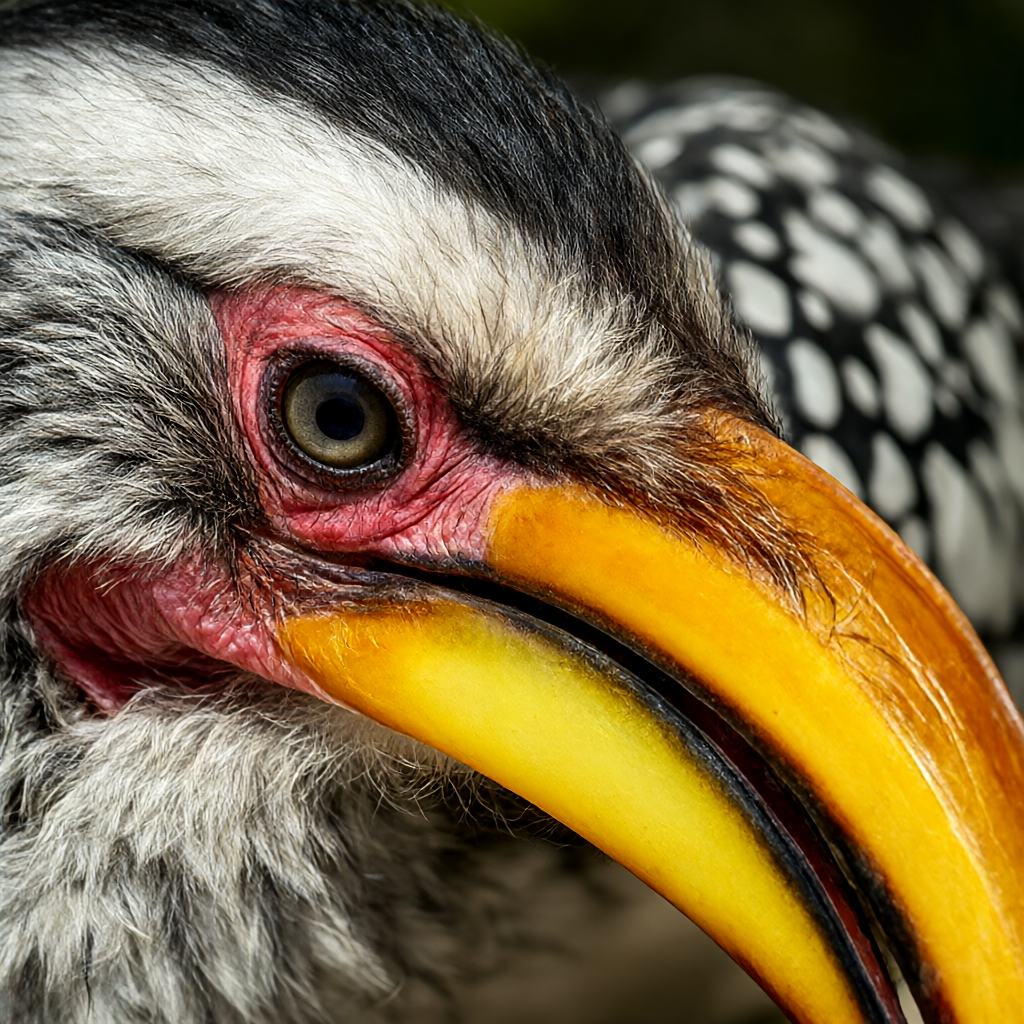
Because the bill holds little bone, the bird can carry it without strain. Bare skin rings each eye, and it turns redder in the breeding season. Plumage runs grey over the body, and white spots cover the wing coverts.
Legs stay short and dark, and the toes grip a branch in pairs. Females run smaller than males, though the difference stays hard to see.
1
2
3
Dry thorn savanna
Where it lives
Dry savanna woodland holds the species across southern Africa. Namibia, Botswana and northern South Africa make up most of the range. Thorn trees give it nesting sites. It needs open ground for feeding, and it keeps both close together.
Because the species takes hollow limbs, a tree with a natural cavity matters more than a tall one. Pairs hold a territory through the year, and they call from the same perch each morning. A Southern Ground Hornbill walks the same savanna, and both species hunt on foot rather than in the canopy.
Beetles and seeds
What it eats
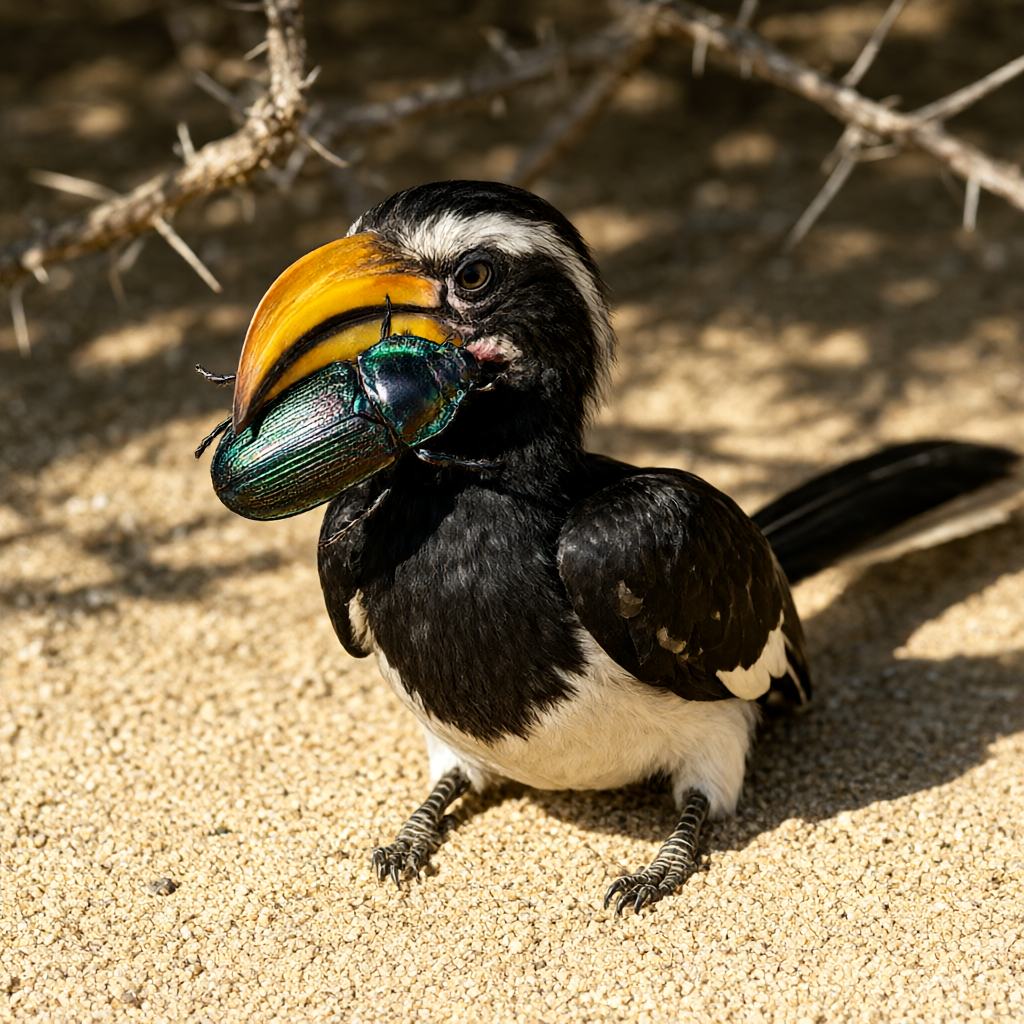
Insects make up most of the food. It takes beetles, grasshoppers and termites from the ground, and it digs with the bill. Scorpions get eaten after the sting is removed, and the bird works with care. Because the bill reaches into crevices, prey that hides in bark still gets taken.
Seeds and small fruit fill the rest of the diet. A bird that finds a swarm of termites returns for days. It works the same spot until the swarm goes.
Walled in
The breeding cycle
A pair chooses a natural cavity in a tree trunk. She seals the entrance with mud and droppings. A slit stays wide enough for the bill.
Because the male feeds her through that slit, the pair stays bound for the whole nesting period. Three to four eggs hatch after about a month. She breaks out when the chicks fledge.
Both parents then feed them, and the pair stays together. Young birds stay with the parents for a few weeks after leaving the hole.
No concern
Conservation
The Red List calls the species Least Concern. Nothing suggests a rapid fall across the range. Because the bird uses natural cavities, the removal of dead trees costs it nest sites.
Farmers tolerate the species, since it eats insects that damage crops. Roads kill a number, and collisions happen where the bird feeds on spilled grain. Protected areas hold stable groups, and the species also lives on farmland.
Side by side
How It Compares
| Trait | Southern Yellow-billed Hornbill | Rhinoceros Hornbill |
|---|---|---|
| Length | 40 cm | 80-90 cm |
| Weight | 165-250 g | 2-2.5 kg |
| Bill | yellow with a low casque | pale with a raised casque |
| Nest | a sealed tree cavity | a sealed tree hollow |
| Eggs | 3-4 | 1-2 |
| Rating | Least Concern | Vulnerable |
Common misreadings
What People Get Wrong
- Not a toucan. Two continents separate them. The hornbill carries its casque on top of the bill and seals its nest in a tree, while a toucan has no casque and nests in an unsealed hole in the Neotropics.
- Not a fruit eater. It works dry ground. Beetles, termites and small animals make up much of the diet, and because the bill reaches into loose sand the bird can take prey that stays buried.
- Not a quiet nest. The female stays walled in for weeks. She keeps a slit wide enough for the bill, and because the male feeds her through it the pair stays bound until the chick is ready to fly.
Going further
Sources and Further Reading
Quick hits
Five things to remember
- Its bill looks like a banana.
- It walks rather than hops.
- The female seals the nest.
- It removes a scorpion’s sting.
- Its eye skin turns redder in spring.