 By st20113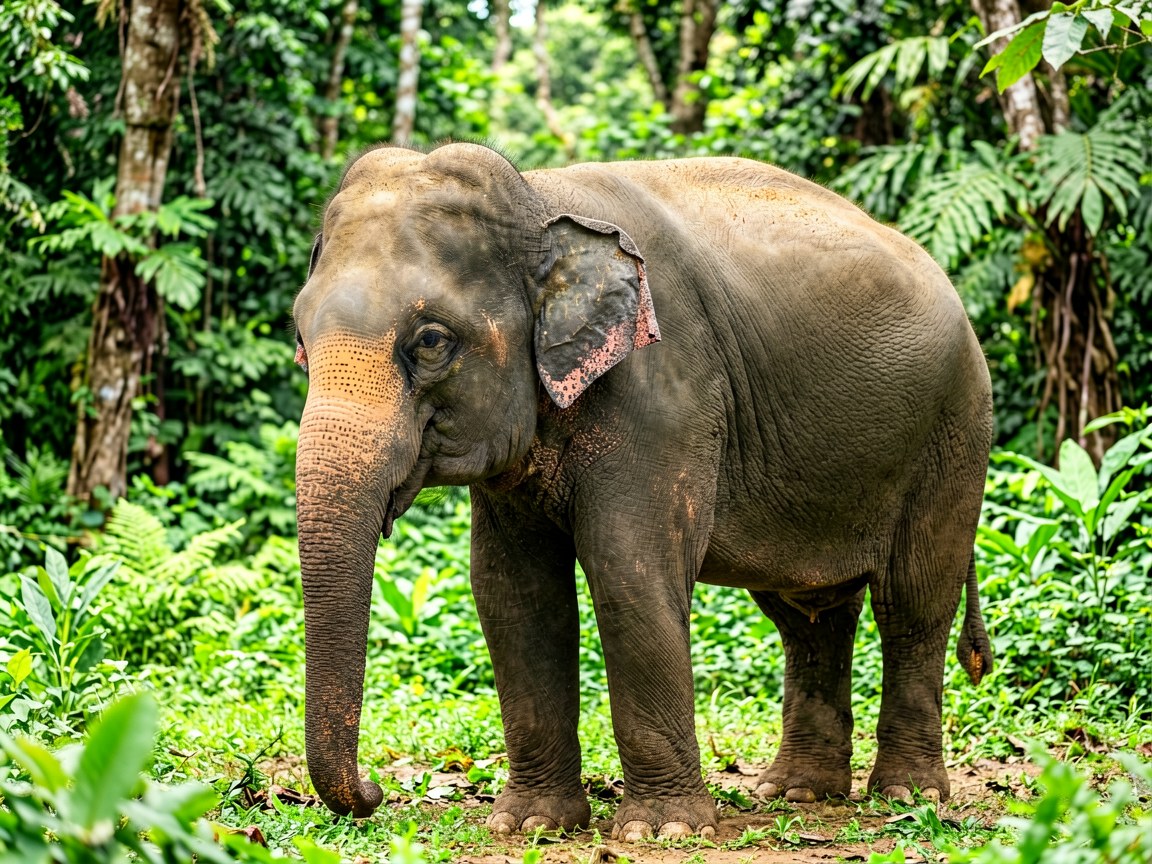
Elephas maximus | Asian Elephant
Introduction
Elephas maximus, the Asian elephant, is the largest land mammal of Asia and the continent’s answer to Africa’s giants. Ranging from the forests of India and Sri Lanka through Southeast Asia to Borneo and Sumatra, it has been intertwined with human history for millennia — as a beast of war and ceremony, as a working animal in timber and agriculture, and as a central figure in Hindu and Buddhist tradition. Smaller and lighter than the African elephant, it is recognised by its domed back, smaller ears, and a single finger-like tip on the trunk. Today the species is Endangered, squeezed into ever-smaller forest and grassland fragments by expanding human settlement, and its survival depends as much on coexistence with people as on protected reserves. It is the closest living relative of the African elephant, and the two together are the only surviving members of the elephant family, relics of a lineage that once spanned most of the world’s continents.
Taxonomy
Elephas maximus is the sole living member of the genus Elephas and, with the two African species in Loxodonta, one of only three living elephant species. The family Elephantidae also includes the mammoths and mastodons of the recent past, making today’s elephants the last survivors of a once-diverse group. The species is divided into several subspecies, including the Indian elephant, the Sri Lankan elephant, the Borneo pygmy elephant, and the critically threatened Sumatran elephant, each adapted to its regional habitat. The name Elephas is Latin for “elephant,” and maximus simply means “largest,” a title it earns in Asia even if it is outclassed by the African savanna bull. Genetic studies confirm that Asian and African elephants split tens of millions of years ago, after which they evolved their differences in parallel — the Asian line keeping smaller ears and a single trunk tip, the African line developing larger ears and a twin-tipped trunk. This deep separation explains why, despite their similar form, the two are no more interchangeable than their distant shared ancestor allowed. The Asian elephant and the [African elephant described elsewhere](https://www.gloencyc.com/african-elephant-loxodonta-africana/) are thus the last branches of a once-diverse family, separated by tens of millions of years of independent evolution.
Physical Characteristics
The Asian elephant is substantial but more compact than its African cousin, with bulls standing around 2.5 to 3 metres at the shoulder and weighing up to about five tonnes. Its back is rounded or humped, and its ears are comparatively small and rectangular. The trunk ends in a single prehensile “finger” used with fine control to pick up individual blades of grass or a single fruit. Only the males, and some females in certain populations, grow tusks; many Asian elephants are tuskless, and the visible “tusks” of working elephants are often the shorter, always-present tushes of females. Skin is grey, often pinkish on the ears and trunk, and sparsely haired. The forehead bears two characteristic bulges, and the animal’s massive legs support its weight with pillar-like strength. As in all elephants, the trunk is a marvellous organ — part nose, part hand, part straw — equipped with tens of thousands of muscles that let the animal smell, drink, trumpet, lift logs, and comfort calves with equal ease.
Habitat
Asian elephants occupy a mosaic of habitats across southern and southeastern Asia: tropical evergreen forest, deciduous monsoon forest, grassland, and the forest–clearing edges where they raid crops. They favour areas with reliable water, shade, and abundant browse, and they undertake seasonal movements between wet- and dry-season ranges in search of food and water. Historically they ranged across most of the continent’s wooded lowlands, but today they survive mainly in fragmented reserves and the corridors linking them, often sharing landscape with dense human population. They need large home ranges — a herd may use hundreds of square kilometres — and they are increasingly confined to protected pockets surrounded by farms and villages. Rivers, swamps, and salt licks are important, and the species shows a strong attachment to forest cover during the heat of the day, emerging into grasslands and fields at dusk. This dependence on extensive, connected habitat makes fragmentation the central threat to its persistence.
Diet
The Asian elephant is a庞大的 herbivore that eats enormous quantities of plant matter — often 150 kilograms or more per day — consisting of grasses, leaves, bark, twigs, roots, and a wide variety of fruits. Like its African relatives it is a generalist browser-grazer, switching between grasses in the wet season and woody browse in the dry, and it uses its trunk to strip bark, pull down branches, and pluck fruit with precision. It needs both bulk and variety, so it ranges widely to meet nutritional needs, and its dung disperses the seeds of many forest trees, making it an important gardener of Asian woodlands. Mineral licks supply salts and trace elements absent from vegetation. Because it eats so much, it can damage crops severely when it enters fields, and a single night’s raid on a rice or banana plot can devastate a smallholder’s livelihood. This diet-driven movement between forest and farmland is the root of most human–elephant conflict across its range, and managing that overlap is now central to conservation.
Reproduction
Asian elephants reproduce slowly, with females bearing a single calf after a gestation of nearly 22 months — the longest of any land mammal. Calves nurse for years and remain dependent on the mother and the herd’s collective care well into childhood, and females may not breed again for four to five years, so a mother raises only a few offspring in her life. Sexual maturity arrives around 10 to 15 years in females and later in males, and males compete for mates, entering musth at intervals when testosterone surges and they become more aggressive and mobile in search of females. Calves are born into matriarchal herds of related females that share knowledge of food, water, and danger across generations — a social memory essential for surviving in a fragmented landscape. This long, invested life history means populations cannot quickly replace losses: the death of a mature female removes not only her future calves but also decades of ecological knowledge the herd relies on.
Conservation
The Asian elephant is listed as Endangered, with total wild numbers in the tens of thousands and declining in many regions. The principal threats are habitat loss and fragmentation, which shrink and isolate populations and force elephants into conflict with people, and poaching for ivory and, in some areas, for meat and skin. Conservation combines protected areas and habitat corridors, measures to reduce conflict such as early-warning systems and crop-protection fencing, and legal protection backed by anti-poaching efforts. Crucially, because so many elephants live outside reserves, success depends on local communities benefiting from coexistence — through tourism, compensation for crop loss, and respect for the animal’s cultural stature. Captive management of domesticated elephants, long part of Asian life, is also under reform for welfare reasons. As a keystone and flagship species, the Asian elephant’s survival is entwined with the fate of the continent’s last great forests and the people who share them.
Fun Facts
- Its trunk has a single “finger” at the tip, unlike the African elephant’s two, yet it handles objects with great precision.
- Only some males grow prominent tusks; many Asian elephants are naturally tuskless.
- The gestation lasts about 22 months, the longest of any land mammal.
- It can eat more than 150 kilograms of plants in a single day.
- Across Asia it is revered in Hindu and Buddhist tradition, yet wild populations keep shrinking as habitats fragment.