 By st20113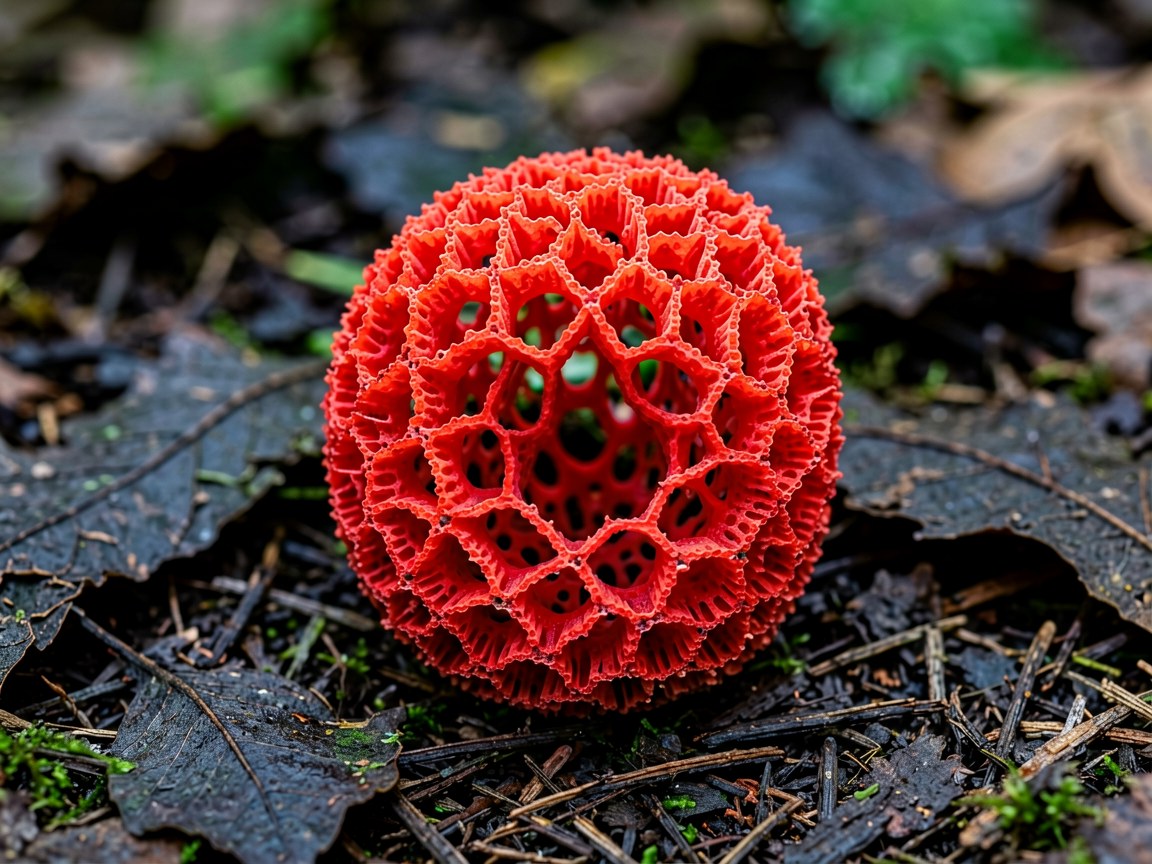
Clathrus ruber | Red Cage Fungus
Introduction
Clathrus ruber, known as the red cage fungus or lattice fungus, is a striking saprobic fungus that bursts from a rounded “egg” on the forest floor into a hollow, cage-like red mesh that can look like something from a coral reef. It belongs to the stinkhorn family and, like its relatives, lures insects with a foul smell to spread its spores. Found across southern Europe, parts of North Africa, and introduced regions including the Americas and Australia, it typically appears in gardens, mulch beds, and leafy woodland after warm wet weather. The vivid color and perforated structure make it one of the most recognizable and photographed fungi in its range. Although it looks alarming, it is not considered poisonous to humans, though its odor makes it thoroughly unappetizing.
Taxonomy
Clathrus ruber is placed in the family Phallaceae, the stinkhorns, within the order Phallales. The genus Clathrus contains several latticed stinkhorns, and ruber refers to the characteristic red coloration of the mature receptaculum. It is closely related to other stinkhorns that begin life as an egg-shaped volva and then rapidly expand a spore-bearing structure. The family is united by this unusual method of insect-mediated spore dispersal rather than by wind. As a filamentous fungus it shares the basic ecology of decomposer relatives such as the [Cauliflower Fungus](https://www.gloencyc.com/sparassis-crispa-cauliflower-fungus/), breaking down dead organic matter, though Clathrus uses scent instead of a shelf form to do its work.
Physical Characteristics
The young fungus emerges as a whitish to pinkish “egg,” technically a peridiole enclosed in a gelatinous volva, sitting partly buried in soil or mulch. Within a day or two the egg splits and a hollow, branched, net-like structure inflates, reaching ten to twenty centimeters tall and spanning a similar width. The cage is composed of fleshy reddish-orange arms joined at the top, leaving large gaps through which the interior is visible. The inner surfaces of the arms are coated with a dark olive-green gleba, the slimy spore mass that produces the strong odor. Color varies from scarlet to pinkish salmon, and faded specimens turn yellowish with age. The whole structure is fragile and collapses within a few days as the gleba dries. The egg stage can be mistaken for a small puffball before it opens.
The gleba that coats the inner arms is composed of microscopic club-shaped cells called basidia, each bearing spores, suspended in a jelly that the fungus liquefies as it matures. The spores themselves are smooth, elliptical, and only a few micrometers long, yet they are produced in the millions to offset the randomness of insect transport. Beneath the cage, the volva remains as a cup-like base from which the structure arose, and this cup can persist in the soil for some time after the cage collapses. The reddish pigment in the arms is water-soluble and fades quickly once the tissue dries, which is why freshly opened specimens are far more vivid than older ones. The entire above-ground body is a short-lived reproductive phase supported by a perennial mycelium below.
Habitat
Clathrus ruber favors disturbed and cultivated ground as much as wild habitats, commonly appearing in parks, gardens, greenhouses, and wood-chip mulch where decaying plant material is abundant. It also occurs in coastal scrub, Mediterranean woodland, and sandy soils beneath shrubs. It thrives in warm, humid conditions and often fruits in clusters after rain in late spring through autumn. The species is native to the Mediterranean and southwestern Europe but has spread to temperate regions worldwide, probably via movement of contaminated soil and mulch. It is not picky about substrate as long as there is ample decomposing organic matter and enough moisture to trigger the rapid expansion of the fruiting body.
Diet
Like all fungi in its group, Clathrus ruber is a saprobe, feeding by secreting enzymes into dead wood, leaf litter, and mulch and absorbing the dissolved nutrients. It does not photosynthesize and does not attack living plants; instead it recycles carbon and minerals locked in dead organic matter, playing a useful role in soil health. The “egg” and cage are reproductive structures, not feeding organs, and the mycelium beneath the soil does the actual digestion year-round. Because it flourishes on wood chips and garden compost, it is often a sign of active decomposition rather than plant disease. The gleba it produces is packed with spores that the fungus “advertises” with smell rather than nurtures with food.
The enzymes the mycelium releases include cellulases and lignin-degrading compounds that break plant cell walls into simple sugars the fungus can absorb, the same chemistry that drives forest-floor recycling on a vast scale. Because the cage itself is not a feeding organ, the fungus does all its nutrition invisibly through the soil, and the visible structure exists only to spread spores. Gardeners who find it among wood chips are seeing the fruiting signal of a healthy decomposer network rather than a pathogen attacking living plants. The slimy gleba is rich in the spores but nutritionally useless to the insect visitors, which leave with spores stuck to their legs and bodies.
Reproduction
Reproduction depends on insects rather than wind. The mature cage exudes a putrid odor reminiscent of rotting meat or sewage, which attracts flies, beetles, and other carrion-feeding insects. These visitors crawl over the gleba, picking up sticky spores on their bodies, and carry them away to new sites where the fungus can establish. The spores are released in the slime and are hardy enough to survive passage through an insect gut. Because the structure is short-lived, the window for dispersal is only a few days, making the scent signal intense and efficient. The subterranean mycelium persists for years, sending up new eggs whenever conditions are favorable, so a single colony can produce repeated flushes across a season.
Conservation
Clathrus ruber is widespread and locally common, with no global conservation concern; it is not listed as threatened. Its ability to grow in gardens and disturbed ground has helped it expand its range far beyond the Mediterranean. The main risks it faces are habitat alteration and, in developed areas, the removal of mulch and leaf litter that it depends on, though these are minor at the population level. Because it is innocuous and even welcome by many gardeners as a sign of healthy soil, there are no targeted conservation actions. Citizen science records and fungal surveys help track its spread into new regions, where it is generally regarded as a naturalized curiosity rather than an invasive threat.
Fun Facts
- The red cage fungus starts life as a white “egg” that can hatch into the latticed form within a single day.
- Its smell is so foul it is sometimes compared to rotting meat, which is exactly the bait meant to lure spore-spreading flies.
- The hollow red cage is not solid but a network of arms with wide gaps you can see through.
- Although it looks toxic, it is generally considered non-poisonous, just too smelly to eat.
- A single underground network can pop up new cages repeatedly through a warm, wet season.