 By st20113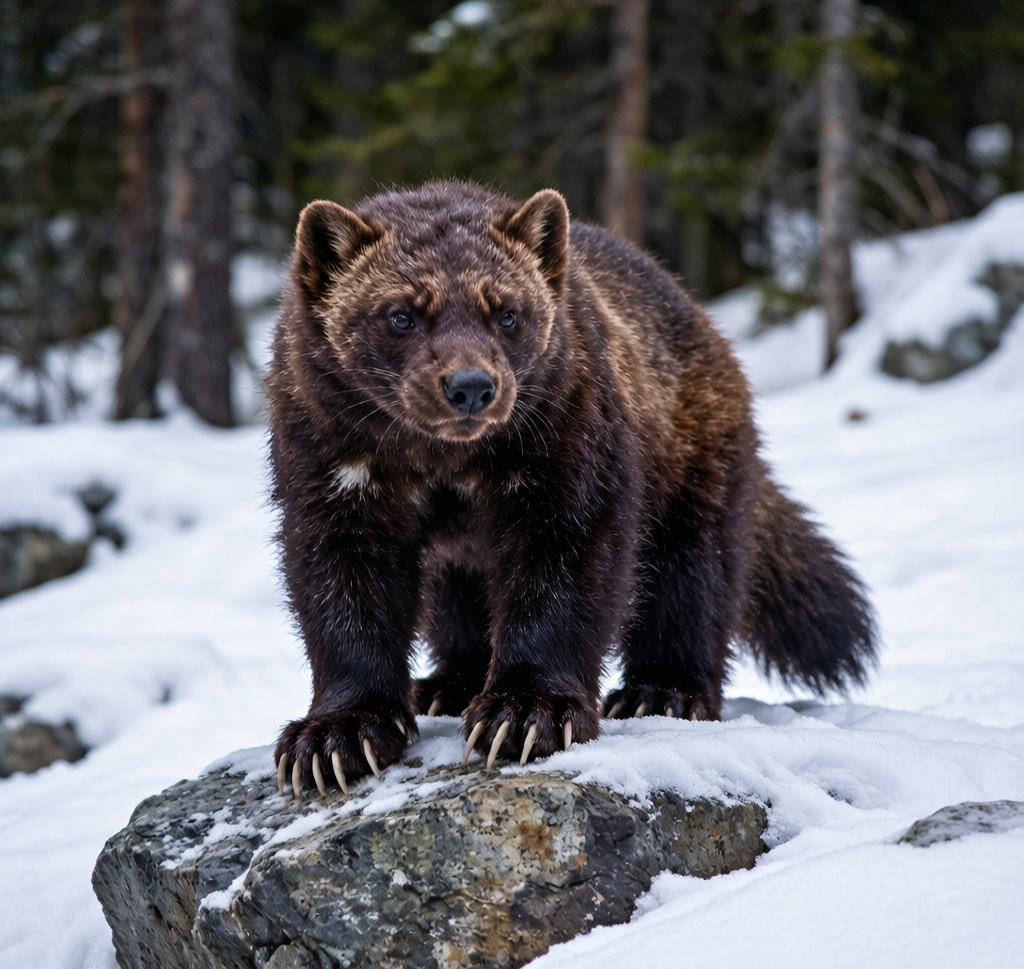
The wolverine (Gulo gulo) is one of the most remarkable and tenacious mammals on Earth — a stocky, powerful carnivore of the mustelid family that has earned a legendary reputation as a fierce, tireless predator and scavenger capable of driving wolves and even bears away from their kills. Despite weighing no more than a large domestic dog — typically 9 to 18 kilograms — the wolverine has an enormous home range spanning up to 1,000 square kilometers for a single individual, making it one of the most elusive and difficult-to-study carnivores. Its dependence on deep snow cover for denning and prey caching makes it particularly vulnerable to climate change. Found in the remote boreal forests, tundra, and alpine regions of the Northern Hemisphere, the wolverine represents one of the most resilient and extraordinary predators in the animal kingdom.
## Physical Characteristics
The wolverine has a compact, powerful body with a broad, rounded head, small eyes, and short, rounded ears. It measures 65 to 105 centimeters in body length, plus a bushy tail of 17 to 26 centimeters, and stands approximately 30 to 45 centimeters at the shoulder. Males are 20 to 30 percent larger than females. The fur is long, dense, and oily — distinctly hydrophobic and resistant to frost accumulation — and is typically dark brown to black, with a distinctive pale buff or yellowish stripe running from the forehead along both sides of the body to the base of the tail. The legs are short and sturdy, ending in large, five-toed paws with long, sharp, semi-retractable claws — excellent for climbing, digging, and gripping ice and snow. The jaws are exceptionally powerful for its size, capable of crushing frozen meat and bone.
## Habitat and Distribution
The wolverine has the largest range of any terrestrial member of the Mustelidae family, found throughout the boreal and subarctic zones of the Northern Hemisphere. In North America, it ranges from Alaska and northern Canada south through the Rocky Mountains to the Pacific Northwest. In Europe and Asia, it is found in Scandinavia, northern Russia, Siberia, and the Russian Far East. Wolverines inhabit boreal forests, subalpine forests, tundra, and alpine zones — environments characterized by long, harsh winters with deep, persistent snow cover. The availability of deep snow cover for denning is a critical habitat requirement that makes the species particularly vulnerable to warming winters.
## Behavior and Diet
The wolverine is a solitary, primarily nocturnal predator and scavenger, capable of covering extraordinary distances — up to 50 kilometers per day — in search of food. Despite its small size, it is an aggressive and tenacious hunter capable of taking prey as large as adult deer, moose, and caribou. More commonly, it feeds on small mammals such as rodents, hares, and ground squirrels. As a scavenger, the wolverine is legendary: it can detect carcasses buried under deep snow and has been documented driving wolves, lynx, and even bears away from kills. Wolverines cache excess food in snow or underground. They are excellent climbers and swimmers.
## Reproduction
Wolverines exhibit delayed implantation, in which the fertilized egg does not implant in the uterus until environmental conditions are favorable. Mating occurs between May and August, but birth does not occur until approximately 30 to 50 days after implantation, resulting in births in February to April. Litter size is typically one to three kits, born in a snow den excavated by the female. Kits are born blind and helpless, covered in a thin layer of white fur. They emerge from the den at approximately three months of age and begin learning to hunt with the mother. They remain with the mother for approximately one to two years. Sexual maturity is reached at two to three years of age.
## Conservation
The wolverine is classified as a Species of Special Concern in the United States. The primary threats include habitat loss and fragmentation due to logging, mining, and development; persecution by humans; and climate change, which is reducing the duration and depth of snow cover across the wolverine’s range. Conservation efforts focus on protecting wolverine habitat, reducing human-wildlife conflict, and monitoring populations to detect climate-driven declines before they become irreversible.