 By Iris
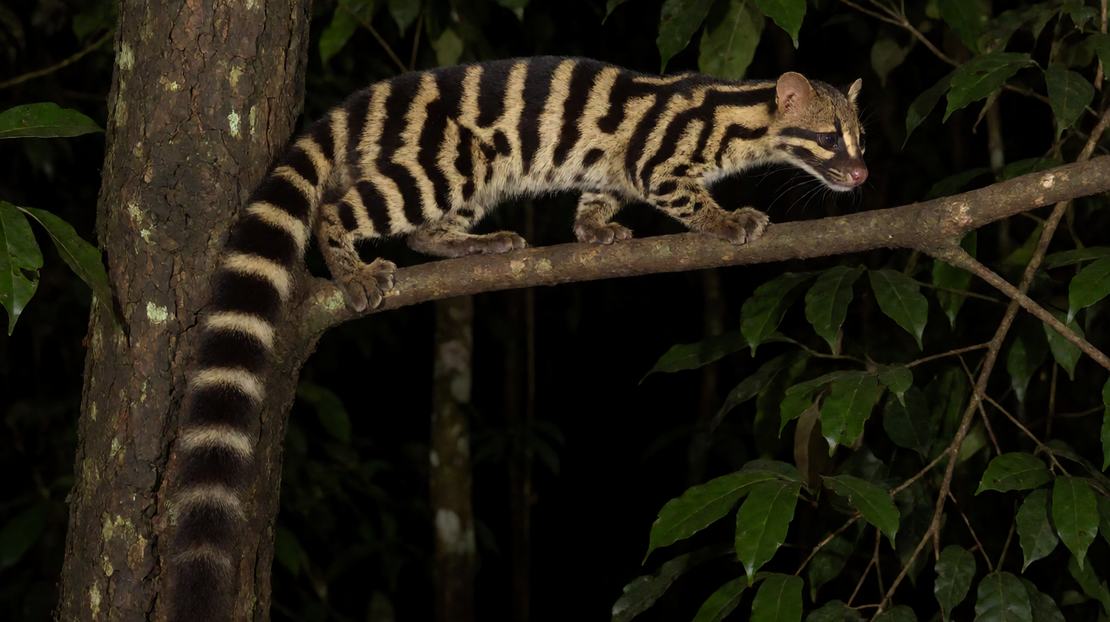
Prionodon linsang | Banded Linsang
Species Profile · Prionodontidae
Banded Linsang
A cat-like hunter in a striped coat, with claws that fold away.
Least Concern
Body
Tail
Weight
Claws
Range
Rating
Seven hundred grams of tree hunter
Five bars and a long tail
Pale yellow fur carries five dark bars across the back. A tail longer than the body ends in a dark tip. Banded linsangs hunt at night in the trees of the Sunda region. Claws can be drawn back into the foot, as a cat does.
Few small hunters climb with such ease. Branches, vines and trunks all serve as roads. Daylight hours pass in a hollow or a thick crown. Darkness brings the animal out along a regular route.
Such a route is short, yet the animal checks it every night. Seeing one is rare, because the animal keeps away from open ground and stays in cover.
Family tree
Prionodontidae, the Asiatic linsangs
Prionodon linsang sits in Prionodontidae, a family with only two species. Hardwicke named the animal in 1821 from a Javan skin. Older texts place both linsangs inside Viverridae. Genetic work changed that, since the two species group with the cats and not with the civets.
Four subspecies are described, and a full revision is still needed. A revision may split the island forms, since each island holds a slightly different coat. The Common Genet lives in Africa and Europe, while this animal stays in Asia. Bodies and habits look alike, and both hunt small animals at night.
Their claws differ, though, since only the linsang can draw them back. No count of wild animals exists.
Closer to cats than to civets
How to tell one
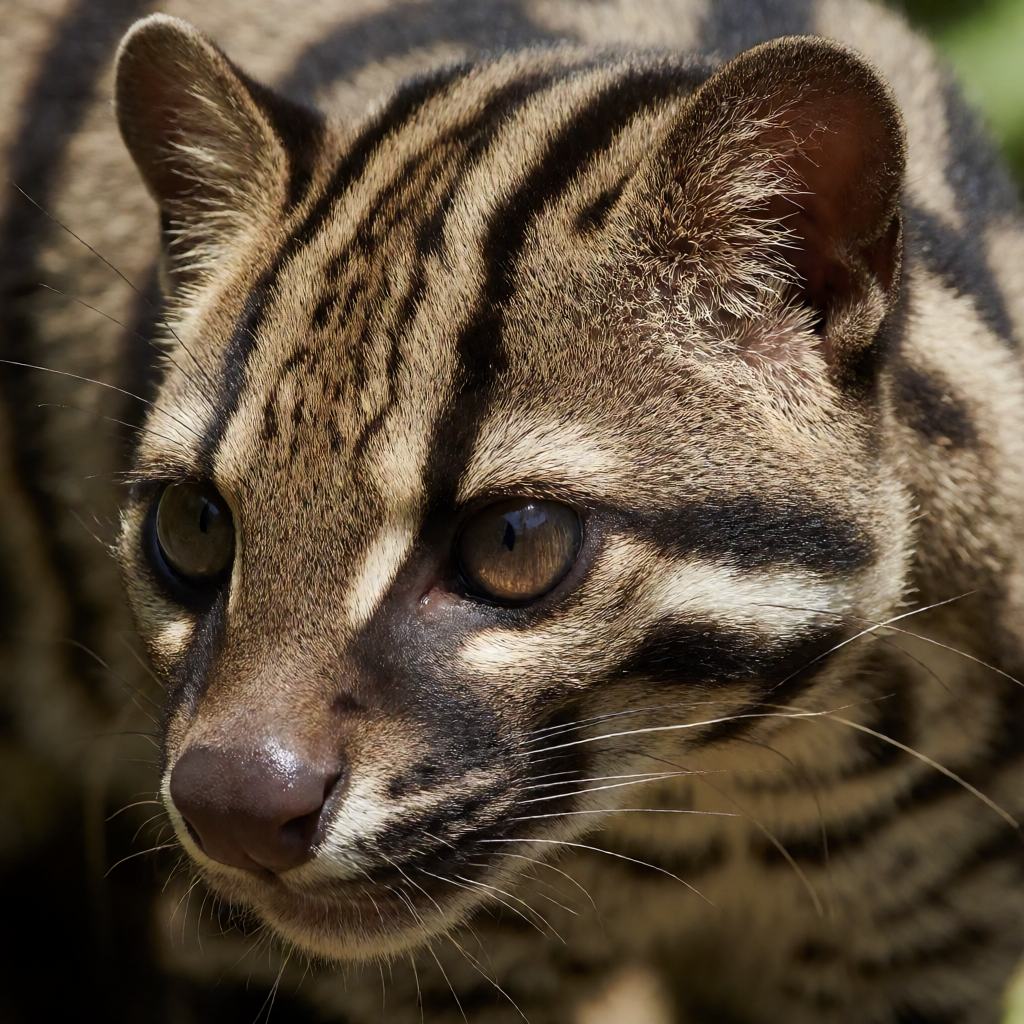
Body length runs 35 to 41 cm. Its tail reaches 43 cm in a large male. Weight sits near 700 grams. Five broad bands cross a pale yellow back, and the neck carries stripes.
Seven or eight dark rings mark the tail, and the tip is black. Claws fold back into a sheath when the animal walks, which keeps the points sharp. Pads on the feet grip smooth bark, and the grip still holds on wet wood after rain. Teeth are sharp and close set, which suits a diet of meat and small bones.
Heads are small and snouts are pointed. A linsang of this weight can cross a gap of two metres without touching the ground below.
1
2
3
A body built for branches
Where it lives
Evergreen forest holds the species through most of its range. Records come from southern Myanmar and southern Thailand. Peninsular Malaysia, Sumatra, Java and Borneo all carry animals. Small islands such as Bangka and Belitung hold their own forms.
Secondary forest and old plantations also suit the animal. Oil palm blocks are crossed only when cover remains between them, though the animal rarely stays long. Hill forest holds animals up to about 1,500 m. A camera trap in Karen State recorded the species in 2013, the first record for that part of Myanmar.
Forest loss is the main pressure across the range. Roads open the forest to hunters, and the animal then disappears from that block within a few years.
Evergreen forest and old plantation
What it eats
Meat makes up almost the whole diet, though fruit is taken now and then. Birds, rats, lizards and snakes are taken in the trees. Insects and small frogs fill out the list. Hunting starts after dusk and runs until dawn.
Prey is stalked along a branch, then seized with a quick bite to the back of the neck. Small animals are eaten where they fall. Big prey is carried to a fork and held down with the front feet while the animal feeds. Drinking happens often, so water sources matter.
Feeding stops when the stomach is full, and the rest is left. Nothing is stored, since the climate spoils meat within hours and a cache would draw rivals.
Meat taken in the trees
The breeding cycle
Little is known about breeding in the wild. Captive animals suggest two litters a year. Two or three young make up a litter. Birth happens in a hollow tree or a dense crown, well above the reach of ground hunters.
Young open their eyes at about two weeks. Solid food comes at around two months. Mothers hunt alone by then. Males take no part in raising the young.
Captive animals have lived past ten years. Wild lifespans stay unknown, because few animals are followed for long and the species seldom repeats a catch.
Least Concern, and quietly declining
Conservation
IUCN lists the species as Least Concern, in an assessment from 2016. A wide range and a large count keep the rating low. Numbers still fall, though the drop has not reached a critical rate. Forest clearance drives most of that fall.
CITES Appendix II covers the species, so trade needs a permit. Hunting for fur is rare, and the animal has little value in trade. Reserves in Malaysia and Indonesia guard a large share of the range, and most of them hold the species. Camera traps now give better counts than they did ten years ago.
No single site holds a large share of the animals, so no site stands alone. Keeping forest between the reserves matters as much as keeping the reserves, since a small hunter needs a whole landscape.
Side by side
How It Compares
| Trait | Banded Linsang | Common Genet |
|---|---|---|
| Length | 35 to 41 cm body, with a 43 cm tail | 40 to 55 cm body, with a 50 cm tail |
| Weight | about 700 grams | 1.5 to 2.5 kg |
| Home | Sunda evergreen forest, and old plantation | Africa, and southern Europe since long ago |
| Coat | pale yellow with five dark cross bands | grey with dark spots and a ringed tail |
| Food | birds, rats, lizards and snakes | small mammals, birds, insects and fruit |
| Claws | retractable, as in the cats | fixed, and they stay out when the animal walks |
Common misreadings
What People Get Wrong
- Many people mistake the animal for a genet, yet the two sit in different families.
- Some books place both linsangs among the civets, although genetic work links them to the cats.
- A common claim says the species hunts by day, yet every camera record comes after dark.
Going further
Sources and Further Reading
Quick hits
Five things to remember
- Five dark bars cross the back.
- Tail length passes the body length.
- Claws fold back like a cat’s.
- Two or three young form a litter.
- Camera traps found it in Karen State in 2013.