 By Iris
Lycorma delicatula | Spotted Lanternfly
Species Profile · Fulgoridae
Spotted Lanternfly
A planthopper from eastern Asia that now spreads through North American orchards.
Not Evaluated
Length
Forewing
Hindwing
Range
Invaded
Rating
Grey wings, red flash, black spots
A spotted invader
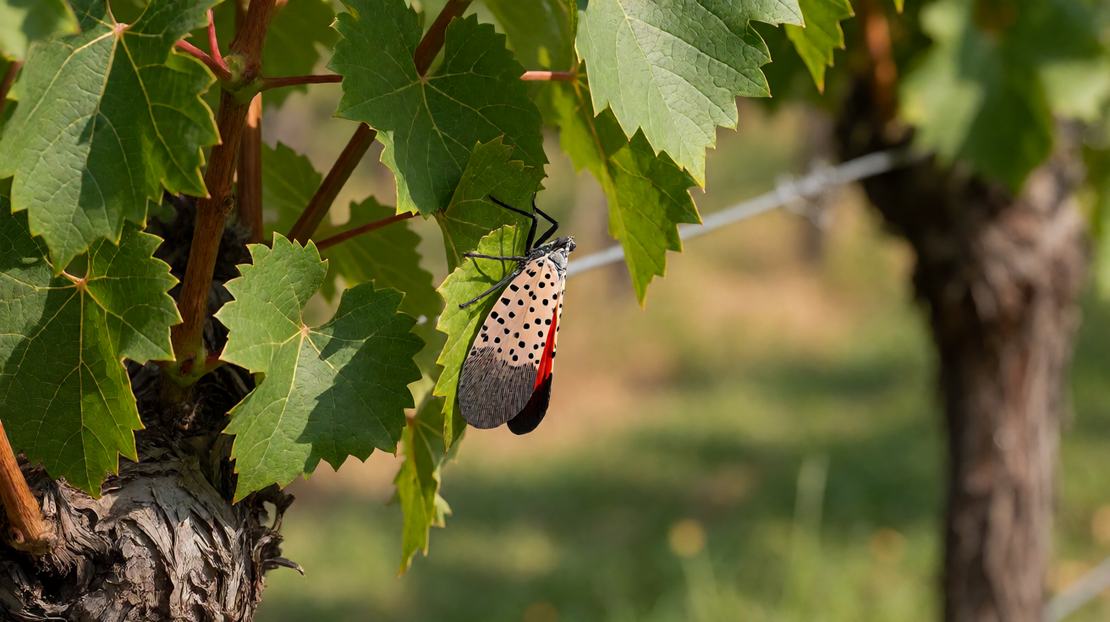
In late summer, spotted lanternflies gather on tree trunks with their wings folded like tents. Grey forewings carry black dots, and the hidden hindwings flash red when the insect moves. Adults reach about 2.5 cm, and they jump far more often than they fly. This species came from China, and it now lives in Korea, Japan and the eastern United States.
That spread worries growers, since the bug feeds on the sap of vines and fruit trees. Grape, apple and hops all lose sap to it, and a heavy group can kill a young vine. Nothing in the new range eats the insect, as far as anyone has seen. Birds leave it alone.
That leaves people with scrapers, traps and spray. A bug with no enemy and a wide taste in plants is hard to stop.
Family tree
Fulgoridae, the lantern bugs
Workers call the insect Lycorma delicatula, one of the lantern bugs. Family Fulgoridae is large, and most of its members live in the tropics. Its closest kin here is the Firebug, a red and black bug of European gardens. Both wear warning colour, and both feed on plant sap, although the two sit far apart on the family tree.
Yet the firebug does no harm, while the lanternfly costs growers a fortune. Workers described the species in 1845 from material sent out of China. Its common name is wrong, since the insect gives off no light at all, not even a glow. Early workers thought the swollen head glowed in the dark, although no one had seen it.
It does not, and the mistake has survived for nearly two centuries. This genus holds a few species, and all of them live in Asia, from China to Vietnam.
Fulgoridae, the lantern bugs
How to tell one
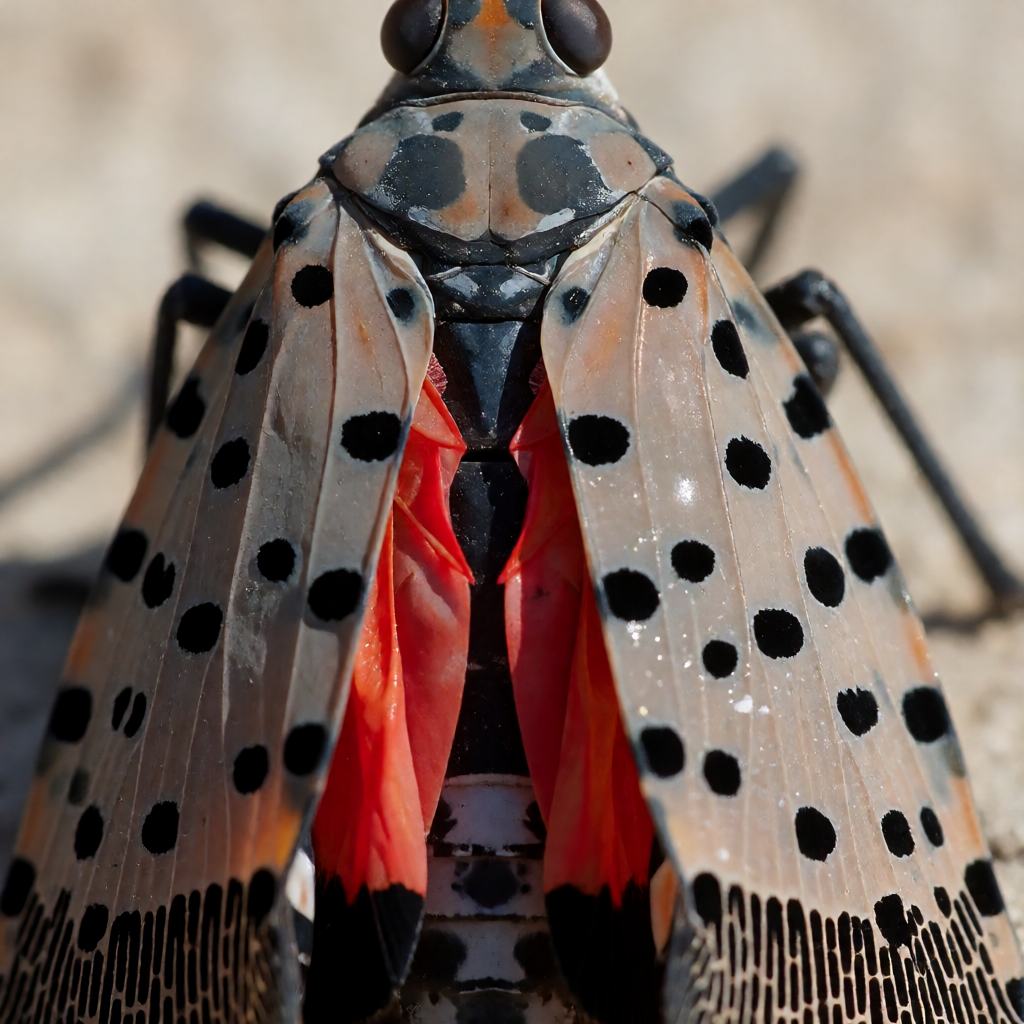
Adults measure about 2.5 cm from the head to the tip of the wing. Forewings are pale grey with black spots. They fold flat. Hindwings are red at the base, with black tips and a white band across them.
That red shows only when the insect opens its wings to jump. Abdomen is yellow with black bands along the side, and it shows when the wings open. Legs are black, and the hind pair carries strong muscles, so the insect can clear a metre. A young nymph looks nothing like the adult it will become.
First three stages are black with white dots, and they walk more than they jump. Stage four turns red, and it jumps well. Head is short and rounded, with two small eyes at the side and a blunt face.
1
2
3
Spots, red and black
Where it lives
This species lives on trees and vines, and it prefers one host above all others. Tree of heaven, Ailanthus altissima, draws the largest groups by far. That tree came from China too. The insect followed it.
Orchards and vineyards also hold the bug, since sap is sap wherever it runs. Adults gather on trunks in late summer, and they mate there, although they keep feeding until the first frost. Eggs go on bark and stone. They also ride on rail cars.
Females coat each mass in wax. That smear hides the eggs from birds and from people looking for them. Movement by road and rail explains the long jumps between states, since eggs travel well. One infested load can start a new population a thousand kilometres away.
Tree of heaven and orchards
What it eats
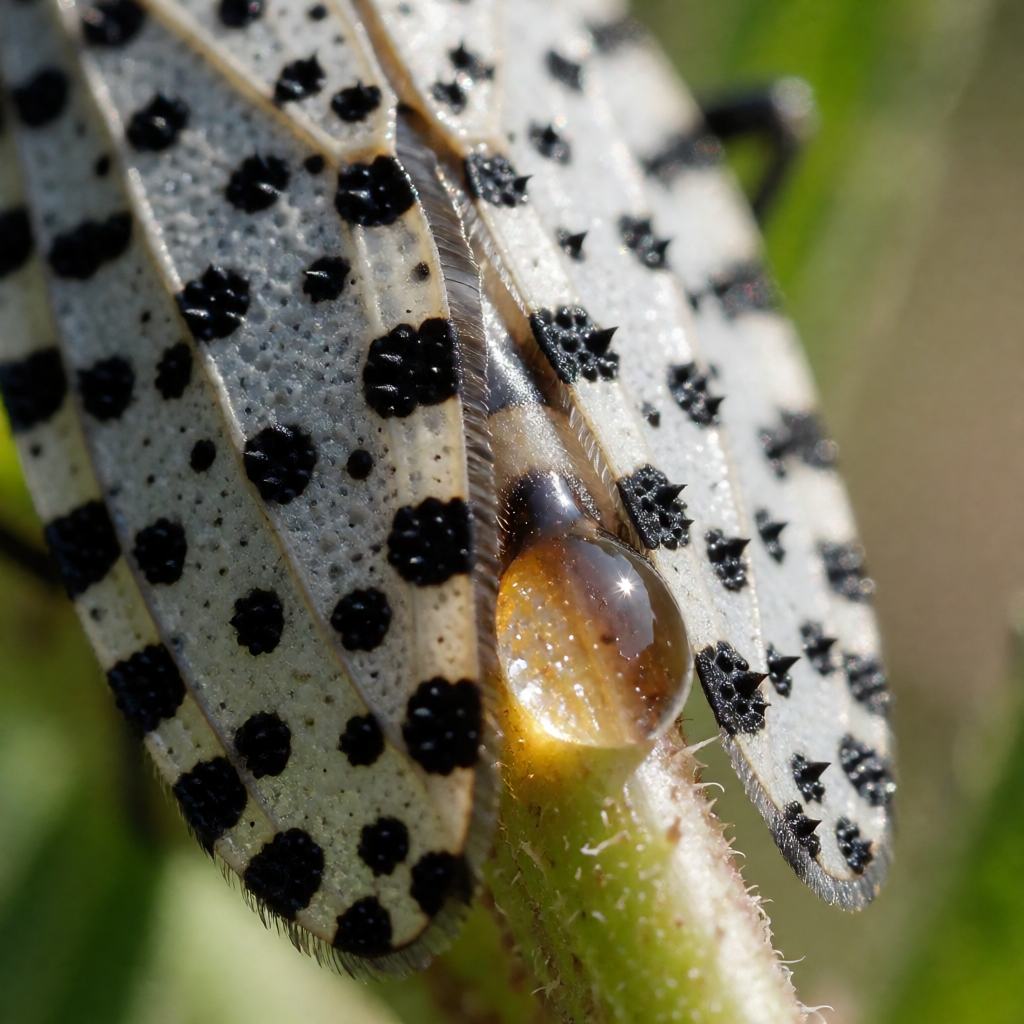
This bug drinks sap from the phloem of a plant, and it needs a great deal of it. It takes far more sugar than it uses, so the rest leaves the body as honeydew. Honeydew falls on leaves and fruit, and sooty mould grows on the film. Sooty mould blocks light, and the plant then weakens through the season.
More than seventy plants appear on the host list. Grape suffers most, since the vine has little reserve to draw on. Feeding also wounds the bark, and a wound invites disease in wet weather. Nothing in the diet comes from animals, and no prey is hunted.
A heavy group can drain a young tree in a single summer. Damage shows first as a sticky leaf, and later as a dead branch.
Sap taken in bulk
The breeding cycle
Adults appear in July and stay until the first hard frost. Males court with a short jump and a flash of red wing. A female lays one or two masses before she dies, and each one sits under a waxy coat. Each mass holds thirty to fifty eggs in a tight row.
Eggs overwinter on bark. They hatch in May. Nymphs climb and feed. They fly after four stages.
The whole cycle takes one year, since the climate suits the insect. Warm springs bring earlier hatching, and that helps the bug spread. No enemy controls it here. A fungus kills some eggs in a wet winter, though the loss stays small.
Not Evaluated, and spreading
Conservation
The Red List has no rating for the species, since nobody counts it as threatened. The problem runs the other way. Growers fight the insect. Scraping egg masses is the cheapest method, though it takes time.
Trap trees of tree of heaven draw the insects into one place, while spray misses the rest. Spraying works, although it costs money and kills other insects too. Quarantine lines slow it down, although the insect still crosses them. Nobody predicts how far the insect will reach in the next decade.
Climate limits the north, though the south looks open, and the insect keeps moving. Pests with no enemy are a problem for a long time. The fight now costs millions a year, and the bug is still spreading.
Side by side
How It Compares
| Trait | Spotted Lanternfly | Firebug |
|---|---|---|
| Length | adults reach 2.5 cm, and the female grows larger than the male | adults reach 1.2 cm, and the sexes look alike |
| Colour | grey forewings with black spots, and red hindwings below | red body with black markings, and no spots at all |
| Food | sap from tree of heaven, grape and fruit trees | seeds of lime trees, and sap from stems |
| Young | four nymph stages, black with white dots | five nymph stages, red with black bands |
| Build | long wings that carry the adult for metres | short wings that cannot lift the body |
| Range | eastern Asia, and now an invader in North America | Europe and Asia, and common in city squares |
Common misreadings
What People Get Wrong
- People often think the insect bites people, yet it only sucks sap from plants. The real damage comes from honeydew, which coats the leaves and feeds black mould.
- A common tale says the species flies far, although most adults stay near the tree they left. Nymphs walk up trunks in spring, and they gather in crowds before the first moult.
- Guides state that the red wings warn birds, yet the colour shows only in flight. On bark the grey forewings hide the animal, since the pattern matches the surface.
Going further
Sources and Further Reading
Quick hits
Five things to remember
- Grey wings carry black spots.
- Red hindwings flash when it jumps.
- It feeds on more than seventy plants.
- It never gives off light.
- One egg mass holds thirty to fifty eggs.