 By Iris
Pinus longaeva | Great Basin Bristlecone Pine
Species Profile · Pinaceae
Great Basin Bristlecone Pine
A slow growing pine of the dry Great Basin whose twisted trunks have stood for more than 4800 years.
Least Concern (2011)
Height
Trunk width
Needles
Oldest tree
Altitude
Rating
Slow growth, very long life
Grey ribbons that have lived for millennia
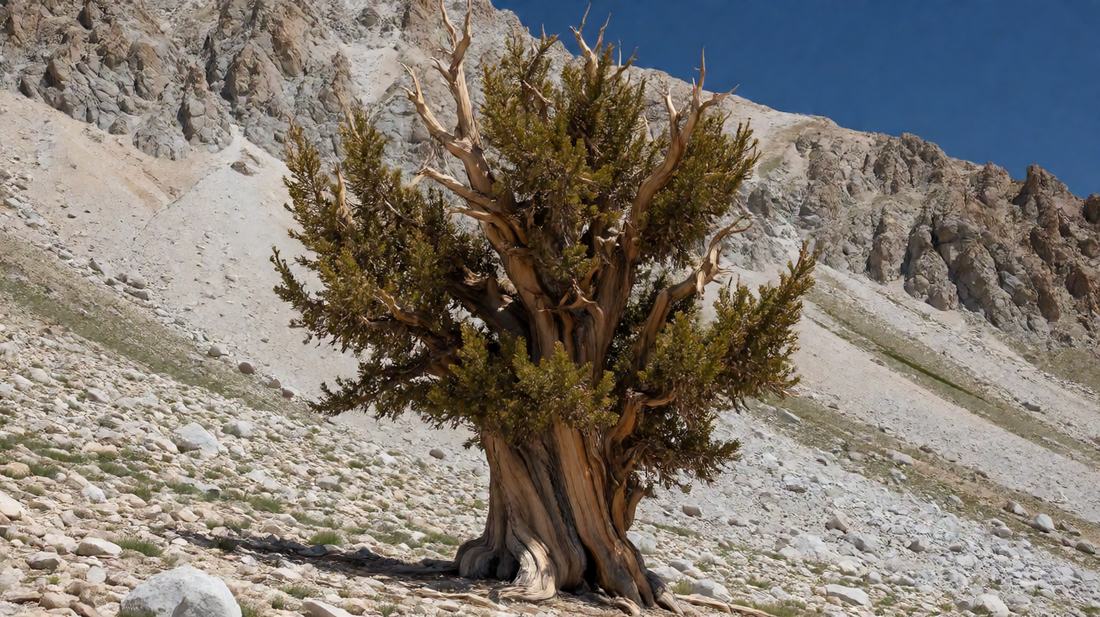
A gnarled tree stands on a dry ridge. Its trunk twists into grey ribbons. Some of the wood died long ago. A narrow strip still lives.
Needles grow in bundles of five. Growth is very slow. Age does not kill the tree. Rot and insects rarely take hold.
Wood stays hard for centuries. Some trees are more than 4800 years old. Because the wood is dense and full of resin, rot cannot spread through the trunk the way it does in softer pines. Since a thin strip of bark can keep feeding the whole crown, a damaged tree may outlive its own scars by many centuries.
Family tree
Pinaceae, the pine family
This tree is a pine. It sits in a small group of pines. Two of the group grow in the western states. The third belongs to California alone.
Fossils of close kin are old. Unlike a pine from a wet lowland forest, which adds a wide ring each year, this species adds a ring too thin to see. Its needles come in fives. Most pines carry two or three.
Because the group members look alike, only a cone can tell them apart. In addition, the group is very old. Likewise, the line has changed little.
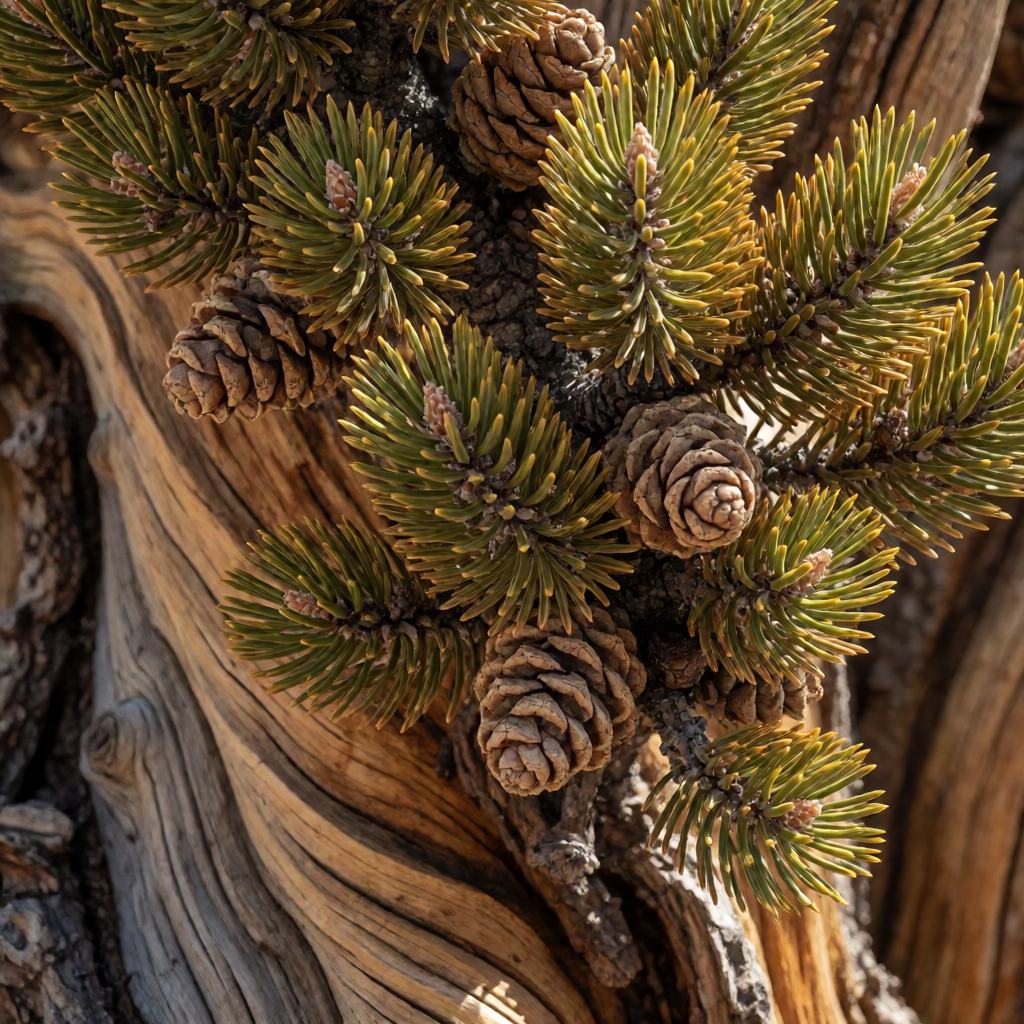
Five needles in a bundle
How to tell one
Needles run from 2 cm to 4 cm. Each bundle holds five needles. A waxy coat seals the surface. Branches twist as they age. Bark forms thin grey strips.
Old wood turns smooth and pale. Trunks reach about 15 m tall. Trunk width runs to 2 m. A 30 cm trunk may be a century old. Wood is dense and full of resin.
Resin blocks rot and insects. Cones need two years to ripen. Cone scales carry a sharp bristle. Meanwhile, the shape of the crown depends on how much bark has died away over the long centuries. Because the needles live for 20 years or more, the tree keeps its food factories for a very long time.
1
2
3
Dry high ridges of the Great Basin
Where it lives
High ridges suit the tree. Utah, Nevada and California hold it. Dry rocky ground is common. Limestone and dolomite rock work best. Altitude runs from 1700 m to 3400 m.
Rain is scarce. Snow supplies most of the water. Winters are long and cold. Summer nights drop near freezing. Wind strips moisture from the needles.
Soil holds few nutrients there. For instance, few other trees can grow on such poor, dry ground. Therefore, the pines stand far apart on open slopes. Although the sites look harsh, they shield the trees from fire, from rivals and from nearly all insects.
Sunlight and snow melt
What it eats
Food is made from sunlight. Needles capture light all year. Water comes from snow melt. Roots spread wide and shallow. Minerals come from broken rock.
Growth stops in cold spells. Sugar moves to the roots in winter. Stored sugar keeps the tree alive. In turn, a slow pace means the tree needs far less water each year than a fast-growing pine does. Indeed, a tree on a dry ridge may add less than a millimetre of wood in a whole season.
Thus, the wood that does form is unusually dense. Of course, a dense trunk resists both rot and insect damage. Nevertheless, growth remains slow even in a wet year.
Cones that ripen over two years
The breeding cycle
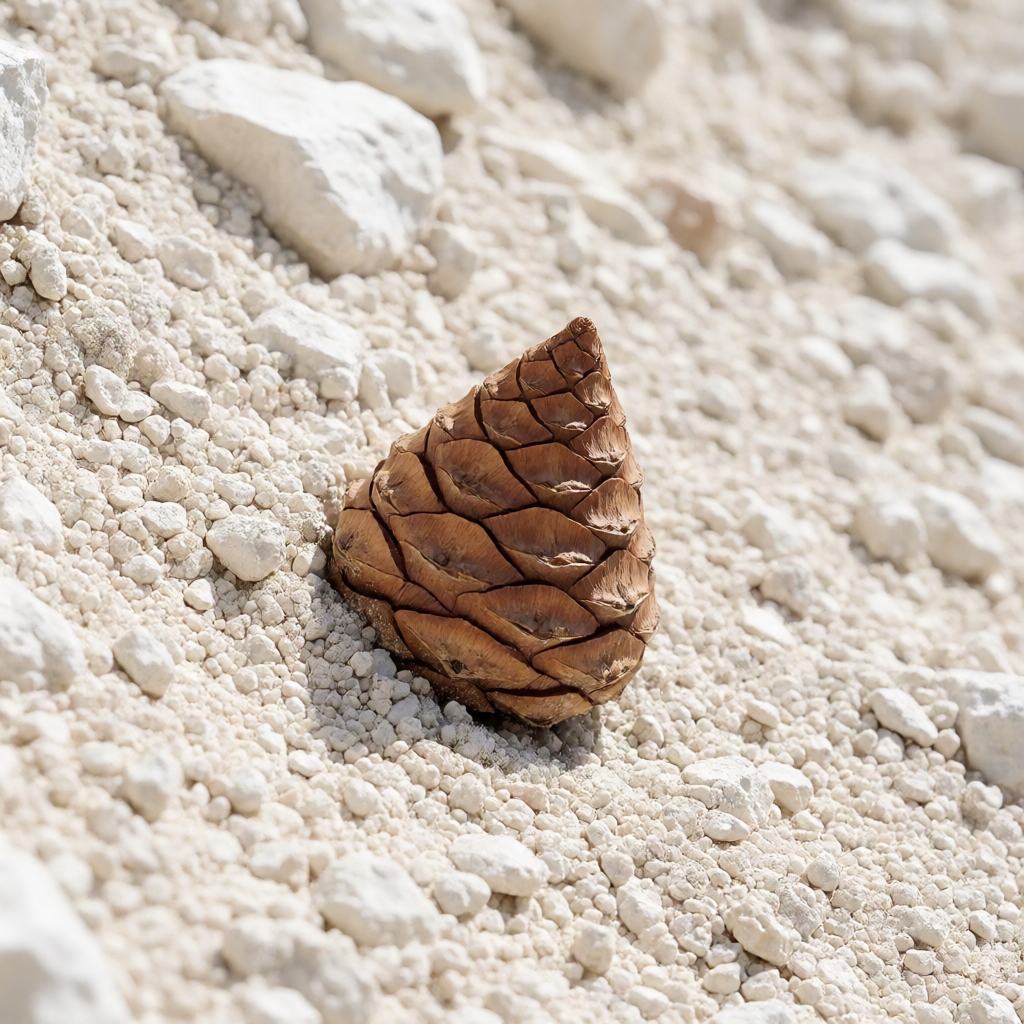
Cones appear on the outer branches. Wind carries the pollen. Each cone ripens over two years. Seeds sit under the cone scales. A bird takes the seeds.
Nutcrackers hide seeds in the ground. Some hidden seeds sprout. Most are eaten or lost. Seed crops vary from year to year. A heavy crop comes every few years.
Similarly, a seedling needs a wet spell to start. Yet a young tree may wait decades for the right summer. Likewise, shade helps a seedling at first, and a nurse shrub can make the difference between life and death. Because so few seeds become trees, a grove may hold only a handful of young plants. Although the tree lives for thousands of years, it replaces itself more slowly than almost any other pine in the world.
Least Concern since 2011
Conservation
The species is rated Least Concern. That global assessment appeared in 2011. Its range is small but remote. Few people visit the sites. Insects are the main threat.
Bark beetles attack old trees. Warmer winters help the beetles. Drought stresses the pines. Blister rust has reached some stands. Still, the wood resists rot for centuries.
By contrast, a dead tree may stand for a thousand years before it falls. Even so, no sharp decline has been recorded. Because the oldest trees grow in a few small groves, a single fire could erase thousands of years of history. Although the sites are protected, a hotter climate may change them far faster than the trees can adapt.
Side by side
How It Compares
| Trait | Great Basin Bristlecone Pine | Giant Sequoia |
|---|---|---|
| Group | genus Pinus | genus Sequoiadendron |
| Height | about 15 m | up to about 90 m |
| Trunk | gnarled, often 2 m wide | massive, up to 8 m wide |
| Needles | bundles of 5 | short sprays |
| Home | dry high ridges, 1700 m to 3400 m | moist groves of the Sierra Nevada |
| Best known for | the oldest known individual trees | the largest trees by volume |
Common misreadings
What People Get Wrong
- Age records usually call this the oldest living thing. Each trunk dies back in strips, yet only part stays alive.
- People assume great age needs rich soil. Poor, dry rock supports the oldest groves.
- A tree of 4800 years looks fragile. Cones and fertile seed are still produced, yet the trunk is mostly dead wood.
Going further
Sources and Further Reading
- Wikipedia, Great Basin bristlecone pine
- Plants of the World Online, Royal Botanic Gardens Kew. Pinus longaeva D.K.Bailey.
- GBIF Backbone Taxonomy. Pinus longaeva.
- IUCN Red List of Threatened Species. Pinus longaeva (Least Concern, assessed 2011).
Quick hits
Five things to remember
- Its wood helped calibrate radiocarbon dating.
- Trees aged 4800 years still make cones.
- The oldest groves sit on poor rock.
- Fallen wood can lie intact for centuries.
- A single trunk may split into many stems.