 By st20113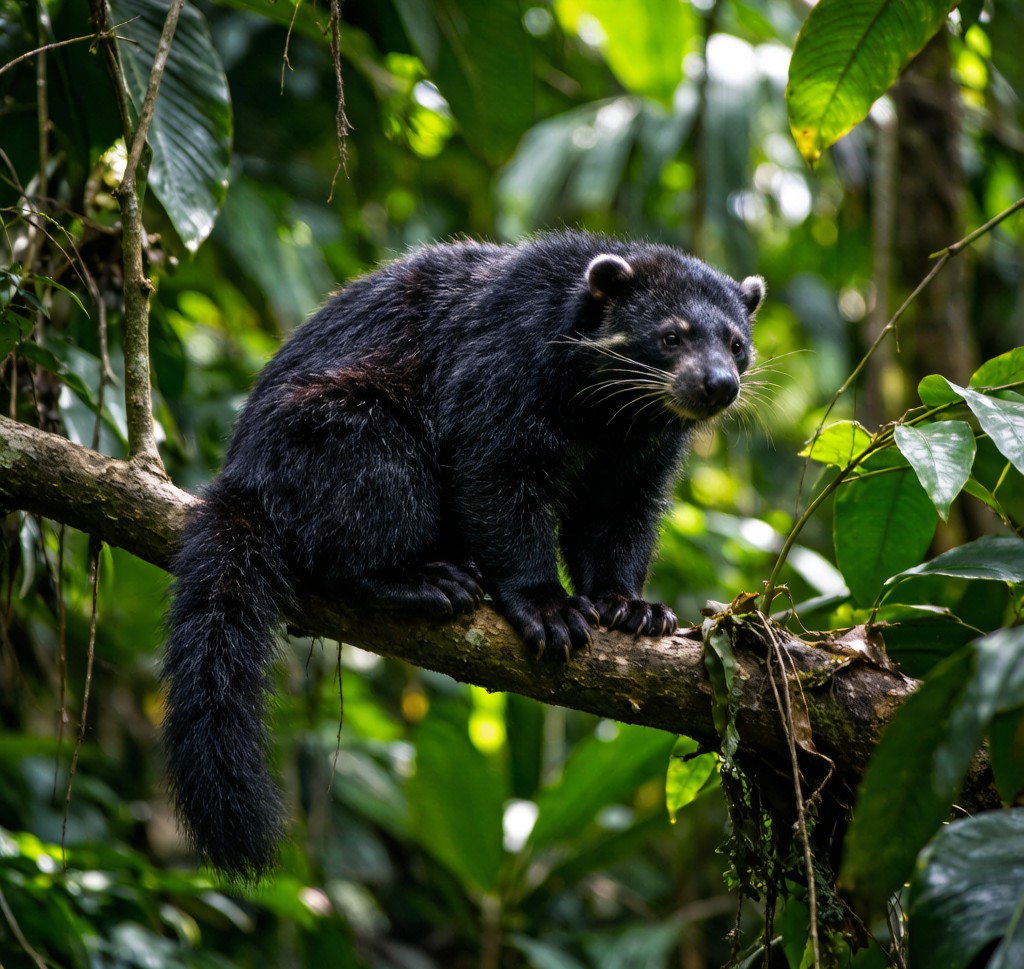
The Binturong (Arctictis binturong) – also known as the bearcat, though it is neither a bear nor a cat – is one of the most distinctive and unusual mammals in the forests of South and Southeast Asia.
Overview
The Binturong (Arctictis binturong) – also known as the bearcat, though it is neither a bear nor a cat – is one of the most distinctive and unusual mammals in the forests of South and Southeast Asia. The binturong is the largest member of the Viverridae family (civets and genets), weighing 9 to 20 kilograms and reaching body lengths of 60 to 95 centimeters, with an additional 60 to 95 centimeters contributed by its remarkable prehensile tail. The species’ most memorable features are its shaggy, entirely black coat – which is粗 (coarse) and long, giving the animal a perpetually disheveled appearance – and its enormous, fully prehensile tail, which is unique among carnivorans in being fully capable of supporting the animal’s entire body weight while hanging from a branch.
The binturong’s taxonomy has been a subject of scientific debate for over a century. The species was originally classified with the civets and genets within the Viverridae family, but more recent genetic studies have placed it within the family Herpestidae (the mongoose family) or in its own family (Arctictidae). For most of its history, the binturong has been classified with the civets, and its common name – bearcat – reflects its unusual combination of features: the bear-like body and shaggy coat, and the cat-like face and movements. Despite its size, the binturong is a skilled climber that spends most of its life in the forest canopy.
Habitat and Behavior
The Binturong is found in the tropical and subtropical forests of South and Southeast Asia, from southern China and the eastern Himalayas through mainland Southeast Asia to the Indonesian islands of Sumatra and Java. The species is primarily nocturnal and arboreal, spending most of its life in the forest canopy where it navigates through the branches using its remarkably flexible prehensile tail as a fifth limb. The binturong is a skillful climber that can descend tree trunks head-first – a feat that requires unusual flexibility and specialized ankle joints – and can hang upside-down from branches using its tail alone. The species is a poor terrestrial walker, moving clumsily on the ground with a characteristic shuffling gait.
Despite its classification as a carnivoran, the binturong’s diet is primarily frugivorous (fruit-eating): the species feeds on a wide variety of tropical fruits including figs, bananas, mangos, and the fruits of several palm species, and is an important seed disperser in the forests it inhabits. The binturong also supplements its fruit diet with insects, small vertebrates, birds, fish, and carrion. The species has a keen sense of smell – as evidenced by its musk-gland secretions, which produce a distinctive scent reminiscent of popcorn or warm leather – which it uses to locate food and to communicate with other binturongs through scent marking.
Scent Communication
One of the binturong’s most distinctive and scientifically fascinating features is its complex system of scent communication. Like many viverrids and mustelids, the binturong has specialized scent glands – located in the anal and perineal regions – that produce a musk-like secretion used for territorial marking and individual recognition. Binturongs mark their territory by dragging their scent glands across branches, tree trunks, and other objects, leaving behind a distinctive scent that can be detected by other individuals for days or weeks. The scent of a binturong has been described by researchers as reminiscent of warm leather, stale popcorn, or a combination of the two – a distinctive aroma that allows researchers to detect the presence of the species in forest areas where direct observations are rare.
Recent research has revealed that the binturong’s scent glands produce a compound called 2-acetyl-1-pyrroline (2-AP), which is also responsible for the distinctive aroma of freshly cooked popcorn and certain varieties of fragrant rice. This compound is produced by the interaction of amino acids and reducing sugars during the Maillard reaction, and its presence in binturong scent suggests that the animal’s metabolism may involve unique biochemical pathways for producing scent compounds. The function of 2-AP in binturong scent communication is not yet fully understood, but it may serve to enhance the longevity or detectability of the scent mark.
Conservation
The Binturong is listed as Vulnerable on the IUCN Red List, reflecting significant population declines driven primarily by habitat loss and degradation. The species’ dependence on tropical forest makes it highly vulnerable to deforestation – the extensive clearing of rainforest throughout Southeast Asia for palm oil, pulp, and timber production has dramatically reduced and fragmented the binturong’s habitat. Forest fragmentation also isolates populations and reduces genetic diversity, making populations more vulnerable to inbreeding and local extinction.
Beyond habitat loss, the binturong is also threatened by direct exploitation: the species is hunted for its meat, which is consumed in parts of its range, and for its alleged medicinal properties, which are promoted without scientific basis in some traditional medicine systems. The binturong is also captured for the illegal wildlife trade – both for use as a pet and for the production of traditional medicine – and is sometimes killed by farmers who perceive it as a threat to crops or poultry. The binturong’s slow reproductive rate – females give birth to only 1 to 3 young every 2 to 3 years – makes populations highly vulnerable to adult mortality and slow to recover from population declines.