 By st20113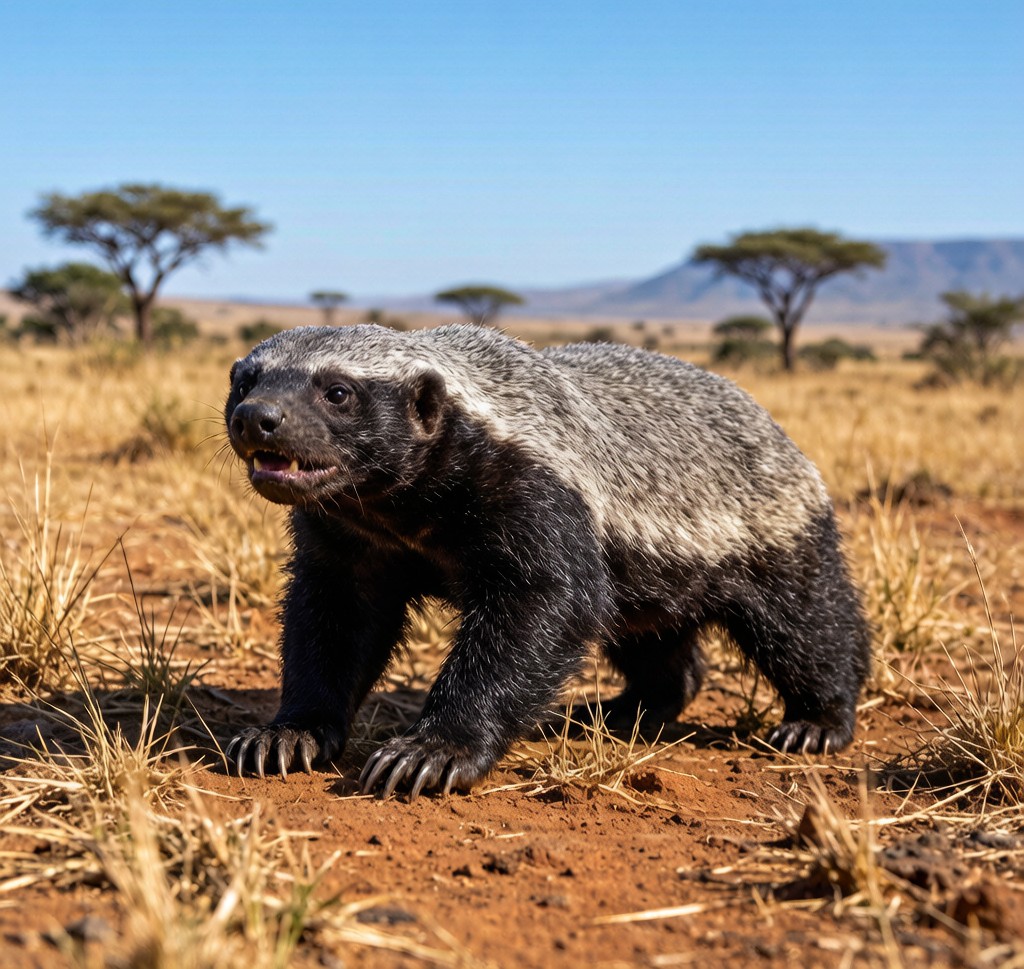
Overview
The Honey Badger (Mellivora capensis), also known as the ratel, is widely regarded as the most fearless and resilient animal on Earth – a compact, powerfully built mustelid that inhabits much of sub-Saharan Africa, the Middle East, and the Indian subcontinent. Despite its relatively small size – adults weighing 7 to 16 kilograms – the honey badger has earned a legendary reputation for ferocity, toughness, and an almost supernatural ability to survive attacks from much larger predators. Its broad, flat body, thick loose skin, and formidable claws – up to 4 centimeters long – make it a formidable opponent even for lions and hyenas, and the species is famously undeterred by bee stings, snake bites, and other threats that would incapacitate other animals.
The honey badger’s most distinctive physical feature is its striking black-and-white coloration: the entire underside of the body – from the chin to the anus, including the legs and tail – is jet black, while the upperparts are a broad, pale silver-grey. This striking color pattern – which makes the animal look almost as if it has been split in half – is thought to serve as a warning display (aposematism) that advertises the honey badger’s formidable defenses to potential predators. The skin is exceptionally thick and loose, allowing the honey badger to twist and turn freely when gripped in a predator’s jaws and to inflict serious bites on its attacker.
Diet and Foraging
The honey badger is one of the most omnivorous mammals in its range, eating almost anything it can catch, dig up, or pry open. The species’ diet includes small mammals (rodents, hares, mongoose), reptiles (snakes, lizards, tortoises), birds and their eggs, insects (especially beetle larvae and scorpions), centipedes, frogs, and carrion. The honey badger is also famous for its ability to tackle venomous prey with impunity: it regularly eats snakes – including puff adders, Cape cobras, and even large black mambas – and is famously resistant to snake venom, which it neutralizes through a combination of thick, loose skin that is difficult for fangs to penetrate and a degree of physiological resistance to the venom itself.
The honey badger’s most famous food-related behavior is its association with the greater honeyguide bird – a species that has evolved a mutualistic relationship with the badger (and with humans) in which the bird leads the badger to wild beehives, waits for the badger to break open the hive with its powerful claws, and then feeds on the wax and bee larvae that remain after the badger has eaten the honey. This remarkable partnership – between a bird and a mammal, based on a shared taste for honey and beeswax – is one of the most celebrated examples of cross-species cooperation in the animal kingdom.
Behavior and Defense
The honey badger’s legendary fearlessness – immortalized in the Guinness Book of Records as “the most fearless animal in the world” – is backed up by extraordinary physical and behavioral adaptations. When threatened, the honey badger responds with a characteristic defensive display: it raises its hindquarters, flares its anal glands, and releases a foul-smelling secretion while letting out a low, growling warning call. If this display fails to deter the threat, the honey badger attacks with remarkable aggression, using its sharp claws and powerful jaws to fight back against animals many times its size. The thick, loose skin that characterizes the species allows it to absorb bites and scratches that would severely injure a thinner-skinned animal.
The honey badger is primarily nocturnal but is frequently active during the day, especially in cooler seasons. It is an excellent digger, excavating burrows to rest in during the heat of the day and to access underground prey including tubers, roots, and burrowing rodents. The species is largely solitary, with adults coming together only to mate. Males and females maintain overlapping home ranges of approximately 500 square kilometers, within which they forage independently. Despite its reputation for aggression, the honey badger is generally shy and avoids human contact, though it can be a significant nuisance to beekeepers and poultry farmers.
Conservation
The Honey Badger is listed as Least Concern on the IUCN Red List, reflecting its wide distribution, relatively large population, and apparent adaptability to a range of habitats including agricultural areas. However, the species faces localized threats in parts of its range, including habitat loss, persecution by farmers who view it as a pest (it raids beehives and occasionally kills livestock), and incidental capture in traps set for other animals. The honey badger is considered a pest species in some countries, and bounties or legal protection (or the removal of protection) vary widely across its range.
The species is protected in South Africa, where it is listed as protected under the National Environmental Management: Biodiversity Act, though enforcement of this protection is inconsistent. In India, the honey badger is listed on Schedule I of the Wildlife Protection Act, providing it with the highest level of legal protection. Research on honey badger populations is limited by the species’ secretive, nocturnal habits and vast home ranges, making population monitoring challenging. Conservation efforts in some areas focus on reducing human-wildlife conflict through improved beehive security and compensation schemes for livestock losses.