 By Iris
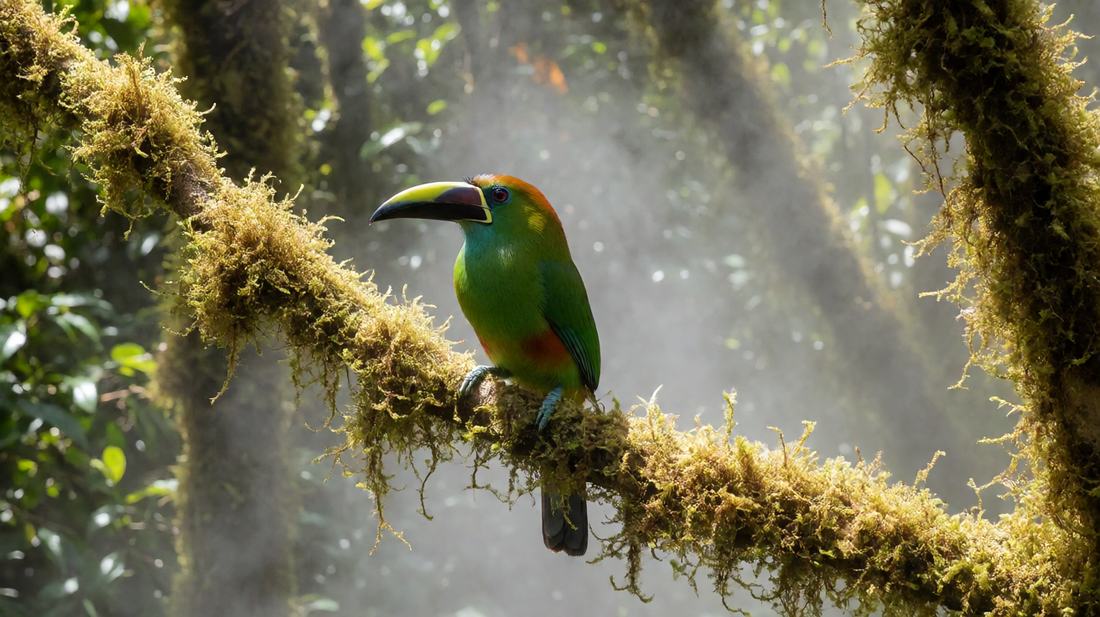
Aulacorhynchus prasinus | Emerald Toucanet
Species Profile · Ramphastidae
Emerald Toucanet
A small green toucan of cloud forest that nests in an old woodpecker hole and hardly ever leaves its territory.
Least Concern (2022) 2022 assessment
Length
Weight
Eggs
Hatch
Altitude
Rating
The Emerald Toucanet
Green toucan of the cloud forest
This small toucan lives in the cloud forests of Central America. Green feathers cover the whole body. A short black bill carries a white band near its base.
Adults reach about 35 cm, and half of that is tail. They weigh roughly 160 g. Because the bird stays inside the tree tops, most people hear it long before they see it.
Its call sounds like a croaking frog rather than a bird. Pairs keep in touch with a steady, low rattle. Groups of 4 to 10 birds drift through the wet leaves, and because their green bodies match the moss and ferns, a whole flock can feed overhead without giving itself away.
Family tree
Ramphastidae, the toucans
This bird sits in the toucan family, Ramphastidae. A French naturalist, Lesson, named it in 1830. He gave it a new genus, which means flute bill. That name refers to the long, narrow upper mandible.
For 150 years, naturalists treated every green toucanet as one species. Genetic work overturned that view. Several distinct forms now hold full species rank. Its closest large relative is the Toucan.
No subspecies is accepted today, although northern birds show a bluer throat. Because the split happened so recently, older field guides still describe one wide-ranging bird, and careful watchers now record several separate species on the same mountain.
35 cm of green
How to tell one
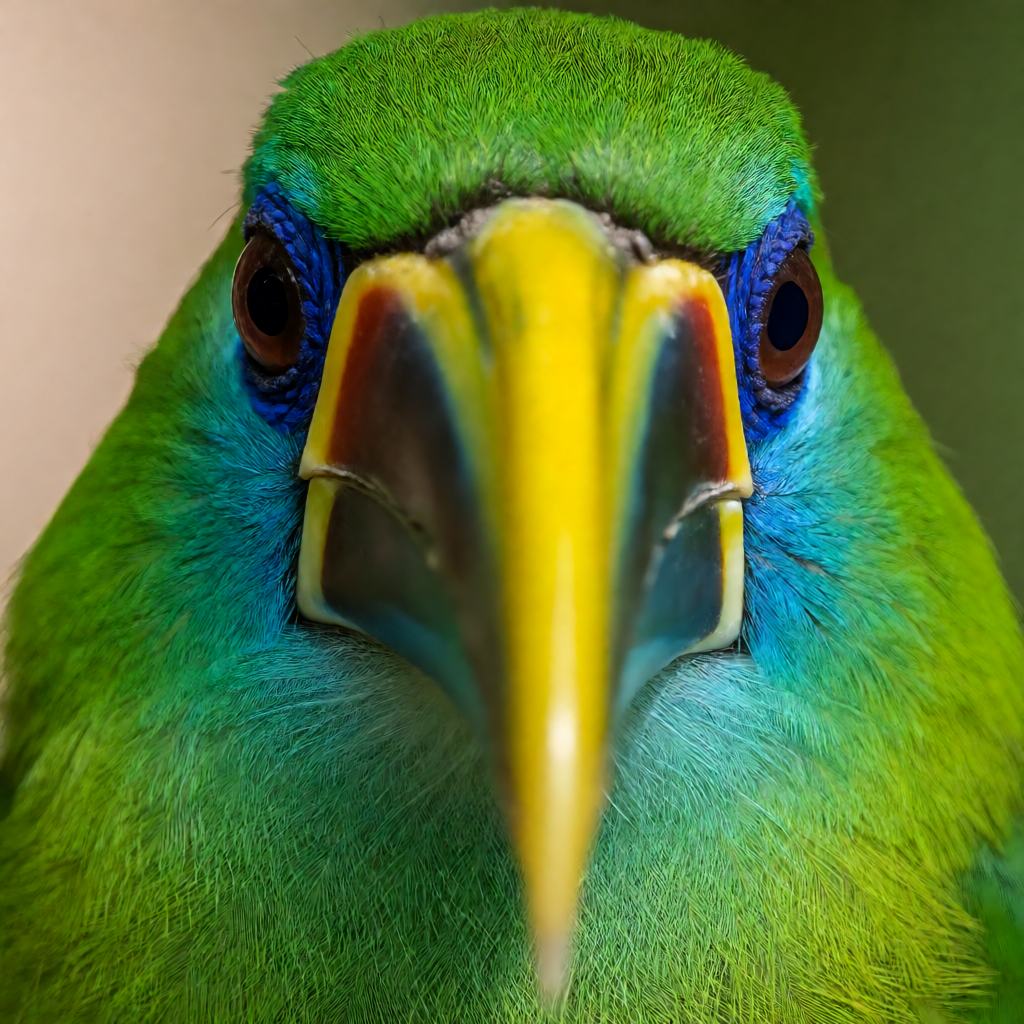
Adults wear green from the crown to the tail tip. The underparts look a little paler. A chestnut patch sits under the tail. Bare blue skin rings each eye, though the head stays green.
Males and females look much the same. The bill measures 5 cm to 7 cm. Despite that size, the bill is light and hollow. Tiny serrations line the cutting edge.
That edge helps the bird grip fruit and small prey. Because the wing is short and rounded, the toucanet flits between branches instead of gliding, and it rarely crosses a gap wider than a few dozen metres.
1
2
3
Cloud forest and shade coffee
Where it lives
Humid montane forest is the main home. Most birds live between 900 m and 3,000 m. Cloud forest above 1,500 m holds the densest numbers. The range runs from eastern Mexico to Nicaragua.
Moss coats the branches where these birds feed. Epiphytes crowd every trunk. Coffee farms with shade trees also suit them. Indeed, such farms can hold more birds than open pasture.
Clear cutting, however, remains the biggest threat to the trees. Although the toucanet tolerates some disturbed ground, it needs tall, old trees with holes for nesting, and those trees vanish first when a slope is cleared.
Fruit, insects and eggs
What it eats
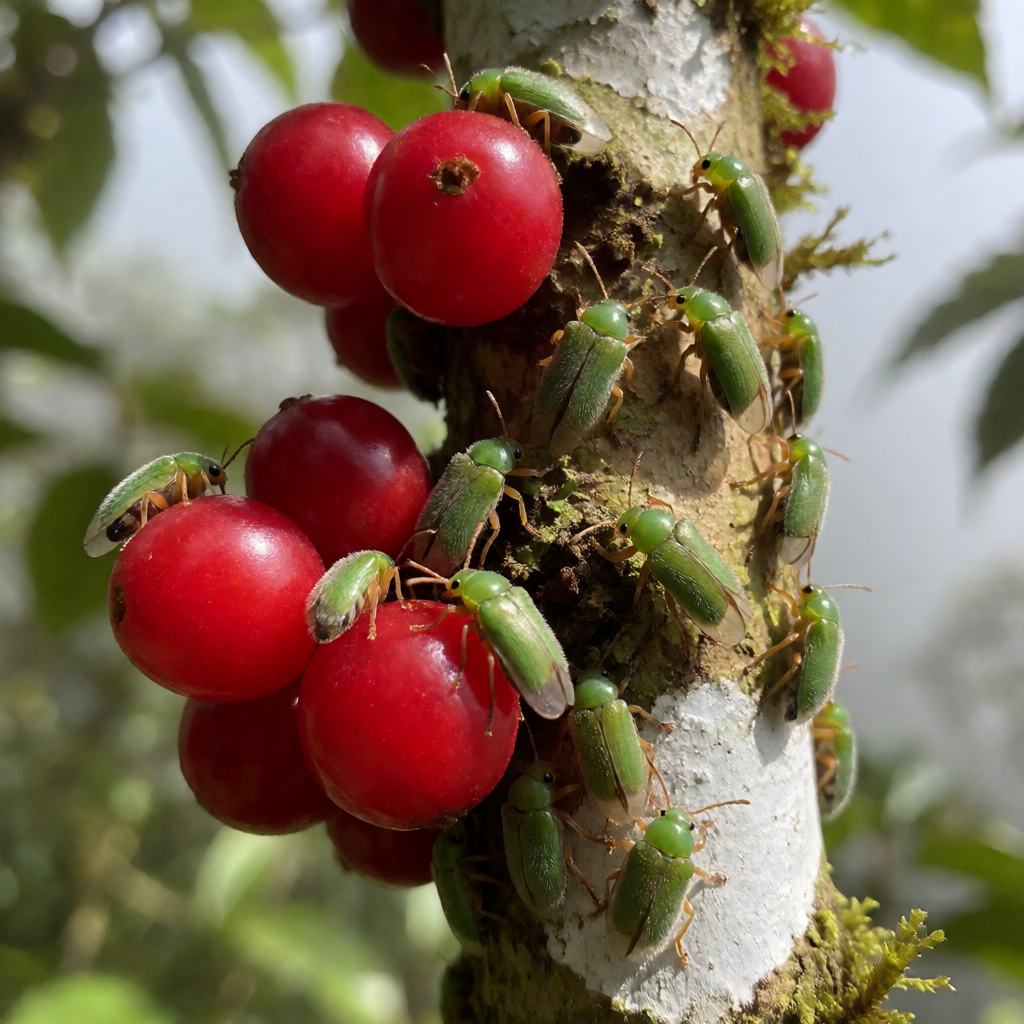
Fruit makes up most of the diet. Berries and drupes come first. The bird swallows them whole and spits out the stone. Insects supply extra protein.
Beetles, ants and caterpillars are taken from leaves and bark, as well as from the air. Small frogs and lizards are eaten too. Some pairs raid other nests, while others stay on fruit. They take eggs and nestlings when food runs short.
Chicks need far more insects than adults do. Because the bird carries fruit far from the parent tree, it acts as a seed disperser, and many forest shrubs depend on that service.
A hole in a dead tree
The breeding cycle
Pairs bond for years. The nest sits in an old woodpecker hole. Both birds may enlarge the entrance. A clutch holds 1 to 4 white eggs.
Incubation takes about 16 days. Both parents share the sitting. Chicks hatch blind and bare. They fledge after roughly 6 weeks.
Juveniles follow their parents for months, though they soon feed alone. Breeding starts at about 2 years.
Least Concern, but falling
Conservation
The IUCN lists this bird as Least Concern. The global assessment dates from 2022. Numbers are falling, however. Deforestation drives the decline.
Each year the range loses more forest. Climate change pushes cloud belts uphill. Birds cannot move higher forever. Coffee grown under shade helps them.
So does keeping dead trees standing. Because so much of the population lives outside protected parks, ordinary farmland and roadside forest will decide whether the decline continues.
Side by side
How It Compares
| Trait | Emerald Toucanet | Keel-billed Toucan |
|---|---|---|
| Length | 35 cm | 50 cm |
| Bill | 7 cm | 15 cm |
| Weight | 160 g | 400 g |
| Colour | green all over | black with a yellow chest |
| Breeding height | 900 m to 3,000 m | below 1,000 m |
| IUCN status | Least Concern | Least Concern |
Common misreadings
What People Get Wrong
- Only the giant birds count as toucans. This one is a toucan too.
- Green toucanets form one species. Genetic work split them apart.
- That bill looks heavy. It is hollow and light.
Going further
Sources and Further Reading
- IUCN Red List entry for Aulacorhynchus prasinus
- Wikipedia, Emerald toucanet
- BirdLife International. Species factsheet: Aulacorhynchus prasinus.
- Short, L. L. and J. F. M. Horne. Toucans, Barbets and Honeyguides. Oxford University Press.
Quick hits
Five things to remember
- Its call sounds like a frog, not a bird.
- That bill looks heavy but is hollow.
- One pair may keep the same hole for years.
- It can swallow fruit as wide as its own head.
- Shade coffee farms often hold more birds than nearby forest.