 By st20113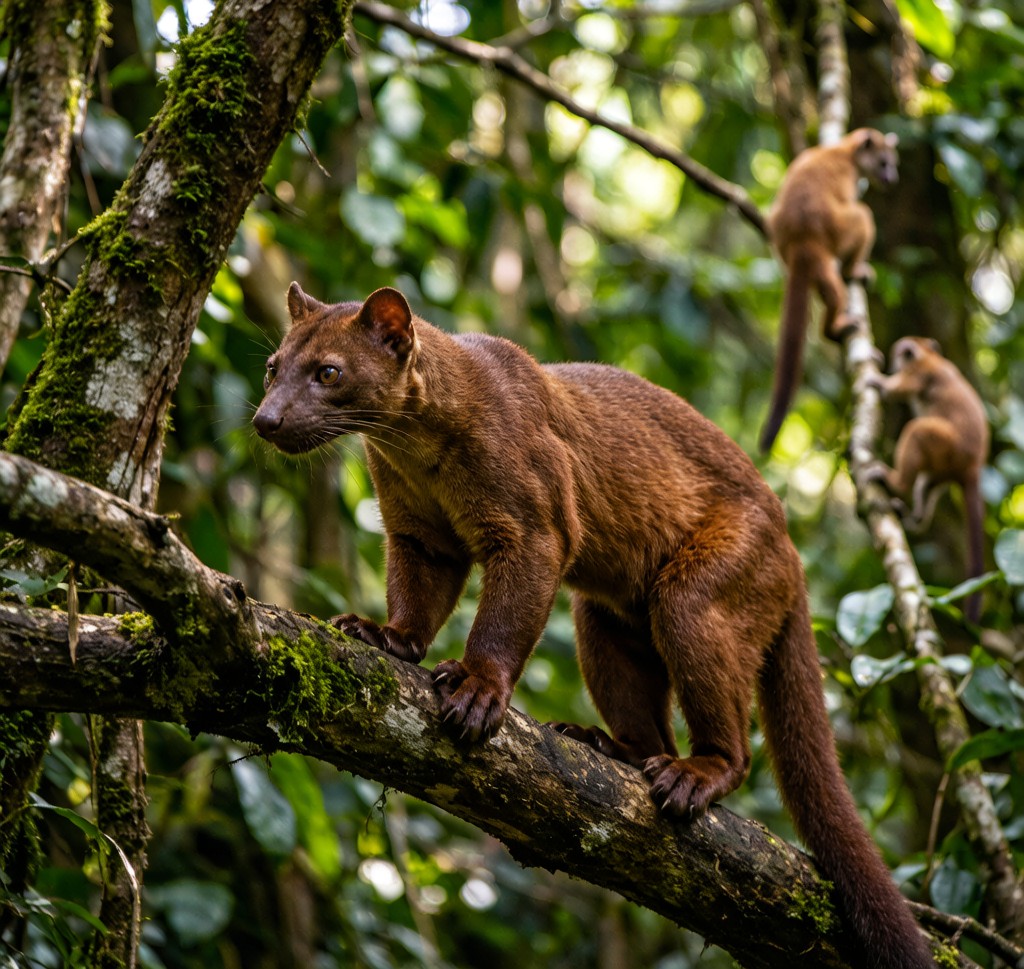
A Fossa (Cryptoprocta ferox) on a tree branch in the Madagascar rainforest, showing its cat-like body and long tail
Overview
The Fossa (Cryptoprocta ferox) is Madagascar’s largest native carnivore – a sleek, cat-like predator that is the top predator of the island’s unique forest ecosystems. Often described as resembling a cross between a cougar and a large mongoose, the Fossa is one of the most unusual and least-known carnivores in the world, with a combination of features that make it uniquely adapted to hunting in the forest canopy. The species stands approximately 30 to 37 centimeters at the shoulder and measures 60 to 80 centimeters in body length, with an additional 60 to 70 centimeters of tail – giving it a total length of up to 1.5 meters, making it the largest carnivore in Madagascar. Despite its impressive size, the Fossa weighs only 5 to 10 kilograms, reflecting its slender, elongated build.
The Fossa’s most remarkable feature is its semi-retractable claws and extraordinarily flexible ankle joints – unique among carnivores – which allow it to descend trees headfirst and move through the canopy with the agility of a primate. The Fossa is the primary predator of lemurs – Madagascar’s endemic primates – and its population dynamics have a direct influence on the behavior, distribution, and evolution of lemur species throughout the island. The Fossa is the sole member of its family (Eupleridae) and one of the most distinctive endemic carnivores on Earth, found nowhere outside of Madagascar.
Habitat and Distribution
The Fossa occurs throughout Madagascar, from the dry deciduous forests of the west and south to the humid rainforests of the east, and from sea level to altitudes of over 2,000 meters in the island’s highland forests. The species is most common in undisturbed primary forest, though it can survive in secondary forest and even in some agricultural landscapes if large trees and forest fragments are maintained. The Fossa requires large, contiguous areas of forest, as individuals maintain home ranges of approximately 20 to 40 square kilometers.
Madagascar is one of the world’s most important biodiversity hotspots, and the Fossa plays a critical role as the island’s apex terrestrial predator. The loss and fragmentation of Madagascar’s forests – driven by slash-and-burn agriculture (tavy), logging, and charcoal production – has significantly reduced the Fossa’s habitat and isolated populations in forest fragments. Forest fragments smaller than approximately 50 square kilometers may be too small to support viable populations of Fossa, making the species particularly vulnerable to the ongoing fragmentation of Madagascar’s remaining forests.
Hunting and Diet
The Fossa is an opportunistic predator that hunts primarily in the forest canopy, where its remarkable agility – including the ability to rotate its ankles nearly 180 degrees to grip the trunk while descending headfirst – gives it a hunting advantage over most other predators. The Fossa’s primary prey are lemurs, which can comprise up to 50 percent of its diet in some areas. The species is particularly associated with medium-sized lemurs including the Ring-tailed Lemur and various brown lemurs, and it is the only predator capable of regularly catching the largest lemurs including the Indri.
In addition to lemurs, the Fossa preys on tenrecs, rodents, reptiles including snakes and large chameleons, frogs, and insects. The species hunts primarily by stalking – moving quietly through the forest canopy and understory to approach prey undetected before launching a rapid attack. The Fossa is primarily diurnal and crepuscular, with a peak of activity around dawn and dusk, though it can hunt at any time of day or night. Uniquely among Malagasy carnivores, the Fossa is known to cache excess food – hiding kills in tree crevices or leaf litter – and return to them over subsequent days, a behavior that is more typical of tigers and other large predators than of a relatively small carnivore.
Reproduction and Conservation
The Fossa’s reproductive biology is poorly known in the wild due to its secretive habits, but studies of captive individuals and field observations have revealed some remarkable details. Females give birth to litters of 1 to 6 pups (typically 2 to 4) after a gestation of approximately 90 days. Pups are born in dens in hollow trees or rocky crevices and are entirely dependent on the mother for the first three to four months of life. Juveniles remain with the mother for approximately one to two years before dispersing, and females do not begin breeding until approximately four years of age.
The Fossa is listed as Vulnerable on the IUCN Red List, with populations declining as a result of habitat loss, direct persecution by humans who view it as a threat to poultry, and incidental trapping. Forest loss in Madagascar – which has lost approximately 90 percent of its original forest cover – is the primary long-term threat to the species. Conservation efforts focus on protecting large areas of continuous forest within Madagascar’s national park system, reducing human-Fossa conflict in areas where the species preys on poultry, and continuing scientific research into its ecology, population dynamics, and ranging behavior. The Fossa is also of significant cultural importance to Madagascar’s communities, featuring prominently in traditional stories and cultural beliefs.