 By st20113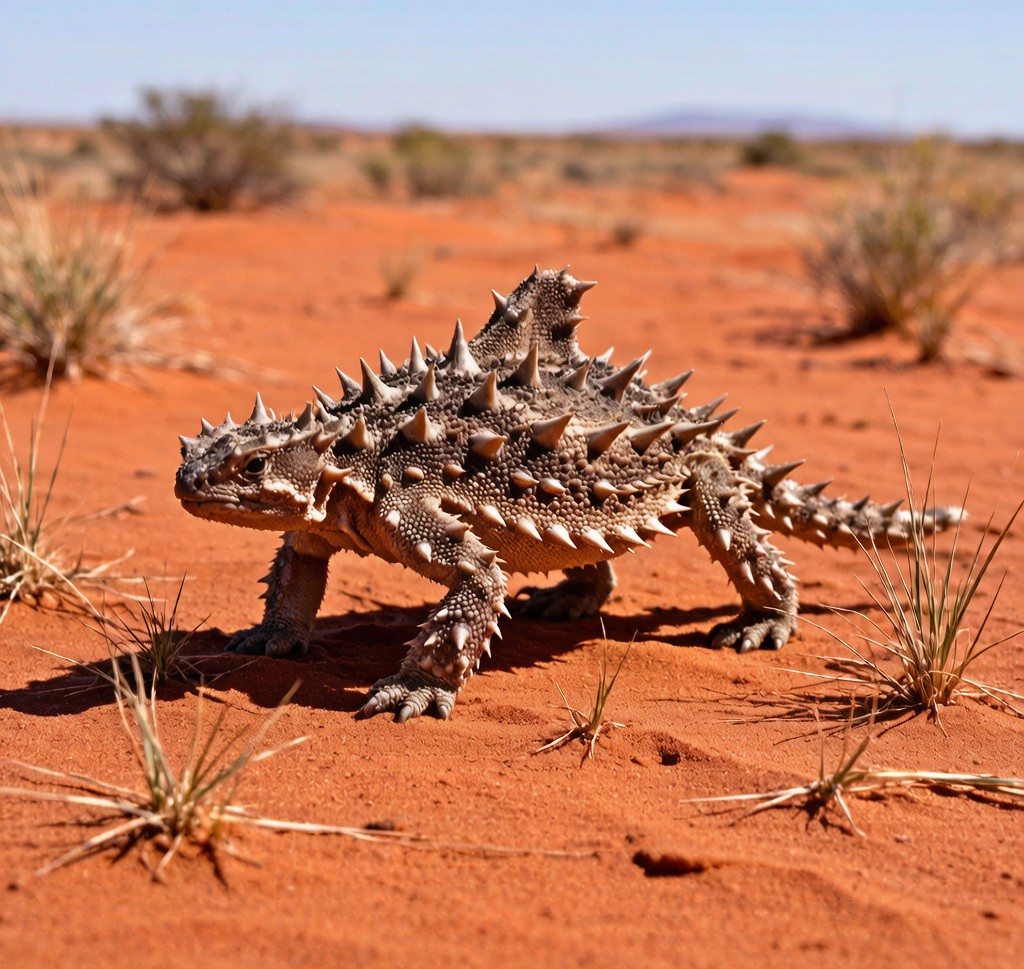
A Thorny Devil (Moloch horridus) walking across red Australian desert sand, displaying its extraordinary body covered in conical spines
Overview
The Thorny Devil (Moloch horridus) is one of the most bizarre and visually startling reptiles on Earth. Found exclusively in the arid and semi-arid regions of central and western Australia, the Thorny Devil is a small lizard – reaching only 20 to 23 centimeters in total length – that has evolved one of the most elaborate defensive armor systems in the animal kingdom. Its entire upper surface, from head to tail, is covered in uniformly spaced, sharply pointed conical spines of varying sizes, giving it the appearance of a small, spiny dragon or a piece of living cactus. The largest spines are arranged in regular rows along the flanks, around the eyes, and above each eye, giving the lizard a perpetually fierce and armored appearance.
Despite its fearsome appearance, the Thorny Devil is completely harmless to humans and is an insectivore that feeds almost exclusively on ants – particularly Iridomyrmex species. Its scientific name Moloch horridus was given by biologist John Edward Gray in 1841, inspired by the Canaanite deity Moloch, though the common name Thorny Dragon is equally appropriate for this remarkable Australian endemic. The species is the only member of its genus, making it an evolutionary singleton – a unique branch of the lizard family tree with no close relatives.
Habitat and Distribution
The Thorny Devil occurs throughout the arid interior of Australia, from the west coast of Western Australia across the Great Victoria and Great Sandy Deserts, through the southern Northern Territory, to western Queensland and northwestern South Australia. Within this vast range, the species occupies a variety of sandy and loamy desert and semi-desert habitats, including spinifex grasslands, sandplains, arid scrubland, and claypans. The Thorny Devil is particularly associated with areas of sandy soil overlying laterite (iron-rich rock), which is thought to provide suitable substrate for burrowing and thermoregulation.
The species’ distribution is strongly governed by the availability of its primary food source – ants of the genus Iridomyrmex, which are most abundant in semi-arid grasslands and shrublands rather than in true desert. The Thorny Devil is highly sensitive to habitat disturbance and is rarely found in areas that have been heavily grazed or where fire has removed the ground cover of spinifex grasses. Its habitat requirements are also closely tied to the presence of adequate numbers of ant colonies, making it a useful indicator species for ecosystem health in the arid zone.
Unique Adaptations
The Thorny Devil possesses a suite of extraordinary physical and behavioral adaptations that make it one of the most remarkable lizards in the world. Most striking is its spines – but these are not merely defensive weapons. Each spine is anchored in a bony plate beneath the skin, providing structural support that makes the entire body feel rigid and unyielding to predators. Between the spines, the skin is covered in a network of tiny grooves or channels that direct water – whether from rain, dew, or a puddle – by capillary action toward the lizard’s mouth, allowing it to drink from any point on its body surface. This adaptation is critical in the desert environment where standing water is rarely available.
The Thorny Devil’s locomotion is another remarkable feature: it moves with an exaggerated, jerky, rocking motion, pausing frequently, which is thought to mimic the movement of a dry leaf or debris blowing across the desert floor – an effective form of crypsis that makes it extremely difficult for predators and prey alike to detect. The lizard also has a false head – a small, spiny protuberance at the back of the neck that it presents to predators while the real head is tucked down, potentially confusing attackers and directing their attack away from the vulnerable skull.
Diet and Conservation
The Thorny Devil feeds almost exclusively on ants, consuming thousands of individual ants per day. A single Thorny Devil may eat between 750 and 2,500 ants in a single day – one of the highest daily prey counts of any lizard. The lizard uses its sticky tongue to capture ants one at a time, feeding methodically at ant trails and nests. This diet is nutritionally demanding – ants are low in fat and high in formic acid – but provides a reliable year-round food source in the desert environment.
The Thorny Devil is listed as Least Concern on the IUCN Red List, reflecting its relatively stable population and broad distribution across the Australian interior. However, the species faces localized threats from habitat degradation through overgrazing by introduced camels and rabbits, altered fire regimes that remove ground cover, and road mortality on the desert roads of central Australia, where the slow-moving lizards are frequently run over. Conservation efforts focus on monitoring populations in protected areas and reducing road mortality through wildlife crossing signage. The Thorny Devil is a culturally significant species in Australian Aboriginal culture, where it is associated with desert Dreamtime stories, adding cultural value to its conservation.