 By st20113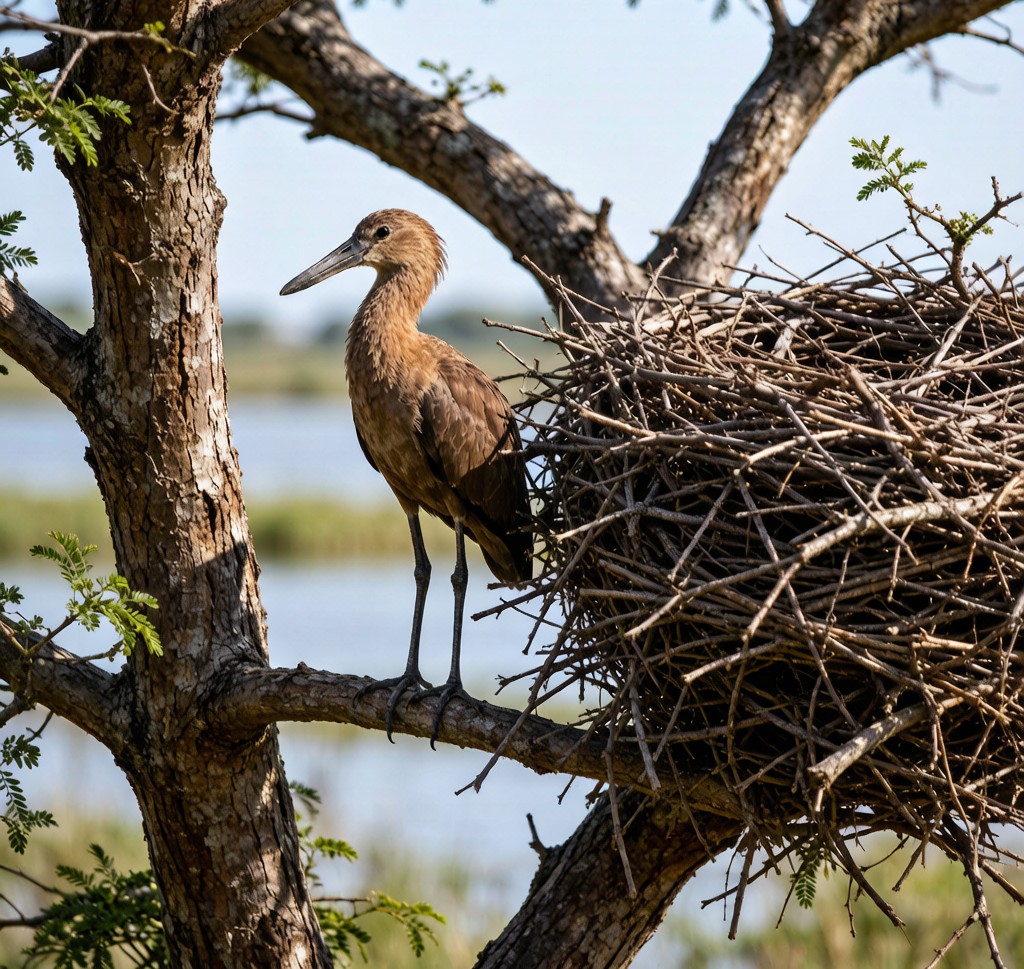
A Hammerkop (Scopus umbretta) standing beside its enormous stick nest on an African acacia tree, with its distinctive hammer-shaped head profile visible
Overview
The Hammerkop (Scopus umbretta) is a medium-sized wading bird found throughout sub-Saharan Africa and parts of Madagascar and the Arabian Peninsula. Its name – derived from the Afrikaans and German words for “hammer head” – refers to the bird’s most distinctive feature: its head shape, in which the long, slightly hooked bill, small eyes, and shaggy crest are arranged in a profile that perfectly resembles the head of a hammer when the bird is viewed from the side. This remarkable silhouette is unique in the bird kingdom and makes the Hammerkop one of the most instantly recognizable birds in Africa.
But the Hammerkop’s fame extends far beyond its unusual head shape. The species builds the largest nest of any bird in Africa – and arguably the most architecturally sophisticated nest of any bird in the world. A Hammerkop’s nest is a cathedral-scale structure of sticks and grasses, with a central nesting chamber reached through a long entrance tunnel. These nests can exceed 1.5 meters in height and 2 meters in diameter, weigh over 50 kilograms, and are so strongly built that they can support the weight of an adult human standing on top. The Hammerkop’s nest is so distinctive and imposing that the bird has given its name to an entire order of birds – the Scopiformes – making it one of the most evolutionarily unique birds in Africa.
Habitat and Distribution
The Hammerkop is one of Africa’s most widely distributed birds, found throughout sub-Saharan Africa from Senegal in the west to Ethiopia in the east, and south to South Africa, as well as on Madagascar, the Comoros, and southwest Arabia. Within this vast range, the species occupies a wide variety of freshwater wetland habitats including marshes, swamps, river margins, lake edges, floodplains, and coastal mangroves. It is largely absent from dense forest and true desert, but occurs in virtually every type of aquatic environment where there is sufficient shallow water for foraging and large trees or cliff faces for nesting.
The Hammerkop is strongly associated with water bodies that have permanent water levels and abundant food resources. It feeds in shallow water – typically less than 30 centimeters deep – where it walks slowly, searching for prey. The species requires large trees with substantial canopy structures for nesting, as the enormous nests must be able to support their own considerable weight. In some areas, Hammerkops also nest on cliff faces and on the ground in dense reedbeds. The species’ habit of nesting near human settlements – where large trees and farm dams provide ideal conditions – has allowed it to maintain stable populations even in heavily modified landscapes.
Feeding Ecology
The Hammerkop is a solitary forager, typically hunting alone in shallow water by day and resting at night. Its diet consists primarily of frogs, tadpoles, fish, crustaceans, aquatic insects, and worms. The species hunts by walking slowly through shallow water with its head angled downward, scanning for movement, then lunging quickly to seize prey with its bill. Remarkably, Hammerkops also practice a behavior called “foot-hovering” – they will hover briefly above the water while resting one foot on the surface, perhaps to disturb prey or to fish in slightly deeper water than they can comfortably wade through.
Hammerkops are typically solitary feeders and maintain large foraging territories. They are highly territorial around their nests but tolerate other Hammerkops in adjacent territories. Research has shown that Hammerkops maintain individual foraging routes and revisit productive feeding sites repeatedly, suggesting that they have detailed spatial knowledge of their habitat. This territorial and site-faithful behavior makes Hammerkops vulnerable to habitat changes that disrupt their foraging areas, but also means that protecting key wetland habitats provides disproportionate conservation benefits to the species.
Nesting and Conservation
The Hammerkop’s nest is its most extraordinary feature. Constructed by both sexes over several months, the nest begins as a platform of sticks and branches, which is progressively enlarged and elaborated into a dome-shaped structure with a central chamber. The entrance tunnel – up to 60 centimeters long – is oriented so that it faces away from prevailing winds and predators. The nest is lined with softer grasses and aquatic vegetation, and a false cup at the entrance of the nesting chamber is added to improve thermal insulation. Some Hammerkop nests are used for multiple breeding seasons and are progressively enlarged, reaching enormous proportions over the years.
The Hammerkop is listed as Least Concern on the IUCN Red List, reflecting its large and stable population estimated at 100,000 to 500,000 individuals across its vast range. However, the species faces localized threats in parts of its range, including drainage of wetlands, pollution of water bodies with pesticides and fertilizers, and disturbance at nesting sites during construction. The species’ tolerance of human-modified landscapes – it readily nests in farm trees and forages in irrigation canals and farm dams – has been an important factor in its resilience. The Hammerkop is also significant in African culture, where it is associated with bad luck in some traditions, which has historically discouraged people from disturbing its nests and may have inadvertently contributed to its conservation.