 By st20113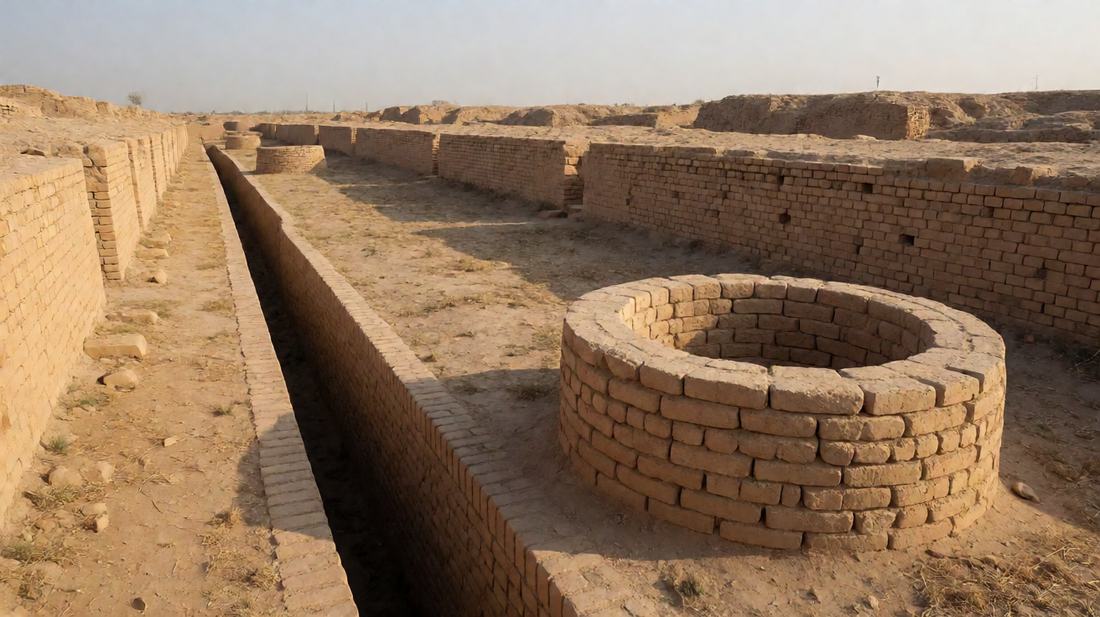
The Indus Valley Civilisation | Harappa
Historical Profile · Indus basin
The Indus Valley Civilisation | Harappa
A great city society with street drains and public baths left behind no kings, no battles and a writing nobody can read.
c. 2600-1900 BC
Period
Rivers
Seals found
Great Bath
Main street
The big picture
Introduction
The Indus Valley Civilisation was one of the first great city societies on earth. It grew along the Indus river and its branches. That land is now Pakistan and north-west India.
It lasted from about 2600 BC to 1900 BC. Its cities had paved streets, covered drains, public wells and huge brick platforms. Yet nobody can read its writing.
No king, no war and no named god can be picked out. It is the quietest of the old civilisations, and in some ways the strangest.
Setting
Historical Context
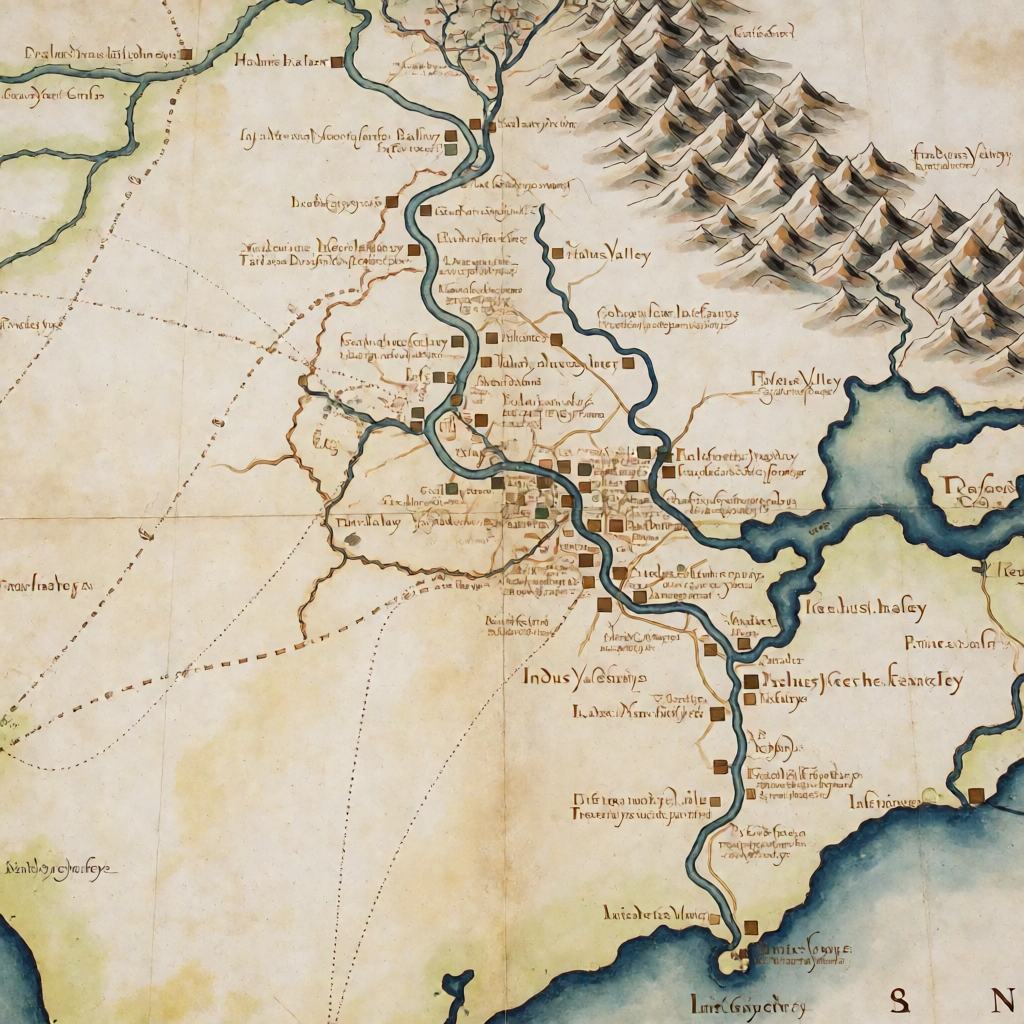
The Indus is one of the great rivers of Asia. It rises in the mountains and runs about 3000 km to the sea. Every summer the snow melts and the water rises. The flood leaves fresh soil on the fields. So the plain between the rivers is very rich.
Farmers had grown wheat and barley there for thousands of years before the cities came. The cities did not grow by chance. The land gave food. The river gave mud for bricks and a road to the sea. The hills to the west gave timber and metals.
By 2600 BC several large towns appeared at the same time. They lay over a stretch of land about 1500 km long. The two largest were Harappa in the north and Mohenjo-daro far to the south.
Turning points
Key Events
The civilisation has three stages. Village life began before 3300 BC. The great cities were built from about 2600 BC to 1900 BC. Scholars call this the mature stage. After that the cities were slowly given up. People moved back to villages. Nobody knows why the cities ended.
There is no sign of a great war and no sign of a sudden blow. The best guess is a mix of causes. The river changed its course. Trade with far lands shrank. The rain became less steady. By 1900 BC most big sites were half empty. By 1700 BC the cities had gone.
Some villages kept the same way of life for centuries after. Egypt and Mesopotamia left lists of kings and boasts of war. The Indus left none. That silence is the whole puzzle. We have the buildings of a great society. We do not have one word that says who ran it.
1
2
3
Who held power
People and Powers
The most striking thing about the Indus cities is what is missing. There are no grand palaces, no royal tombs and no great temples. There are no pictures of kings. There are no scenes of battle and no rows of beaten prisoners. Almost every other early state used art to praise its rulers. The Indus did not, or not in a way we can read. The cities were laid out on a grid. Streets ran north to south and east to west.
In Mohenjo-daro the main street was about 10 m wide. The city was split into a raised upper area and a lower town. The upper area sat on a platform of mud brick. Building it took a huge amount of labour. So there was power of some kind. Someone could give orders. But it may have been shared by a group of families, or by priests of a public faith, rather than held by one king. Two things stand out as signs of order.
The first is the bricks. Bricks were made in fixed sizes. The same sizes were used in cities hundreds of kilometres apart. The second is the drains. Covered drains ran under the streets. They had manholes for cleaning and pits for waste. No other old city of that age came close.
Everyday world
Daily Life and Society
Most people were farmers. They grew wheat, barley, peas and dates. They kept cattle, sheep, goats and pigs. They were also the first people in the world to spin and weave cotton. Cotton cloth from the Indus was sold far to the west. The cities were built of brick, with flat roofs and courts. A house usually had a small court in the middle. Rooms sat around it.
A door opened onto a side lane. Each house had its own well or a shared one nearby. Stairs led up to a roof. The biggest houses had several rooms and private wells. The smallest had two rooms. Clean water and clean waste were public business. Most houses had a bath with a sloped floor and a drain to the street. The Great Bath at Mohenjo-daro is a brick tank about 12 m by 7 m.
It was lined with tar and set in a building with rooms around it. It may have been used for washing as part of a rite. We know almost nothing about the government. Small clay figures of a woman were found in many houses. They may stand for a mother goddess. Seals show a figure sitting cross-legged with animals around it. Some link it to a later god of the Hindu tradition. That is only a guess.
Craft and ideas
Trade, Technology and Ideas
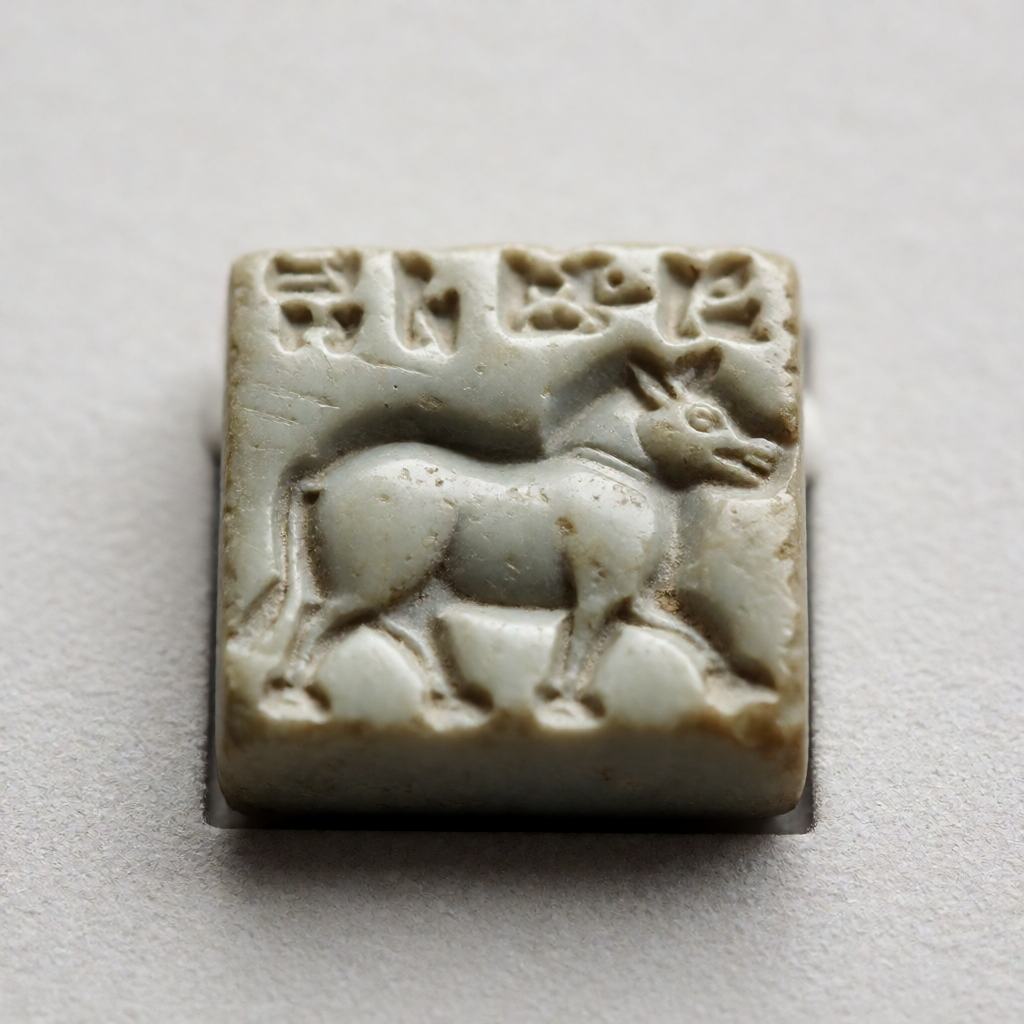
The Indus had no iron. Its people worked copper, bronze, gold, silver and lead. They made fine beads out of stone such as carnelian. Their weights were cut to a fixed set, in a neat run of ratios. The same weights turn up from one end of the region to the other. That is a strong sign of a shared market and shared rules. The most famous objects are the seals. They are small, square and cut in stone.
They carry a short line of signs above a picture of an animal. About 4000 of them have been found. The signs form a real script, with a set number of signs, and it is used the same way in every city. But the texts are all short. The longest is only about 20 signs. There is no key in another language. So the script stays unread. With it go the names, the laws and the songs of the whole society.
Trade reached a long way. Indus seals have been dug up in Mesopotamia. Indus weights have been found on the coast of the Gulf. The one-horned rhinoceros lived in the tall wet grass of the river plain. Ivory, cotton, beads and timber went out. Silver, tin and wool came in.
What lasted
Legacy
Two of the largest sites gave their names to a whole way of life. The cities were never lost. They were forgotten until British engineers took old bricks for a railway in the 1850s. They noticed the strange square blocks and the carved seals.
The legacy is hard to measure, because the script is silent. What survives is a set of habits. Later Indian life made them its own. They are brick building on a grid, cotton cloth, fixed weights and a taste for public bathing.
The ruins also carry a warning. A rich society can end slowly. Not with a fire, but with a river that moves and a market that dries up. Then the people simply walk away.
Quick hits
Five Things to Remember
- The Indus Valley Civilisation ran from about 2600 BC to 1900 BC.
- No other old city of that age had drains under the streets and baths in most houses.
- Its script has about 4000 surviving examples and still cannot be read.
- Its people were the first in the world to spin and weave cotton.
- The cities ended without a war, most likely as the river moved and trade shrank.