 By st20113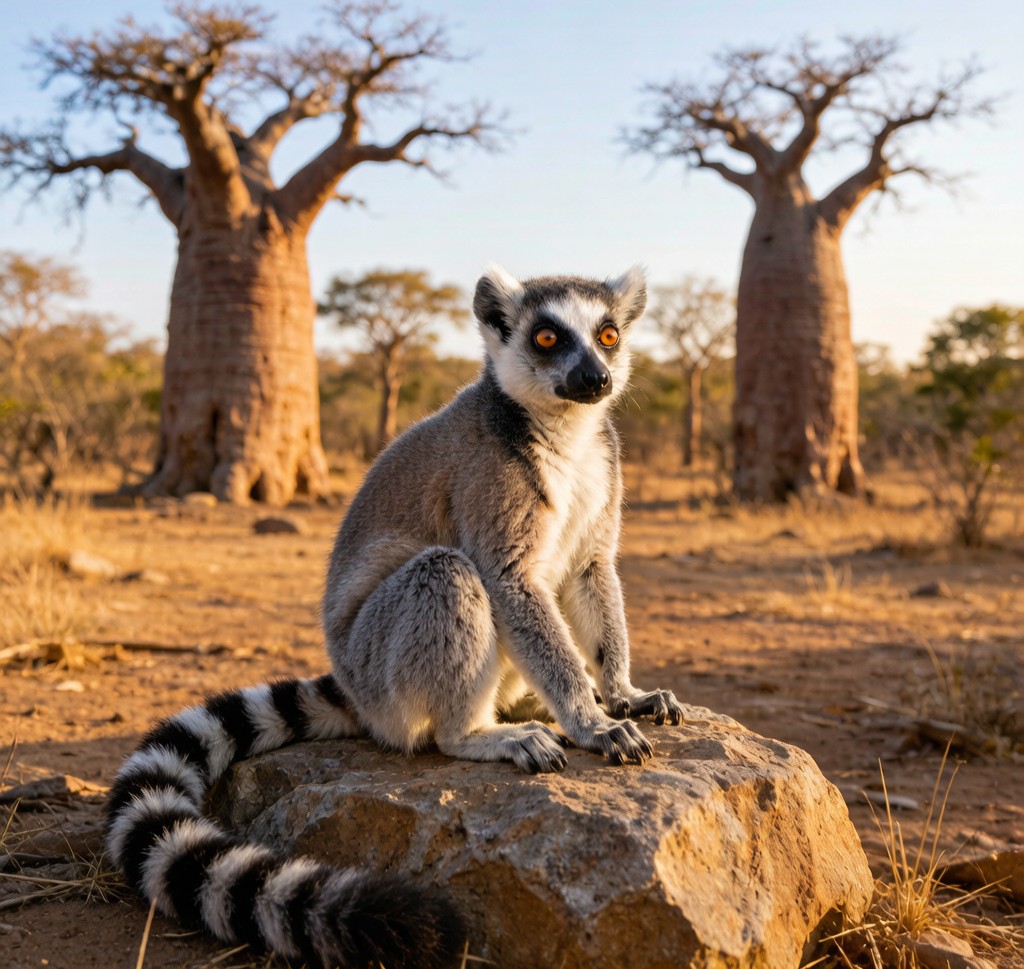
A Ring-tailed Lemur (Lemur catta) sitting on a rock in Madagascar, displaying its iconic black-and-white ringed tail
Overview
The Ring-tailed Lemur (Lemur catta) is one of the most iconic and well-recognized primates on Earth. Endemic to the island of Madagascar, the ring-tailed lemur is instantly recognizable by its strikingly beautiful, vividly ringed black-and-white tail – one of the most distinctive markings in the animal kingdom. As a flagship species for Madagascar’s unique biodiversity, the ring-tailed lemur has become a symbol of the island’s extraordinary evolutionary heritage and the urgent need to protect its remaining forests.
Ring-tailed lemurs are relatively large lemurs, with a body length of 39 to 46 centimeters and a tail length of 56 to 62 centimeters. Adults weigh 2.2 to 3.5 kilograms. Their dorsal pelage is grayish-brown to rosy-brown, with lighter gray on the underparts and limbs. The face is distinctive – white with prominent black patches around the amber-colored eyes that resemble a bandit mask. However, the tail is the lemur’s most remarkable feature: 13 alternating black and white rings that serve as visual signals in their social environment.
Habitat and Distribution
Ring-tailed lemurs are found only in southern and southwestern Madagascar, where they inhabit a range of forest types including spiny forest (dominated by Alluaudia ascblank trees), deciduous forest, and gallery forest along rivers. They are unusual among lemurs in that they spend a significant amount of time on the ground – they are semi-terrestrial – rather than exclusively in the trees. This behavioral flexibility is one reason for their relative success compared to more specialized lemur species.
Their range is fragmented by deforestation, and populations are now restricted to a handful of national parks and reserves including Isalo National Park, Zombitse-Vohibasia, Andohahela, and the famous Berenty Private Reserve. The total wild population is estimated at 2,000 to 2,400 individuals, making it one of the most threatened lemur species. The lemurs’ dependence on dry forest habitats that are under intense pressure from slash-and-burn agriculture, charcoal production, and grazing makes them particularly vulnerable to habitat loss.
Social Structure and Behavior
Ring-tailed lemurs live in social groups called troops, typically numbering 13 to 32 individuals, with an average of about 17. These troops include multiple adult males and females, and the group is matrilineally structured – females hold dominant status over males, and daughters typically remain in their birth troop while males transfer to other groups upon reaching sexual maturity at around 3 years of age.
Social bonding within the troop is reinforced through grooming and through a behavior unique to ring-tailed lemurs called “stink flirting.” During the breeding season, male lemurs will anoint their tails with secretions from their wrist and shoulder glands, then engage in distinctive displays in front of females – waving the highly scented tail back and forth and raising the tail toward the female’s face. This behavior combines olfactory and visual signaling in a way seen in no other primate species.
Diet and Foraging
Ring-tailed lemurs are opportunistic omnivores with a diet that shifts seasonally. They feed primarily on fruits (particularly figs and tamarind), leaves, flowers, bark, and sap, supplemented with insects, small vertebrates, and soil for mineral supplementation. In the dry season, when fruit is scarce, they rely heavily on leaves, including those of plants that are toxic to most other animals. Their elongated, grooming claw and specialized dentition reflect their diverse dietary needs.
As with other lemurs, ring-tailed lemurs rely on gut fermentation to break down fibrous plant material. They also practice cathemeral activity – meaning they are active both day and night, a rare trait among primates that allows them to exploit food resources across all hours. During the dry season, they often spend 30-40% of their time sunbathing on exposed rocks to conserve energy and reduce thermoregulatory costs.
Reproduction and Conservation
Ring-tailed lemurs have a highly seasonal breeding pattern, with mating taking place over a 2-3 week period in April-May and births occurring in August-September after a gestation of approximately 134 days. Females typically give birth to a single infant (twins are rare but possible), which clings to the mother’s underside for the first 1-2 weeks of life before being transferred to ride on her back. Alloparenting – where other troop members help care for infants – is common, with juvenile females and other troop members assisting the mother.
The ring-tailed lemur is listed as Endangered on the IUCN Red List. Their population has declined by approximately 50% over the past 21 years due to habitat destruction, hunting for bushmeat, and the exotic pet trade. Madagascar has already lost over 90% of its original forest cover, and ring-tailed lemurs now survive in some of the most degraded and fragmented landscapes on the island. Urgent conservation action, including expanded protected area networks and community-based forest management, is critical to prevent the species from sliding toward extinction.
[…] the strepsirrhine group, slow lorises are most closely related to angwantibos, pottos, and the ring-tailed lemur of Madagascar, sharing the characteristic wet nose and reflective eye layer. Slow lorises are […]