 By Iris
Eledone cirrhosa | Curled Octopus
Species Profile · Octopodidae
Curled Octopus
The small reddish octopus of the north-eastern Atlantic — one sucker row instead of two, a tight curl at every arm tip, and a single breeding season at the end of a short life.
IUCN: Not Evaluated
Range
Length
Suckers
Depth
Life
The small red octopus
One sucker row, curled tips
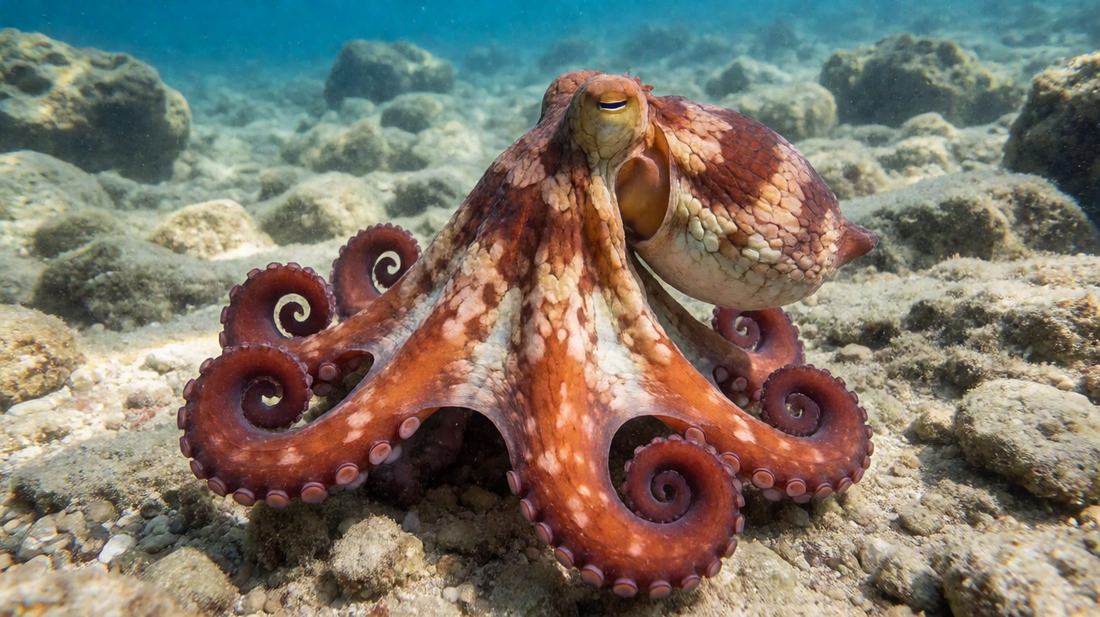
The Curled Octopus is a small, reddish animal. It lives in the north-eastern Atlantic and the Mediterranean. It is one of the commonest ones seen by divers and fishermen there. Its body colour is a warm orange-brown or brick red. Fine mottling covers the surface and changes from moment to moment. The animal alters its colour with its mood.
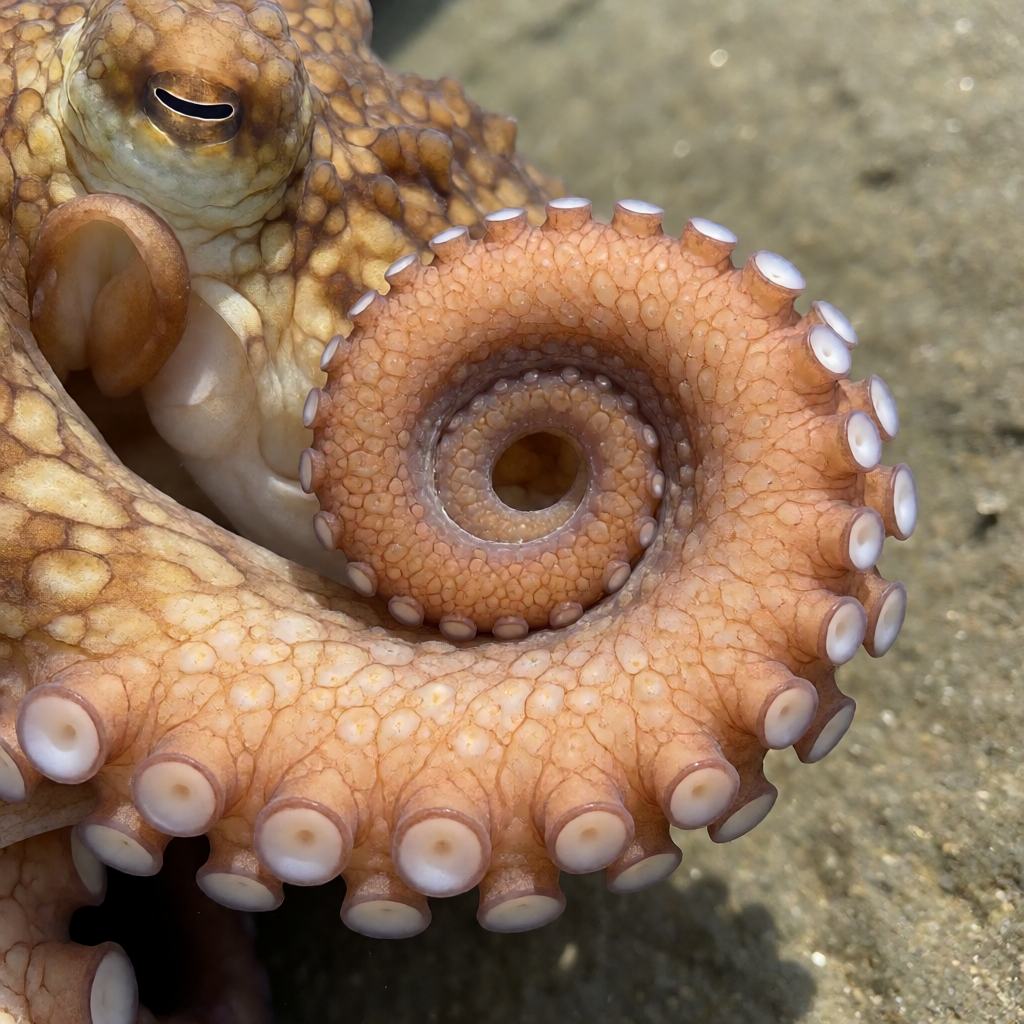
The skin carries a scatter of small, soft bumps and warts. They give the body a rough, slightly shaggy surface. This is quite unlike the smooth skin of the common octopus. The 8 arms are short and sturdy rather than long and whippy. Their tips curl into tight spirals. This is where the name of the species comes from.
Each arm carries a single row of suckers. This is the quickest way to tell it from the common octopus, which has 2 rows. The Curled Octopus is a night hunter. It lives on sandy and muddy bottoms and among rocks from the shoreline down to about 800 metres. It feeds mostly on crabs.
Family tree
Octopodidae, the typical octopuses
The Curled Octopus sits in the family Octopodidae, the typical octopuses. It belongs to the genus Eledone. It was described by Lamarck in 1798. This is the largest and most familiar group of octopuses. It is defined by the basic octopus plan. There are 8 arms and no shell. The brain is large.
The animal has a set of feeding and defence habits that make these creatures the cleverest of the invertebrates. The genus Eledone holds a small number of species. It is set apart from the rest of the family by an unusual feature. There is only 1 row of suckers along each arm instead of 2. The group is also marked by short, thick arms and fine, warty skin. The eggs are large, and the female broods only a few hundred of them. The genus name comes from the Greek word for a fish.
The species name cirrhosa refers to the curled, tendril-like arm tips. Some species of Eledone live in European waters. The other one here, Eledone moschata, is a shallow-water animal with a musky smell. The Curled Octopus shares its family with the common octopus. That is the big, smooth-skinned species of the same seas. The 2 are set apart by the number of sucker rows and by the shape of the skin. But they share the same family, the same cleverness and the same short life.
Curled arms, one sucker row
How to tell one
The Curled Octopus reaches a mantle length of about 15 cm. Its total length is 50 cm, and a large animal may weigh 1 kg. Most of the length sits in the arms. They are short and muscular and taper to thin, tightly curled tips. The skin is covered in small warts. The animal can raise and lower these at will. This changes the texture of its surface and makes it look more like a rock or a patch of weed.
The colour range is very broad. A relaxed animal is a pale yellow-orange with fine reddish speckling. An alarmed one turns pale grey-white. An angry one flushes a deep brick red. The colour change is controlled by tiny pigment cells in the skin. It happens in a fraction of a second. The head is small and carries 2 large, dark eyes with flat pupils.
The arms are joined at the base by a short web. There is 1 row of round white suckers along each arm. The males are easy to know because the third arm on the left side is changed into a special organ that carries sperm. The animal has no inner shell at all. So it can squeeze its whole body through a gap no wider than one of its eyes.
1
2
3
Sand, mud and rough ground
Where it lives
The Curled Octopus lives on the shelf and the upper slope of the north-eastern Atlantic. Its range runs from Iceland and Norway south to Morocco. It also lives throughout the Mediterranean. It has been found from the shoreline down to about 800 metres. It is most abundant between 50 and 300 metres. The species is a bottom-living animal.
It prefers a mixture of sand, mud and small stones. It is often found near rocks and boulders, because it needs a crevice or a hole to hide in. It will readily take up home in an old shell, a bottle or a piece of pipe. It is rarely seen in the open during the day. It comes out at night to hunt. The Curled Octopus is more tolerant of cold and of muddy ground than the common octopus.
For this reason it lives further north and reaches deeper water. There it is the commonest one of the deeper trawling grounds. The common octopus takes over the shallow rocky areas. The species makes short seasonal moves, into shallower water in spring and back into deeper water in winter.
Crabs, above all else
What it eats
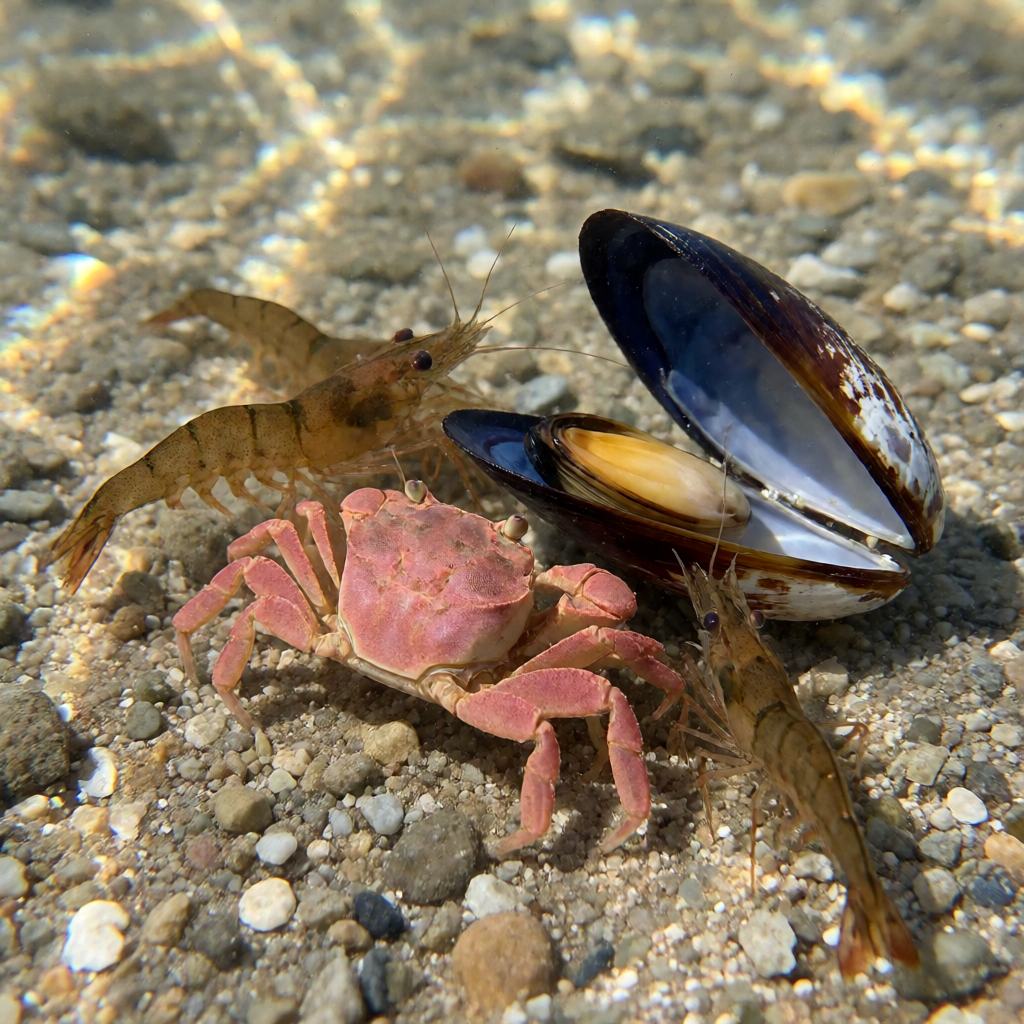
The Curled Octopus feeds mainly on crabs and other crustaceans. It is one of the most important hunters of crabs in European coastal waters. The main prey are swimming crabs, shore crabs and spider crabs. It also takes lobsters, prawns, squat lobsters and hermit crabs. Mussels and clams form a large part of the diet in some areas. Fish, including small flatfish, are taken when the chance comes.
The animal hunts at night. It finds its prey by touch and by taste as much as by sight. Octopuses have excellent eyesight, but they also carry chemical receptors on the suckers. So they can taste an object simply by touching it. Once a crab is caught, the octopus wraps the web of its arms around it. It holds the crab against its mouth.
Then it drills a small hole through the shell with its radula. This is a tongue-like rasp covered in rows of tiny teeth. It then injects a paralysing spit and sucks out the soft flesh. The empty shell is left behind. A pile of empty crab shells outside a den is a sure sign that one lives inside.
One brood, then the end
The breeding cycle
The Curled Octopus has a short life and it breeds only once. This pattern is called semelparity. The animals live for 1 or 2 years and die soon after they have spawned. Mating takes place mainly in the spring and summer. There it often runs from spring through to late summer. The male passes a packet of sperm to the female using the special arm.
The female stores it until her eggs are ready. She then lays several hundred large eggs. Each one is about 1 cm long. She fixes them in a cluster on the roof of her den or on a hard surface. The female guards the eggs for 4 to 5 months. During that time she does not feed at all.
She cleans the eggs with her suckers, blows water over them and drives away hunters. She will die of hunger soon after the young hatch. The young have no free-swimming stage. They come out as small octopuses and settle on the seabed at once. This gives them a good chance of survival. They grow fast and reach maturity within a year.
No assessment, taken as bycatch
Conservation
The Curled Octopus has not been assessed on the global Red List. There is no reason to think the species as a whole is at risk. It is very widespread and it is abundant over much of its range. The real concern is local and it comes from fishing. The species is taken in large numbers as a bycatch of bottom trawling in the Mediterranean and the Atlantic.
It is sold in markets beside the common octopus, often with no separation of the 2 species. The animal lives only 1 or 2 years and breeds only once. So a group that is heavily fished has very little capacity to recover. There have been clear falls in the size of the animals landed in some southern ports. The species has also been affected by the damage that trawling does to the seabed.
The octopus depends on the crevices, stones and shell debris that trawling removes. There is no special management for the Curled Octopus anywhere in its range. The most useful steps would be the protection of nursery areas and the recording of the 2 octopus species apart.
Quick hits
Five things to remember
- Each arm carries a single row of suckers, and this is the quickest way to tell the species from the common octopus, which has 2 rows.
- The animal can raise and lower the small warts on its skin at will, so it can look like a rough stone or a lump of weed.
- The female stops eating while she guards her eggs for 4 to 5 months, and she dies of hunger soon after the young hatch.
- The young come out of the egg as small octopuses and settle on the seabed at once, with no free-swimming stage at all.
- The animal has no inner shell, so it can squeeze its whole body through a gap no wider than one of its own eyes.