 By st20113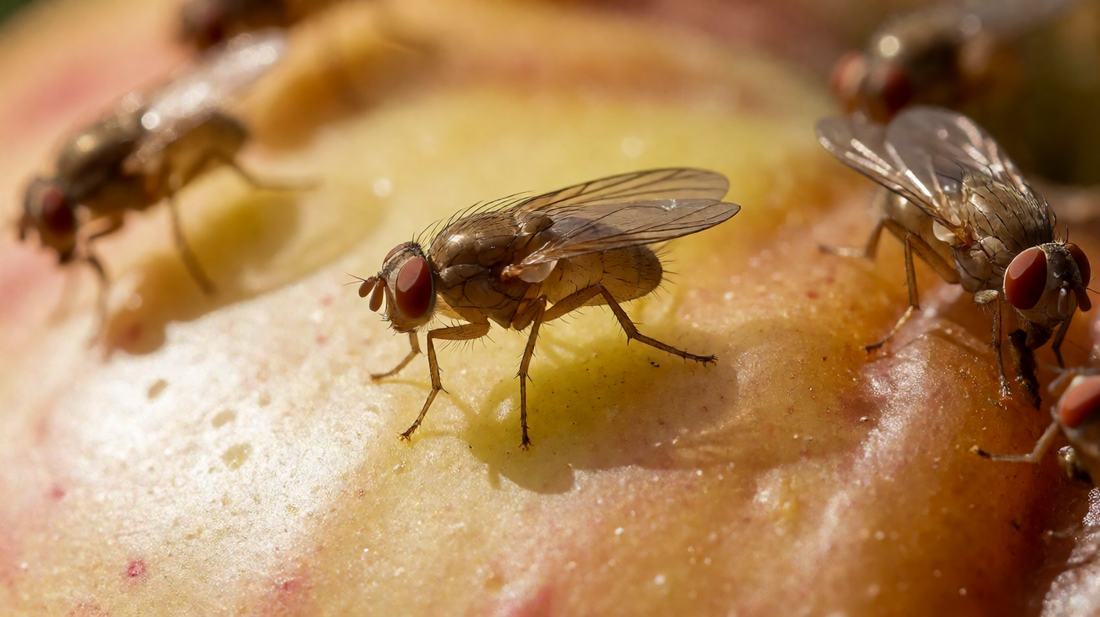
Drosophila melanogaster | Fruit Fly
Species Profile · Drosophilidae
Fruit Fly
The small red-eyed fly that comes to overripe fruit before anything else — and the model organism behind a great share of the prize-winning work on the genes.
IUCN: Least Concern
Range
Body
Life
Eggs
Role
The red-eyed laboratory classic
More important than any garden
The fruit fly is a small, tan, red-eyed fly. It comes to overripe fruit faster than anything else. It is one of the most important animals in all of biology. This is not because of what it does in the garden. It matters because of what scientists have learned from it in the lab. It belongs to the order Diptera, the true flies.
It sits in the family Drosophilidae. That family carries the 4 species that live in and around the rotting fruit of the Old World. The species is so key to the study of the passing of life that a great share of the prize-winning work on the genes was done on it. It is now the model organism for the whole field. It is a small, short-lived fly. In warm weather it goes from egg to adult in a little over a week.
It breeds in such numbers that a single overripe peach can turn out the next generation in a matter of days. The species is found across the Old World. It was carried across the Atlantic in the fruit that traders brought. It is now at home in every country where the fruit grows.
Family tree
Drosophilidae, the fruit flies
The fruit fly is in the order Diptera. It belongs to the family Drosophilidae. The Swedish entomologist Meigen described it in 1830. It has kept the name Drosophila melanogaster ever since. The order Diptera is defined by one thing. The front pair of wings is the only pair that flies.
The back pair folds into two small, stiff, club-shaped organs called the halteres. The fly uses these to keep its balance. The family carries the small flies that live in the fruit and in the plant saps. The species sits among the 4 close relatives that feed on the overripe fruit. The whole family is one of the most studied groups of the smaller insects in the world. Its close relatives in the New World are the many species of the same family.
Those feed on the tropical fruits. The fruit fly shares the order with the seven-spot ladybird. That is a very different order and a very different kind of insect. The two live in the same place. They meet in the overripe fruit and the fallen leaves. The ladybird eats the small, soft-bodied insects that the fruit fly and its relatives will not.
Red eyes, tan body
How to tell one
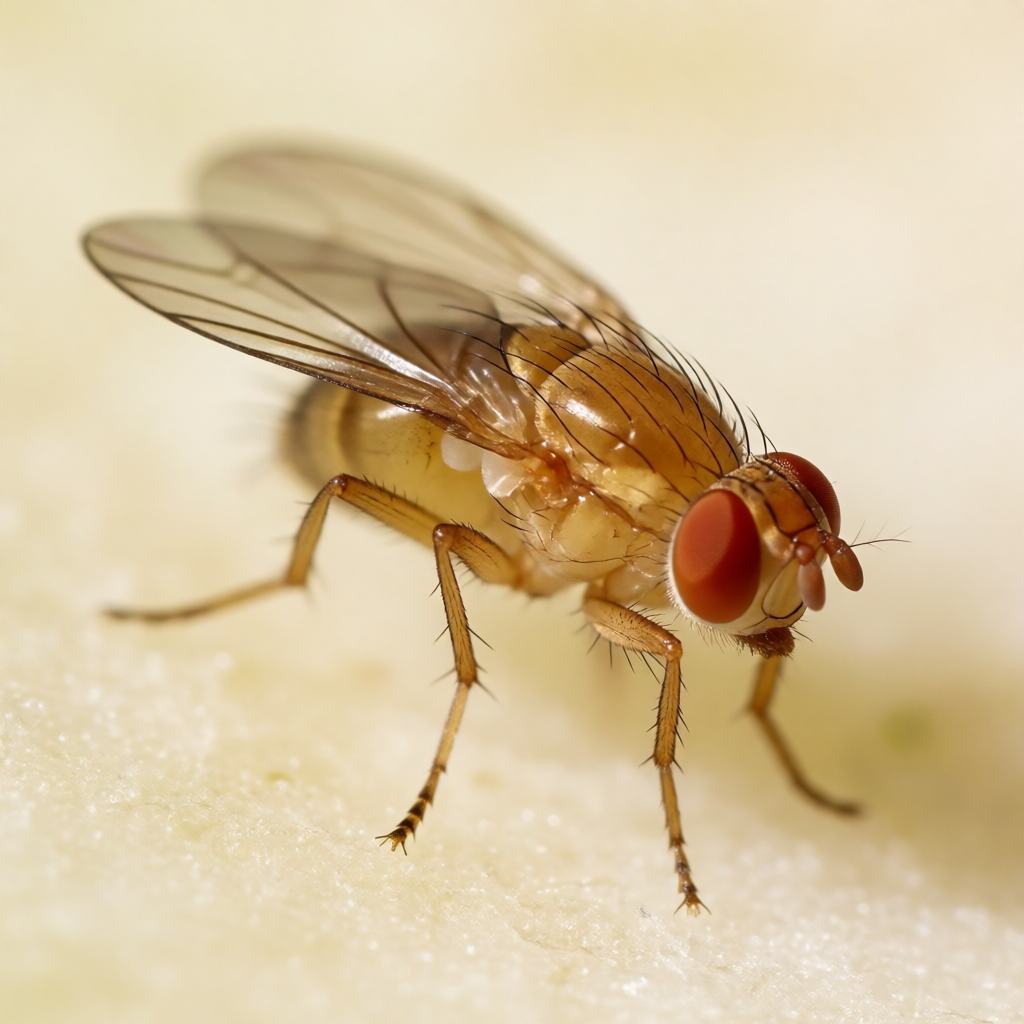
The adult fruit fly is very small. Its body is 4 to 5 mm long. It is tan in colour. A darker band crosses the middle of its back. The eyes are the most obvious feature. They are a bright red. The body is covered in a fine, short, dark hair.
The wings are clear. They carry two dark spots on the front margin. The legs are thin and dark. The species is one of the few insects that can be told apart by the colour of the eyes. The red is a mark of the healthy animal. The larvae are small, white and curved. They have a dark, cone-shaped head.
They live in the soft, rotting fruit where they feed. The pupa is a small, brown, barrel-shaped case. It is the last stage before the adult flies out. The species is one of the fastest of the insects to go from egg to adult. A whole life can be lived in under a week in the warm weather.
1
2
3
Wherever the fruit turns
Where it lives
The fruit fly lives wherever there is overripe fruit. That puts it in the orchard, the garden, the kitchen, the compost heap and the fallen leaves on the ground. It is a creature of the warm season. It is one of the commonest flies in the summer of the Old World. The species is at home in the temperate and the tropical regions.
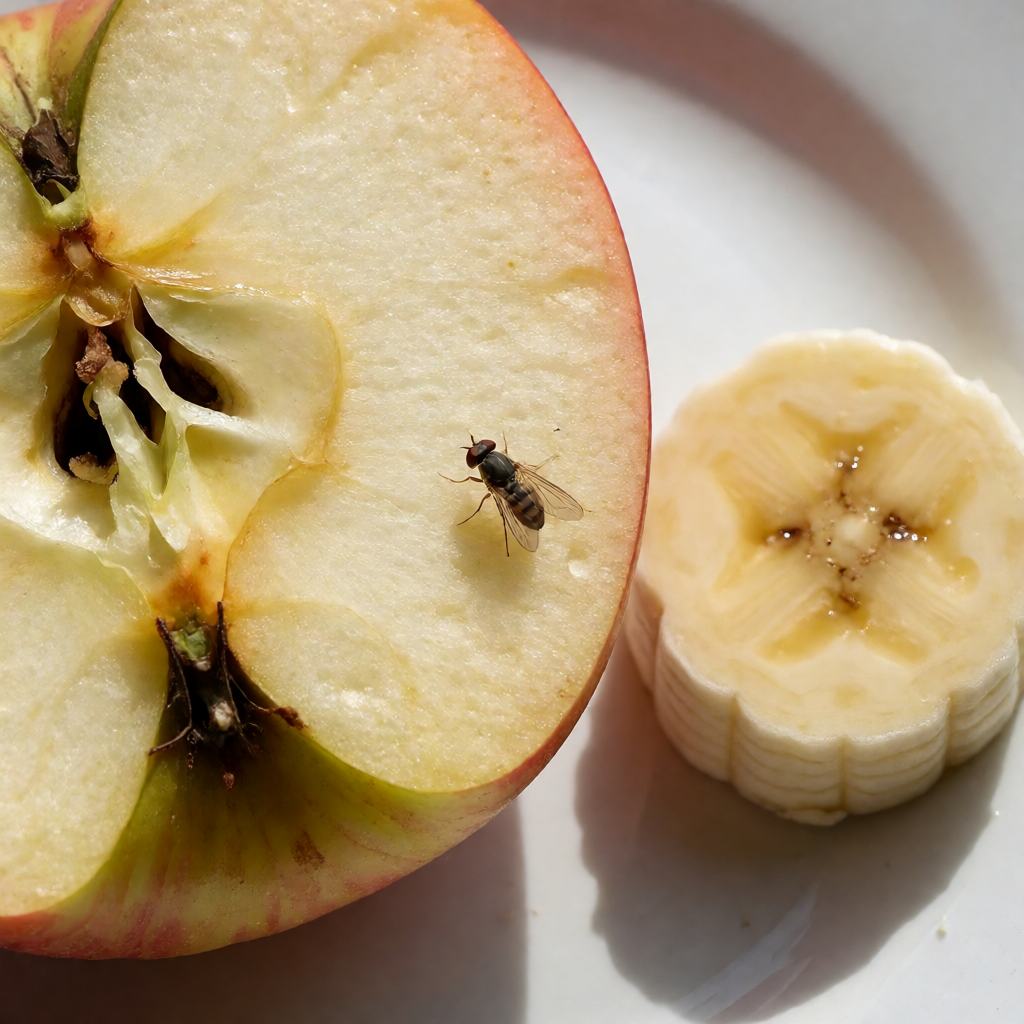
It will breed in a peach, a pear, a fig or a banana that has been left to ripen. It is not a long-distance flier. A single fly spends most of its life close to the fruit where it was hatched. The species is so well fitted to the human garden that it is one of the flies that comes to the kitchen. It is the one that will find the fruit left on the counter.
The animal is a useful marker of the ripeness of the fruit. It will not come to the green, firm fruit. It will come to the soft, overripe one in a matter of hours.
Soft rotting fruit, sugar and sap
What it eats
The fruit fly feeds on the soft, rotting fruit. The larvae hatch inside the fruit. They eat their way through the soft flesh. The adult drinks the sugar from the ripe fruit. It also takes the plant saps.
It will also take the honeydew that the small insects leave on the leaves. The species is one of the few flies that can make its own alcohol from the sugar in the overripe fruit. That is one of the things that lets it live in fruit that is already in the early stages of the rot. The larvae are strict eaters. They feed only on the soft, overripe fruit.
They will not take the firm, green fruit. The whole life of the species is tied to the ripening of the fruit. It is one of the insects that the gardeners call a pest. It comes to the crop before the market can pick it.
A week from egg to fly
The breeding cycle
The fruit fly breeds in the warm weather. A female lays her eggs in the soft, overripe fruit. The larvae hatch within a day or two. They feed for a week or more. They then drop to the ground, or they find a dry place.
They spin the small, brown pupa there. The adult comes out of the pupa in a matter of days. It lives for a short time. It mates and lays the eggs that start the next generation. A single female can lay a few dozen eggs in her life.
The whole cycle, from the egg to the adult, takes under a week in the warm weather. This fast breeding is why the species is the model for the study of the passing of life. A whole life can be studied in a matter of weeks. The offspring can be counted in a matter of days.
Least Concern, a managed pest
Conservation
The fruit fly is not in any danger. It is one of the most common of the small flies in the Old World. It does not appear on any list of the threatened insects. Its range is as wide as the fruit that it feeds on.
The one concern the growers have is that the species is a pest of the fruit. It reaches the crop before the market can pick it. It also spoils the fruit that is left to ripen. The growers have found a way to hold the fly down.
They put the traps in the orchard to take the males. The fly is kept to a low number. The species marks the ripeness of the fruit well. It is one of the insects that tells the grower the fruit is ready to pick.
Quick hits
Five things to remember
- The fruit fly is the model organism for the study of the passing of life. A great share of the prize-winning work was done on it.
- You can tell the species apart by the red of the eyes. It is one of the few insects where the eye colour is the mark.
- A whole life, from egg to adult, takes under a week in the warm weather. A single overripe peach can turn out the next generation in a matter of days.
- The species can make its own alcohol from the sugar in the overripe fruit. That lets it live in fruit that is already in the early stages of the rot.
- The growers put the traps in the orchard to take the males. The fly is held to a low number in the crop.