 By st20113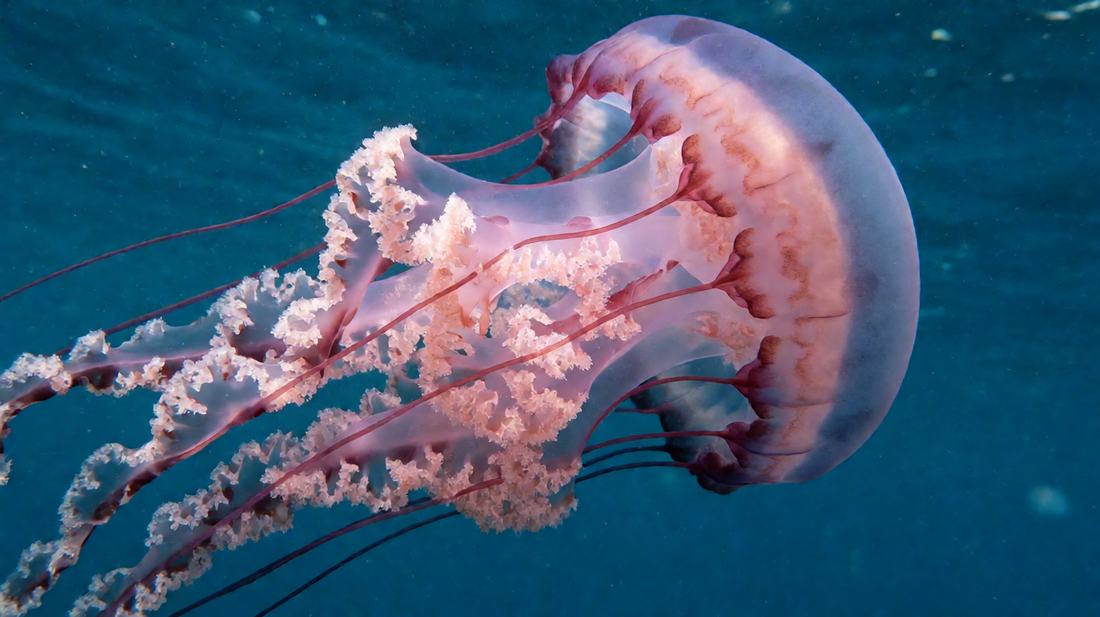
Pelagia noctiluca | Mauve Stinger
Species Profile · Pelagiidae
Mauve Stinger
The glowing purple jellyfish of warm seas whose swarms close beaches — a drifter with no brain, no blood and a sting that burns for hours.
IUCN: Not Evaluated
Range
Bell
Water
Arms
Sting
The glowing purple drifter
A jellyfish you can feel
The mauve stinger is the jellyfish that swarms off Mediterranean beaches in late summer. It sends swimmers out of the water. It is a true jellyfish, a scyphozoan. Its bell is a dome tinted pink, violet or mauve. A fringe of long fine tentacles hangs from it. It glows in the dark when it is upset. That is where its name comes from. Noctiluca means night light.
The animal drifts and pulses in open water. It does not sit on the sea bed. It spends its whole life in the plankton. It eats other plankton. It catches copepods, fish eggs and larvae on stinging cells. Unlike most jellyfish it has no fixed stage on the sea bed at all. Every part of its life happens in open water. The species lives in warm and temperate seas across the Atlantic, the Mediterranean and the Pacific.
It is common in the western Mediterranean. Numbers there have risen over recent decades. Blooms can run for kilometres. They can appear over a few days when conditions suit them. The sting is painful. It is not dangerous to healthy people. It is the reason this is the best-known jellyfish in southern Europe.
Family tree
Pelagiidae, the mauve stingers
The mauve stinger is in the family Pelagiidae and the genus Pelagia. Forskål named the species in 1775. The genus name comes from the Greek word for the open sea. That fits an animal that never settles. Pelagiidae sits in the order Semaeostomeae. Those are the true jellyfish with a bell edge that is not fused. They have oral arms rather than a fused mouth tube. The class is Scyphozoa, the true jellyfish.
The phylum is Cnidaria. That holds jellyfish, sea anemones, corals and hydroids together. Cnidarians are defined by the stinging cell, the nematocyst. No other animal group has it. The mauve stinger is one of the few scyphozoans with no bottom-living polyp stage. That single fact sets it apart from most of its kin. Genetic work suggests the name Pelagia noctiluca may hide more than one species. Animals from the Pacific and the Atlantic differ from those in the Mediterranean.
The name is still used for all of them. The mauve stinger shares the class Scyphozoa with the moon jellyfish. That animal is much flatter and paler. It has a clear four-ring pattern on the bell. The two are in different orders. They differ most in life cycle. The moon jellyfish has a polyp stage stuck to the sea bed. The mauve stinger does not.
Purple bell, long tentacles
How to identify one
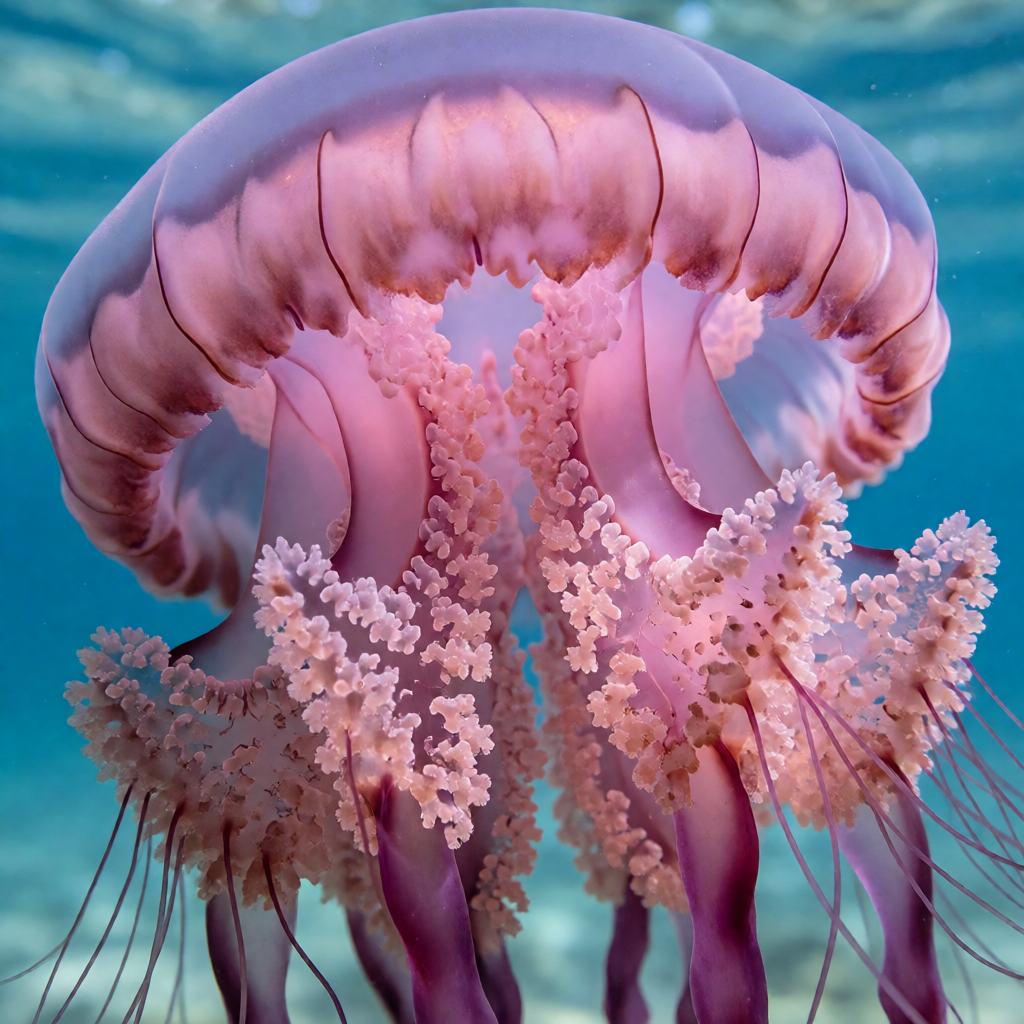
The bell of the mauve stinger grows to about 12 cm across. Most animals seen at the surface are 5 to 10 cm. The bell is a smooth dome. It is higher than it is wide. Its surface has a fine pattern of wart-like bumps. The colour runs from pale pink through violet to a deep mauve or reddish purple. The gonad tissue inside shows through the bell as a darker mass. Eight long fine tentacles hang from the bell edge.
They can stretch much longer than the bell when the animal feeds. They shorten to a stub when it is upset. Between them sit 4 thick frilled oral arms. They hang from the centre of the underside. They carry the mouth. The whole animal is clear when young. It becomes more solid and more strongly coloured as it matures. The tissue is more than 95 per cent water.
There is no head, no brain and no blood. A loose nerve net runs through the bell. It works the pulse of the swimming muscle. Simple light and balance organs sit around the bell edge. The sting comes from nematocysts. These cluster on the tentacles and oral arms. They fire on touch.
1
2
3
Open water and warm seas
Where it lives
The mauve stinger is an animal of open water. It lives in the upper layers of the sea over deep water as well as close inshore. It is most often reported near the coast. That is simply where people meet it. The species likes warm water. It is most common where the surface water is hot. That is why Mediterranean blooms peak in late summer and autumn. It lives through the Mediterranean.
It lives in the eastern and western Atlantic from the Bay of Biscay to West Africa. It reaches into the Caribbean and the Gulf of Mexico. It lives in the Pacific around Japan, Australia and New Zealand. It stands a wide range of salt and heat. That lets it live in water many rivals cannot use. The animals drift with currents and wind. They are pushed into bays and along beaches. A bloom is often a piling up by the water rather than a local breeding burst.
Moving up and down matters. The jellyfish rises towards the surface at night. It sinks through the day. That daily trip of tens of metres keeps it in the layer where its prey is thickest. Storms, calm weather and onshore winds all shift where a bloom ends up. A beach can be clear one day and full of jellyfish the next.
A catcher of plankton
What it eats
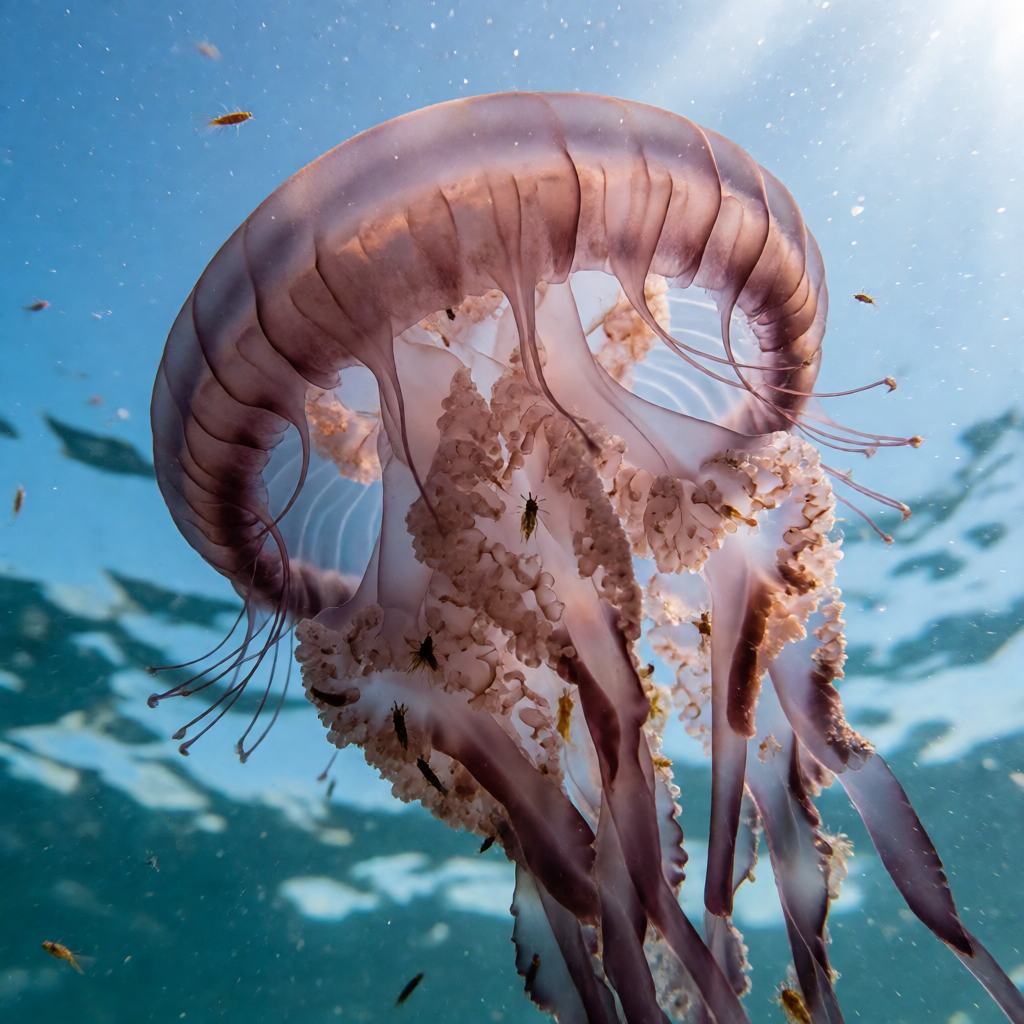
The mauve stinger is a meat eater. It eats other plankton. Most of its food is small crustaceans, especially copepods. It also takes the eggs and larvae of fish. It takes the larvae of other invertebrates. It takes small fish. It eats other jellyfish too, including smaller members of its own species. Prey is caught on the tentacles and oral arms.
When a copepod touches a tentacle, the stinging cells fire. The tentacle pulls in. The prey goes to the oral arms. They pass it to the mouth and then into the stomach. Digestion happens in the gut cavity. That is the system of canals running through the bell and arms. Waste leaves through the mouth. Feeding is not choosy.
The animal drifts with tentacles spread and eats what it touches. So the diet shows whatever is in the water at the time. That makes the species a real rival to fish. Where jellyfish are many they take the same copepods and fish larvae that sardine and anchovy need. Eating its own kind is common in dense blooms. The animal can also take in dissolved food through its thin body wall. That helps it live when prey is scarce.
No fixed larval stage
The breeding cycle
The mauve stinger has separate sexes. It breeds sexually. Its life cycle is the simplest of any scyphozoan. There is no polyp stage on the sea bed. The female sheds eggs into the water. The male sheds sperm. The egg is fertilised in open water. The egg grows straight into a larva and then into a young jellyfish.
It never sticks to anything. So the whole cycle from egg to adult happens in the plankton. That removes the block that limits most jellyfish. The animal does not need to find a hard surface for a polyp to settle on. Spawning happens through the warmer months. In the Mediterranean much of it is in late summer and autumn. The animals are short-lived. Most finish the cycle in well under a year.
After spawning the adults weaken and die. That is why a bloom collapses as fast as it builds. Because the animals keep breeding while conditions are good, numbers can build very fast. A bloom comes from high survival of eggs and larvae plus a piling up by currents. It can build over a few weeks. The species can also bud from the oral arms at times. But sexual breeding is the main route.
Not Evaluated, closely watched
Conservation
The mauve stinger is not assessed on the global Red List. There is no worry for it in the usual sense. The species is common and widespread. In most places it is doing better than it used to. Reports of jellyfish blooms in the Mediterranean have risen over recent decades. Research points to several causes working together. Overfishing takes away the fish that compete with jellyfish for plankton.
It also takes away fish that eat jellyfish eggs and larvae. Warmer water speeds up the life cycle. It also lengthens the season in which the animals can breed. Nutrient runoff feeds the plankton that jellyfish eat. Coastal building adds hard surfaces, though this species does not need them. The effects are felt by people, not by the jellyfish. Swimmers get stung.
Beaches close. Fishing nets are damaged. Intake pipes at power and water plants clog. Catches of small open-sea fish fall. Managing the problem means managing the causes. That means cutting nutrient input and rebuilding fish stocks. Little can be done to remove a bloom once it has formed.
Quick hits
Five things to remember
- The name noctiluca means night light, because the animal glows blue-green when it is upset in the dark.
- Unlike almost every other jellyfish it has no stage stuck to the sea bed; its whole life happens in open water.
- A single bloom can stretch for kilometres and appear within days, because currents pile up drifting animals.
- Its body is more than 95 per cent water, and it has no head, no brain and no blood.
- The sting comes from nematocysts, stinging cells found in no other animal group, which fire on touch.