 By st20113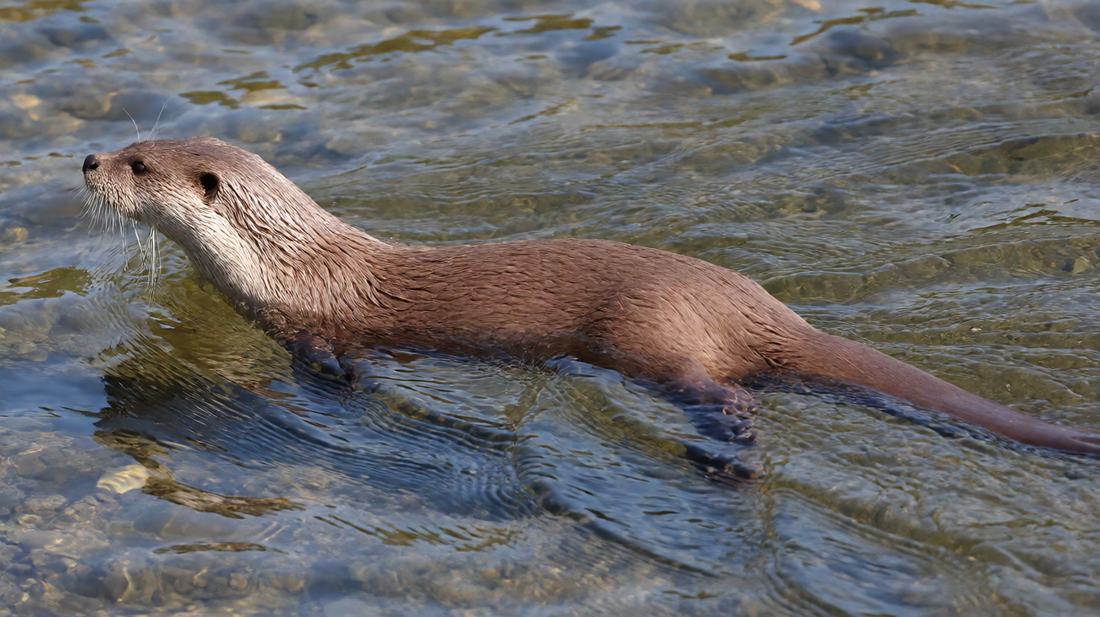
Lutra lutra | Eurasian Otter
Species Profile · Mustelidae
Eurasian Otter
The sleek hunter of European rivers and coasts that vanished from much of lowland Europe in the 20th century — and then came back.
IUCN: Near Threatened
Range
Body
Weight
Dive
Cubs
The river hunter
Europe’s comeback mammal
The Eurasian otter is a large sleek hunter that lives in and near water. It was gone from much of lowland Europe in the 20th century. Then it came back. The otter is a mustelid. It has a long body, a broad flat tail, short legs and webbed feet. Its thick coat keeps the skin dry. It hunts fish under water and eats on the bank or in the water.
It lives by rivers, streams, lakes, marshes, estuaries and quiet coasts. It needs clean water with plenty of fish. It also needs banks where it can rest by day. The animal lives alone and hunts at dusk and at night. In quiet places it hunts by day. Its droppings are called spraints. It leaves them on rocks and ledges.
Surveyors use them to find the animal. Across Europe the species crashed between the 1950s and the 1980s. The causes are well known. They were poisons in the water, killing by people, and the loss of river banks. Bans on the worst poisons and legal protection brought a strong return. The otter is now back over most of its old range in western Europe. It is the clearest sign of whether a river is healthy.
Family tree
Mustelidae, the weasel family
The Eurasian otter is in the family Mustelidae, the weasel family. It sits in the genus Lutra. Linnaeus named the species in 1758. He first put it in the genus Mustela. It was moved to Lutra later. The name Lutra is Latin for otter. The family holds weasels, stoats, polecats, martens, badgers and the other otters. The otters form their own group inside it, called Lutrinae.
There are 13 living otter species in the world. The Eurasian otter is the only one that lives across Europe, Asia and part of North Africa. Several subspecies have been named across that huge range. Most rest on skull size and coat colour. The status of many of them is unsettled. The closest kin of this otter are the other Old World otters. These include the smooth-coated otter and the hairy-nosed otter of southern Asia. Fossil otters of the genus Lutra appear in the Pliocene.
The modern species is known from Pleistocene deposits across Europe. The Eurasian otter is in the same family as the European badger. The badger is much heavier and lives on land. The two sit in different groups inside the family. The otter’s branch is shaped by life in water, not by digging. Both have the long low body and short legs of a mustelid. Both eat what they can find. But the badger digs and the otter swims.
Streamlined, whiskered, webbed
How to identify one
An adult otter has a head and body of 57 to 95 cm. The tail adds 35 to 45 cm. Males weigh 7 to 12 kg on average. Big males reach 17 kg. Females are smaller at 5 to 8 kg. The body is long and low. The tail is thick at the base and comes to a point. The coat is the key part. Each square millimetre of skin holds a huge number of underfur hairs.
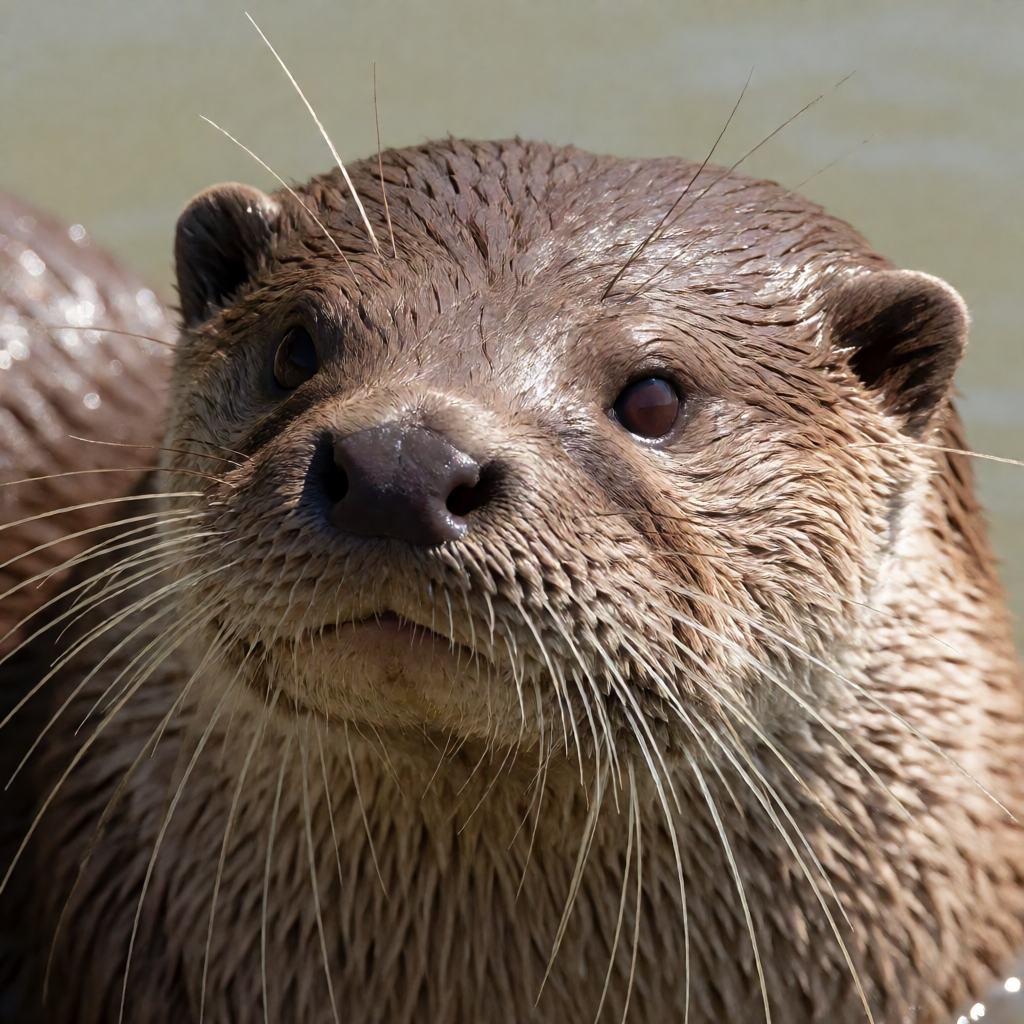
That is far more than a land mammal of the same size. The guard hairs are stiff and shed water. The underfur holds a layer of air next to the skin. That layer keeps the animal warm in cold water. The otter grooms all the time to keep it working. The fur is dark brown on top and pale on the chin and belly. The head is broad and round. The muzzle is blunt and the nose pad is wide. The eyes are small and set high.
The ears are small and round and shut under water. Long stiff whiskers stand out from the muzzle. They feel the water moves made by a fish in the dark. The feet are webbed to the tips. The claws are short. The tail works as a rudder. The animal swims fast. It can stay under for 1 to 2 minutes.
1
2
3
Clean rivers and rocky coasts
Where it lives
The Eurasian otter uses almost any water with enough fish and banks where it can rest. Rivers and streams are the core habitat. It lives from upland headwaters down to slow lowland reaches. It also uses lakes, reservoirs, canals, marshes, reedbeds, peat pools and estuaries. On coasts it needs fresh water to wash its coat. Sea-going otters in Scotland and Norway always have a fresh source near by. Cover matters as much as water quality.
The animal needs plants, rock piles, tree roots, pipes or thick scrub where it can lie up by day. That resting place is called a holt. A breeding female needs a den with a safe way in. The range covers most of Europe. It runs from Ireland and Iberia east to the Urals and on through Asia to Japan and Indonesia. It reaches into North Africa. The animal is gone from heavily built-up and farmed stretches.
There the banks are bare and the fish are gone. Otters hold long narrow territories along a river. The length depends on how much food the water holds. A rich lowland river may feed a female over 5 to 10 km. A poor upland stream may need 30 km or more.
Fish, frogs and crayfish
What it eats
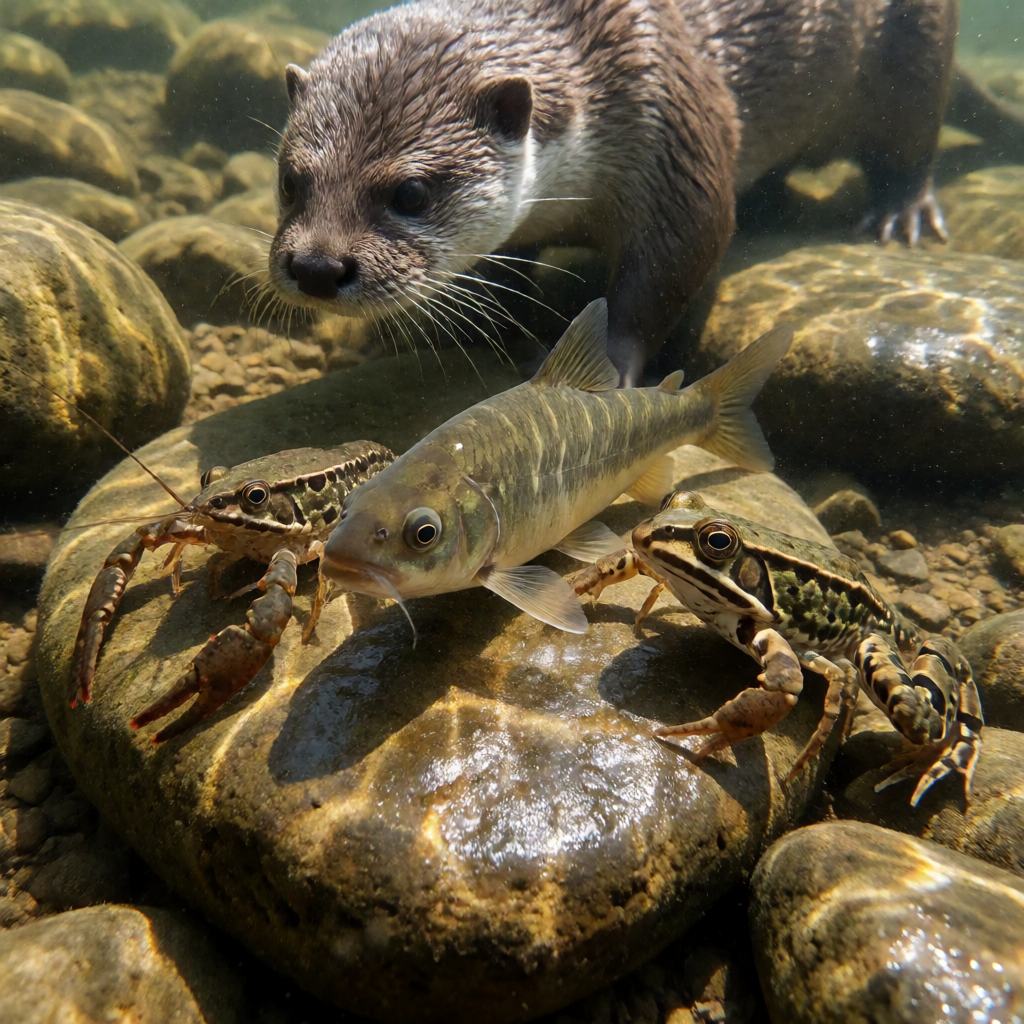
Fish make up most of what the Eurasian otter eats. The animal takes what is easiest to catch, not the most prized fish. That usually means slow fish that live near the bottom. It takes eels, carp, bream, tench, roach and catfish. Where salmon and trout are common it takes them too. Most prey is small. Most fish are 10 to 30 cm long.
An otter can kill a fish much bigger than itself. The animal is also an opportunist. It takes crayfish, crabs and other shellfish, frogs and toads, water birds and their chicks, small mammals and insects. Frogs can be the main food in some wetlands at some times of year. An adult needs 1 to 1.5 kg of food a day. That is about 10 to 15 per cent of its body weight. It loses heat fast in water.
The otter hunts by sight and by feel with its whiskers. In clear water it chases fish. In dark water it works the bottom and the banks. It feels into cracks with its front paws. It brings big prey ashore to eat and often starts at the head. It swallows pieces whole. Bones and scales pass through and show up in the spraint.
Cubs in a riverside den
The breeding cycle
Eurasian otters breed at any time of year. There is no fixed season across the range. Mating often peaks in spring. Males and females meet only to mate. Courtship means chasing and noisy play in the water. They mate in the water. Pregnancy lasts about 60 to 64 days. The species has delayed implantation. The egg does not fix to the womb at once. So the time from mating to birth can run to 9 months or more.
A litter holds 1 to 4 cubs. Most often there are 2 or 3. The cubs are born in a den. The den is usually a burrow among tree roots or a hole under rocks. The cubs are blind and have no teeth at birth. They weigh about 100 g. Their eyes open at 4 to 5 weeks. They start to leave the den at about 8 to 10 weeks. They learn to swim then. They are buoyant at first and have to learn to dive.
The female does most of the hunting. She teaches the cubs to catch fish. She brings live prey back for them to practise on. The cubs stay with her for 6 to 12 months. Then they leave. They often travel a long way along rivers to find their own range. Females first breed at 2 to 3 years. Wild otters usually live 8 to 12 years. Animals in captivity live longer.
Near Threatened, recovering
Conservation
The Eurasian otter is Near Threatened on the global Red List. The global listing rests on a falling trend across much of Asia. There the animal is hunted and its wetlands are lost and dirty. In Europe the story since 1990 is one of return. By the 1970s the species was gone or cut to fragments across lowland England, the Netherlands, Germany, Switzerland and much of central Europe. The main cause was poisoning by farm chemicals and PCBs. These built up through the food chain and cut breeding success.
Killing by anglers and trappers added to it. So did the clearing and straightening of banks. Legal protection and bans on the worst poisons let otters spread back. Better water treatment helped too. They came back from the stocks left in Scotland, Wales, Ireland, Iberia and eastern Europe. In Britain the animal is now found again in every county. Some threats remain.
Roads kill otters where they cross between rivers. Illegal killing still happens. Fish traps drown animals. Farm runoff and sewage still dirty many rivers. Drought packs both fish and otters into shrinking pools. The fix is mostly ordinary river care. Clean water, healthy fish stocks, and banks left with plants and holes.
Quick hits
Five things to remember
- An otter’s fur is so thick that water never reaches the skin, and the trapped layer of air is what keeps it warm in cold water.
- Its whiskers are sharp enough to catch fish in total darkness by feeling the water move.
- Otters shut their ears and nostrils with flaps of skin when they dive, and can stay under for 1 to 2 minutes.
- The droppings, called spraints, are left on rocks as scent marks, and surveyors find otters almost entirely from them.
- Otters have delayed implantation, so the egg floats free for months and the time from mating to birth can pass 9 months.