 By st20113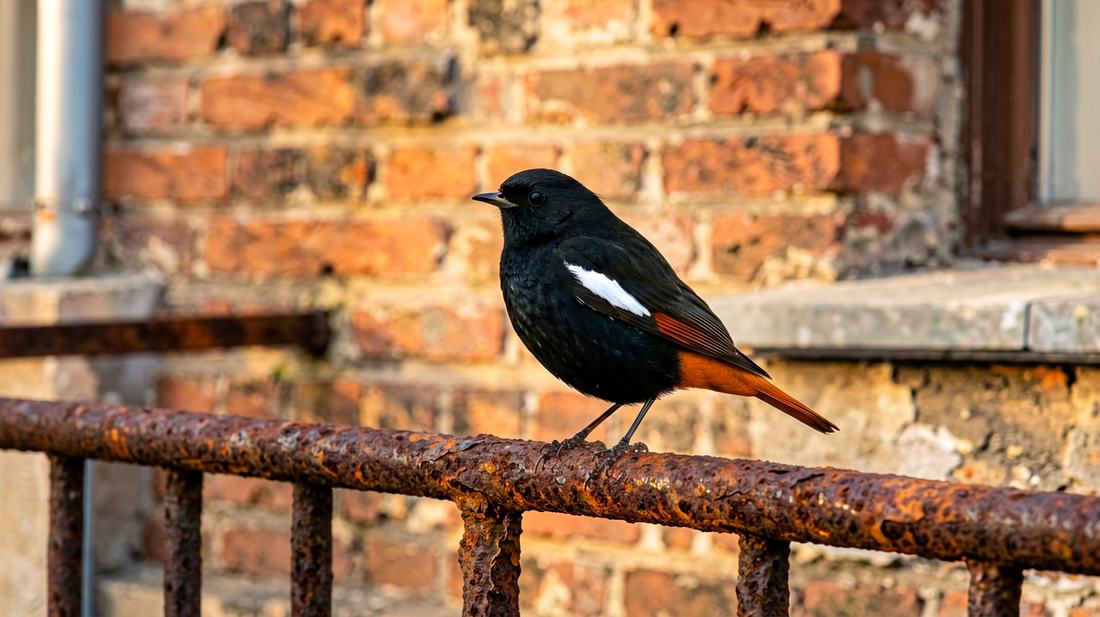
Phoenicurus ochruros | Black Redstart
Species Profile · Muscicapidae
Black Redstart
A mountain chat that moved into towns — smoky grey, white-winged, and in Britain a thin but stubborn population of demolition sites and railway yards.
IUCN: Least Concern
Range
Length
Weight
Nest
UK status
The town chat
From mountain scree to railway yard
The black redstart is a small, slim chat. It belongs to the family of the chats and flycatchers. It is one of the most surprising birds of the British list. It is just as surprising in north-west Europe as a whole. Its ancestors were birds of rocky hillsides, cliffs and screes. They lived in the Alps, the Pyrenees and the Balkans. They also lived in the mountains of Anatolia and Iran. Over the last 2 centuries the species has taken to breeding in towns. It now nests on industrial sites, in railway yards, in quarries and on the shells of ruined buildings.
In doing so it has spread north-westwards across the whole of Europe. It has also built a small, fragile but lasting population in Britain. The adult male is quietly handsome. His plumage is not the bright rufous and blue of the common redstart. It is a smoky, velvety blackish grey that looks almost black in dull light. A bold white panel shows on the closed wing. The rump and tail are rusty red. They flick into view whenever the bird drops to the ground. The female and the young are sober grey-brown birds.
Their rufous tail is the most striking feature they have. The species eats insects. It feeds largely on the ground, and it dashes into the air from a low perch. It is unusual among small songbirds in how far it has taken to the built environment. In the Alps it nests on a rock ledge above the tree line. In London it will nest in a hole in a wall. The survival of the British population is tied to rough, bare and lightly managed urban land. Most towns have been steadily removing that land.
Family tree
Phoenicurus, the redstarts
The black redstart belongs to the genus Phoenicurus, the redstarts. This is a group of about 14 species of small insect-eating chats. They are largely confined to the mountains and temperate forests of the Palaearctic. The bird sits with the chats, the wheatears and the flycatchers in the family Muscicapidae. That large group was created by the molecular revolution in bird systematics. Those studies showed that these birds are not close relatives of the thrushes. They also showed that the African rock thrushes form part of the same radiation. The closest relative of the black redstart within the genus is the common redstart, Phoenicurus phoenicurus.
The common redstart is a woodland and parkland bird of the western Palaearctic. It is markedly more arboreal and more migratory than its relative. The 2 species share the habit of quivering the tail. They also share the rusty rump and tail. They are known to hybridise on rare occasions. That happens where their ranges meet in eastern Europe and in Asia Minor. The taxonomy of the black redstart itself is complicated. The species is divided into a number of subspecies whose limits are still unsettled.
The nominate form, ochruros, occupies the highlands of Turkey, the Caucasus and Iran. A dark western form, gibraltariensis, occupies western and central Europe. That is the form that occurs as a very rare breeding bird in Britain. Further forms live in the Balkans, in the Levant and in Central Asia. It was the western subspecies that made the great urban expansion of the last 200 years. It is the ancestor of every black redstart that has bred in Britain.
Grey, white and rust
How to identify one
The black redstart is a small, neat bird with a rather flat crown. It measures between 13 and 14.5 centimetres in length. Its wingspan is between 23 and 26 centimetres. It has a short, fine bill and a body mass of between 14 and 20 grams. Its tail is a little shorter than that of a typical redstart. The bird keeps the tail in almost constant slight motion. It does this with a nervous, flicking quiver of the whole rear of the body. The adult male in full breeding plumage has a deep smoky grey head and throat. His breast and upper parts are the same smoky grey. On the face and the throat the grey is washed with an almost pure black.
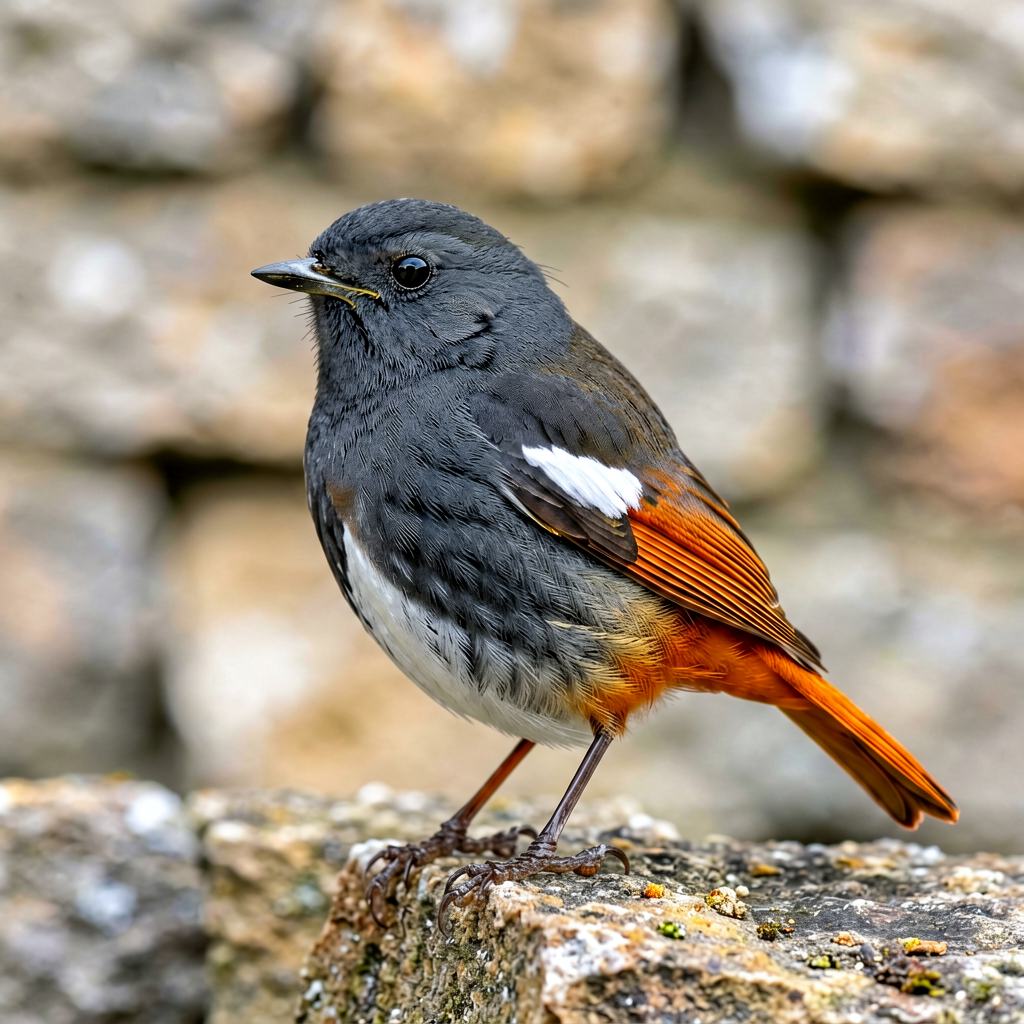
Against this dark ground the white of the wing panel stands out very sharply. That panel is formed by the pale tips of the median and greater coverts. It is also formed by the pale outer webs of those feathers. The lower breast and the belly are a slightly paler grey. The rump and the upper tail coverts are a warm rust-orange. The central pair of tail feathers are dark brown-black. The outer feathers are bright rufous. The bill and the legs are black. The female is a dull, uniform grey-brown above and a paler buff-grey below. She has no white wing panel and no black face.
Her only bold mark is the same rusty rump and tail, which the juvenile also has. The male in his first autumn and winter looks much like the female. He moults into the adult plumage only in his second calendar year. The first-year males seen on passage in Britain are therefore brown-backed birds. They show a hint of black on the face and the throat. The species has an upright, alert carriage. It often perches on a wire, a post or a rooftop aerial. It also uses the topmost twig of a shrub. From there it drops to the ground to take an insect, and it returns at once. That habit, with the constant tail quivering, makes the bird easy to pick out at a distance.
1
2
3
Quarries, walls and waste ground
Where it lives
The ancestral home of the black redstart is the rocky ground of mountains and foothills. The plants there are sparse. The species reaches about 2,400 metres in the Alps. It occurs at similar heights in the mountains of Anatolia and Iran. There it lives on cliffs, rock faces, screes and boulder fields. It also uses alpine pasture with scattered rock and the stony beds of torrents. From those places it has come down into quarries, stone walls, villages and terraced vineyards. Those places imitate the mountain ground. From the middle of the 19th century onwards it has colonised the towns. Roofs, gutters, walls, chimneys, railway stations and docks all work for it.
So do power stations and industrial estates. So do the areas of derelict ground that lie between them. Together they make an artificial landscape of bare rock and hot surfaces. The plants there are sparse and full of insects. That suits the species very well. In Britain the bird is a rare and erratic breeder. Its population has never gone beyond a few dozen pairs. It has been concentrated on the coasts of southern and eastern England. It has also used the industrial and derelict land of Greater London. The clearing of the London bomb sites removed much of what was once the best habitat in the country.
The rebuilding of the old docklands did the same. So did the rebuilding of the industrial riverside. Wintering birds turn up on the coasts and in the towns each autumn. They belong largely to the continental population. They are most numerous in the south-west, in the south and along the east coast. The species is a partial migrant. The birds of the Mediterranean and of the milder parts of western Europe are largely resident. The populations of central and eastern Europe move south and south-west in autumn. So do the birds of the alpine regions. They winter in the Mediterranean basin and in North Africa.
Insects on the ground
What it eats
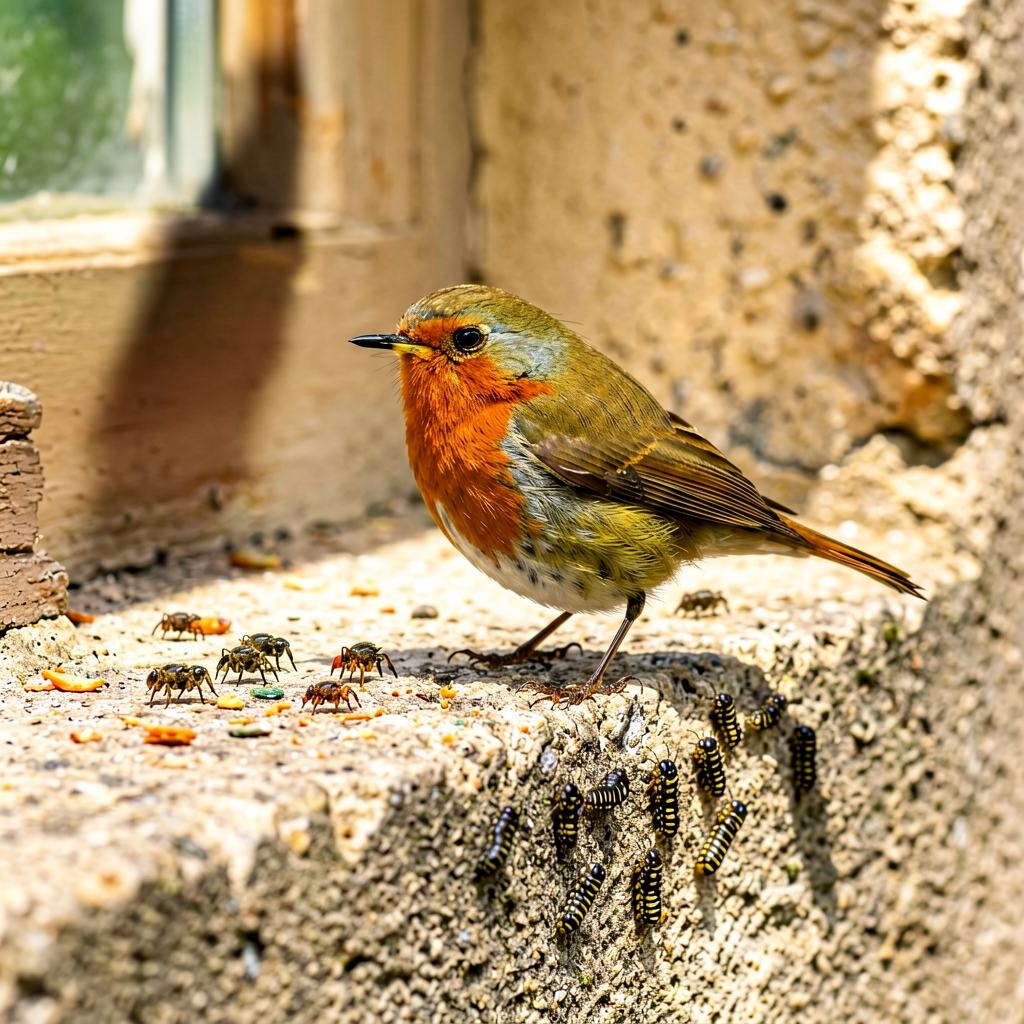
The black redstart eats insects throughout the year. In spring and summer its diet is largely the adults and larvae of small flies. It also takes beetles, moths, bugs, ants, bees and wasps. To these it adds spiders, harvestmen and small snails. It eats tiny earthworms on occasion, and the seeds of low herbs as well. It takes much of this food on the ground. It hops and runs over bare earth, gravel, stone and the flat roofs of buildings. It adds to the ground-feeding habit with flycatching.
It launches short dashes from a low perch into the air. There it snaps up a passing insect and returns to the same vantage point, much as a spotted flycatcher does. The bird also hovers briefly. It will pick insect prey from the surface of a wall or from the leaves of a low shrub. In autumn and winter the diet shifts towards fruit and seeds. Birds that winter in Britain and in the Mediterranean feed on the berries of ivy, elder and hawthorn. They also take the berries of blackthorn, cotoneaster and pyracantha. They eat the seeds of docks and of other weeds of waste ground.
They take whatever small invertebrate life can still be found on warm days in sheltered places. The young are fed on soft-bodied insects and larvae that both parents bring to the nest. The rate at which they are fed is high. The pair must therefore hunt over a considerable area of bare, open ground that is rich in insects. That is precisely the kind of land that is lost first. It goes when a derelict urban site is tidied, mown, paved or built on.
A crevice for a nest
The breeding cycle
The black redstart is typically monogamous. It forms its pairs in spring and may raise 2 broods in a good year. The male sets up a small territory around the site of the nest. He advertises it by singing from an exposed perch and by a display flight. He also flashes the white wing panel as part of courtship. The song is short, dry and scratchy. It is rather tuneless, and it is often described as sounding like a small stone rubbed against a file. It is delivered from a wall, a roof, a wire or the ridge of a building. The nest sits in a hole, a crack, a cavity or a ledge.
The species will use a hole in a wall, a gap between stones or a drainpipe. It also uses a crevice in a cliff or a burrow in the ground. A hole in a building works too. The frame of a window will do as well. The female lines the site with grass, moss and rootlets, and with wool, feathers and hair. The clutch holds between 4 and 6 pale, faintly speckled eggs. They are laid in April or May and incubated by the female alone for between 12 and 14 days. The chicks are fed by both parents. They leave the nest at between 15 and 17 days of age.
A second brood follows in June or July. The young birds depend on their parents for a further 2 or 3 weeks. They leave the breeding area in late summer. Ringing records show that individuals may live for 5 years or more. The oldest known wild bird reached an age of more than 8 years. The breeding season is early for the latitude at which many continental populations nest. Urban and mountain nest sites are warm and dry. That may let the birds start sooner than a woodland bird would.
A foothold in Britain
Conservation
The black redstart is listed as Least Concern on the global Red List. The world population runs into hundreds of thousands of pairs. The species as a whole therefore gives no cause for concern. The interest of the bird in a British setting lies elsewhere. It is a clear case of a species whose fortunes depend on a habitat that people make and destroy. It is also a case of a bird that is abundant worldwide and yet rare at the edge of its range. In Britain the breeding population has never been large. It has moved about between a handful of pairs and perhaps 50 or 60 pairs. It has suffered from the loss of the derelict and industrial land that it favours.
The rebuilding of the London bomb sites of the post-war years took away much of it. The modernisation of the docks and the power stations did the same. So did the tidying of the wasteland that lies between them. The species is listed as a rare breeding bird in Britain. It is also included among the birds of conservation concern. Its conservation therefore means chiefly a few practical things. One is the protection of the small areas of bare ground that remain. Another is the retention of rough, open and lightly managed land within regeneration schemes. A third is the provision of nesting cavities.
Loose stonework, open walls and the crevices of new buildings all help. The species makes a broader point. Some birds do not need quiet wilderness. They need the opposite. A town that keeps a little of its rough and broken ground keeps a bird that many of its people have never noticed. The black redstart is one of very few birds whose British range has been shaped by demolition and building. The climate and the plants of the country have mattered less.
Quick hits
Five things to remember
- The black redstart colonised Britain chiefly through the bomb sites of London after the Second World War. The rebuilding of those sites in the following decades took away much of its best habitat.
- The white panel on the wing of the male is formed by pale tips on the wing coverts. The bird deliberately flashes it during courtship and when it is excited.
- Its song is a dry, scratching jingle of very few notes. It is most often delivered from a roof ridge, a wall top or a wire rather than from a tree.
- The nest may sit in a crevice of a cliff, a hole in a wall, a drainpipe or a burrow in the ground. It may also sit in the frame of a derelict window, and the female lines it with grass, moss, hair and feathers.
- It belongs to the redstarts rather than the thrushes. Its rusty rump and tail, with its constant tail quivering, are the marks that identify it even when the plumage cannot be seen well.