 By st20113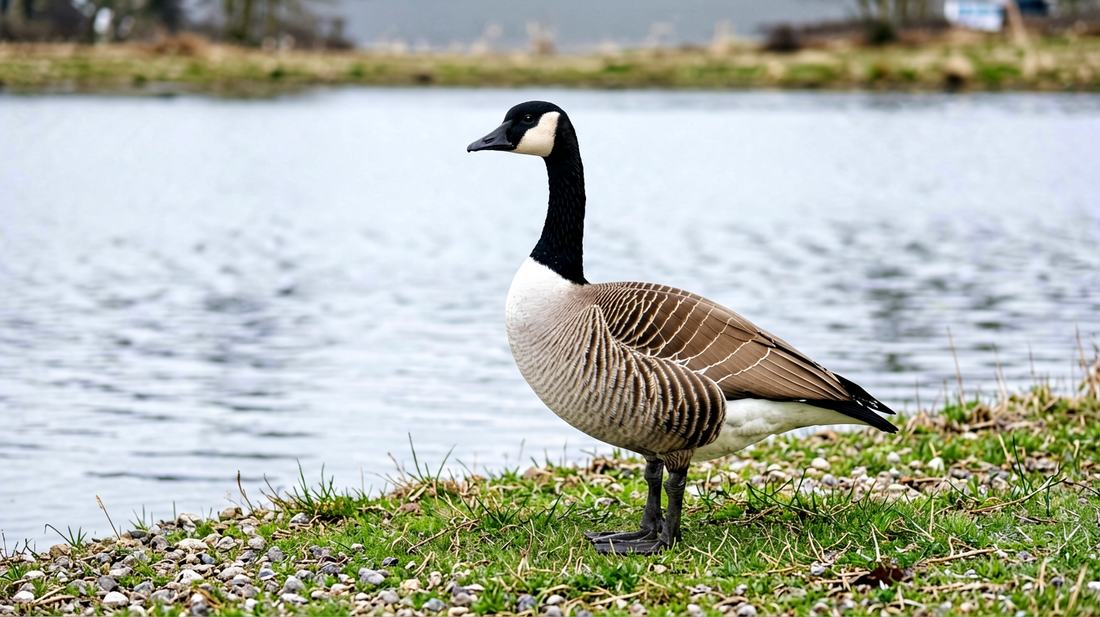
Branta canadensis | Canada Goose
Species Profile · Anatidae
Canada Goose
A grazing goose built for lawns and reservoirs — a treasured wild emblem in North America, and in Europe a park resident numerous enough to be managed as a pest.
IUCN: Least Concern
Range
Length
Weight
Nest
Diet
The park goose
A wild emblem turned town resident
The Canada goose is a large water bird. It belongs to the duck and goose family. It has a long black neck. A white strap runs under its chin. It is one of the best known birds of North America. In Europe it is now common in parks and lakes. It also lives in gravel pits and estuaries. Several countries treat it as a pest.
They manage its numbers. The bird grazes grass. It does not dive. It does not filter food from the water. It feeds in family groups on mown grass. It roosts in noisy flocks on open water. It nests in loose groups on islands and banks. These habits suit a landscape of short grass and rich water.
People make that landscape. In Britain every bird comes from introduced stock. The first arrived as ornaments in the 17th century. They went to a royal collection in England. More came in the 20th century. The flocks now damage crops and foul water. They also pose a risk to aircraft. So this goose faces one of the longest culls of any bird in Europe.
Family tree
Branta, the black geese
The Canada goose sits in the genus Branta. These are the black geese. They differ from the grey geese of the genus Anser. Black geese have a black head and neck. They also have pale chin straps. Grey geese have neither. Within the genus the Canada goose belongs to a group of large species. One of these is the nene, Branta sandvicensis. The nene evolved on the Hawaiian islands. It came from the same ancestral stock. Its islands held no ground predators. They also held very little grass, because the land is volcanic.
So the nene became a land bird. Its feet carry smaller webs. That close link shows something useful. The whole genus is a fairly recent group. It arose in the north Pacific and North America. It has no long history in Europe. Linnaeus named the species in 1758. He called it Anas canadensis. Modern authors accept between 4 and 7 subspecies. The number depends on the author. The nominate form breeds across the eastern Canadian forest. Its range runs from Newfoundland to Hudson Bay.
It is the parent stock of most European feral birds. The Atlantic form breeds in a narrow band. That band lies along north-east Quebec and Labrador. A giant form lives on the mid-western prairies. Other forms occur on the Pacific coast, in Alaska and inland. They differ in body size. They also differ in the darkness of the breast and in the shape of the head and bill. The small forms of the far north are little bigger than a mallard. They have a shorter bill and a higher voice. Many authors treat them as a separate species, the cackling goose. That split is widely but not fully accepted. It has made counts harder to read.
Neck, chinstrap and a grazer’s bill
How to identify one
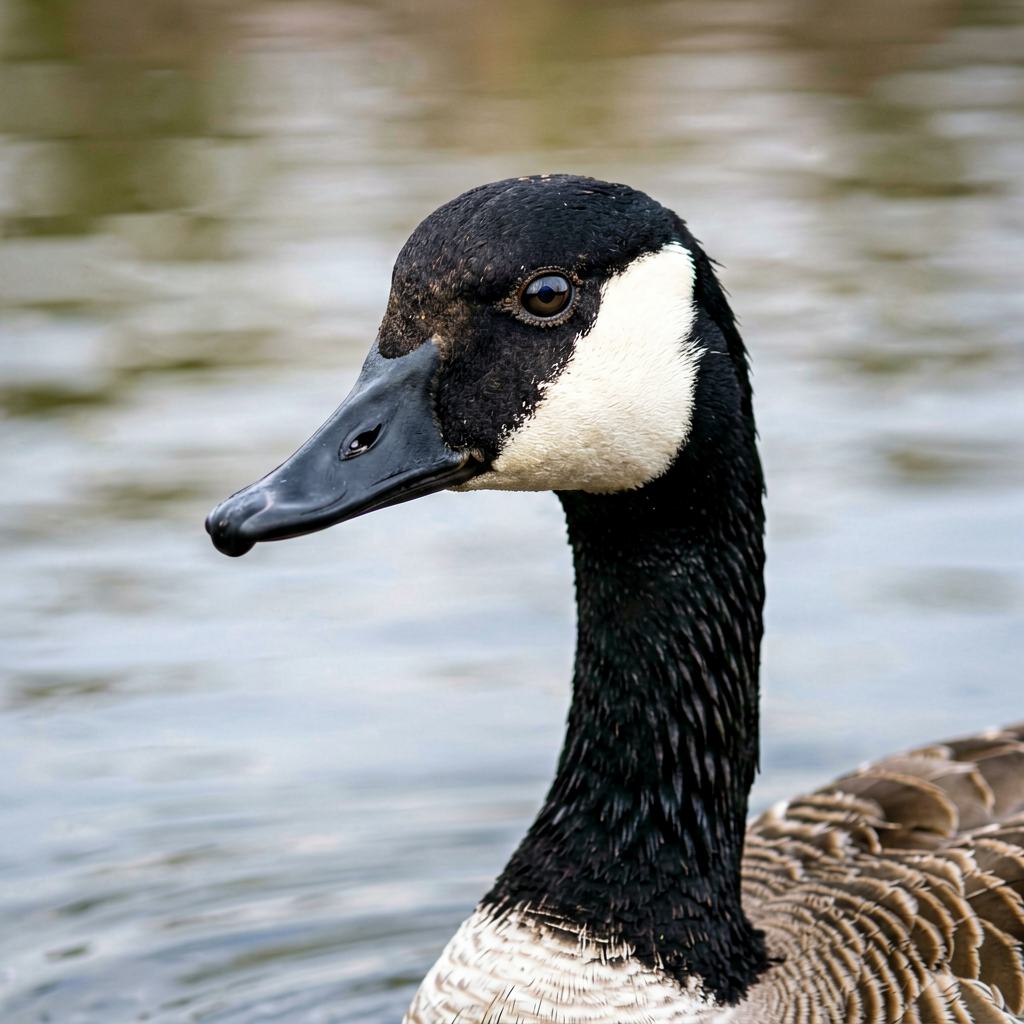
An adult is between 75 and 110 centimetres long. Its wingspan runs from 127 to 185 centimetres. Its weight varies a great deal. It runs from about 2.5 kilograms in the smallest forms to 8 kilograms in the giant prairie form. That is why a flock in a British park can hold birds of very different sizes. The largest is nearly 3 times the size of the smallest. Both sexes look much the same. The head and neck are black. A white strap runs from the chin up the side of the face. The back and mantle are brownish grey. Each feather has a paler grey edge.
The breast and belly are pale. In western forms they carry a buff wash. The tail and its coverts are black. The bill, the legs and the webbed feet are black. The eye is dark brown. Size and behaviour tell the sexes apart, not colour. The wings are broad and strong. Flight is strong and direct, with steady wing beats. A migrating skein flies in a V. The birds honk all the way. It is one of the best known sights of the autumn and spring sky in North America, and one of the best known sounds.
The voice is loud and harsh. The two sexes call at different pitches. The male calls lower than the female. That is easiest to hear in a pair in flight. The moult of the adult is odd. All the flight feathers drop at about the same time in mid-summer. A breeding bird then cannot fly for about 4 weeks. So the adults of a colony gather on open water. There they escape predators by swimming.
1
2
3
Lakes, gravel pits and estuaries
Where it lives
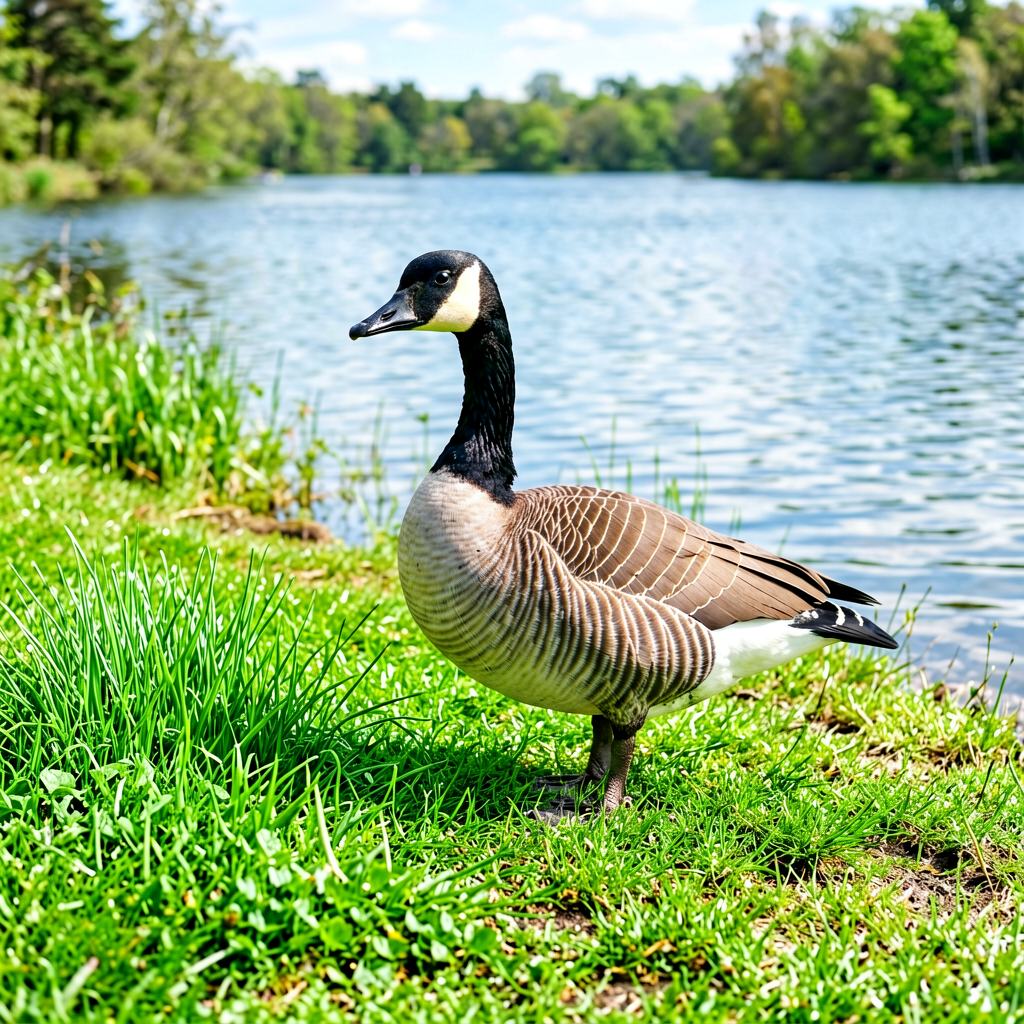
The species needs 2 things above all. The first is open water that is big enough to roost on. It must lie out of reach of foxes and other land predators. The second is short, rich grass within a few kilometres of that water. Pasture supplies it. So do mown grass, the edges of a reservoir and a canal bank. The outflow of a sewage works supplies it too, and so do arable fields of grain, oilseed rape and clover. In its native range the Canada goose breeds on the tundra.
It also breeds on the wooded shores of lakes and rivers of the boreal forest. It uses the aspen parkland and the prairie potholes of the interior. It winters in the coastal marshes of the southern United States. It also winters in the grain fields and the city parks of the southern United States and northern Mexico. In Britain, Ireland, Scandinavia, the Low Countries, Germany and parts of France the feral flocks stay all year. They depend on man-made versions of those places. That is why the largest numbers live in the Thames valley and the Home Counties. They also live in the cities of the Midlands and the industrial north.
Others gather along the estuaries, where the birds add plants from the tidal margins to a diet of grass. The species is a strong flyer. Migratory flocks of the far north travel several thousand kilometres. They move between their breeding grounds and their wintering quarters. They follow routes learnt from their parents. The feral birds of Europe rarely move more than a few dozen kilometres. Ringing shows that a single British bird may stay inside one county for the whole of its long life.
Grass, grain and roots
What it eats
The Canada goose eats almost nothing but plants. Its diet is mostly the leaves and growing points of grasses and sedges. It crops them close to the ground. Its bill is lined with fine serrations. The bill works as a shearing tool. It is not the comb of a filter-feeding duck. A grazing flock leaves a short, even sward. It rejects the stems and the coarser blades. The birds also eat the roots and rhizomes of water plants.
They eat the seeds and young leaves of cereal crops and clover. They take willow leaves and other shrubs where they can. They eat the berries of hawthorn and of the shrubs planted in parks. In spring they take a number of small water invertebrates and molluscs. These come in by accident with the plant food. They supply protein just as the females form their eggs. The birds cannot digest cellulose well on their own. They rely on a large, strong gizzard. They also have a very long caecum.
The result is that they feed for between 12 and 14 hours in every 24. They alternate bouts of fast cropping with rests. They produce a very large volume of droppings. That last fact lies behind much of the conflict with people. In some farming districts winter flocks cause measurable losses. The losses fall on winter-sown cereals and on grass grown for silage. Droppings foul playing fields, golf courses and bathing beaches. They also foul the edges of drinking water reservoirs. That creates both a health problem and a serious cost.
Family parties on the shore
The breeding cycle
Canada geese usually pair for life. A bond may sometimes break after a failed breeding attempt. The normal pattern is that a young bird picks a mate in its second or third year. The two then stay together all year. They return to the same nesting place season after season. The male gives a loud and vigorous defence of a small area around the nest. He drives off other pairs and other species. Nesting starts in the second half of March. It runs into May.
The nest is a bulky heap of grasses, stems, twigs and mosses. It is lined with down that the female plucks from her own breast and belly. It sits on the ground on an island, a bank or a small point of land. It may sit on a muskrat lodge or an old crow’s nest. It may sit on a ledge of a building or a haystack. In the more adventurous cases that have made the species notorious, it sits on the flat roof of a factory. It also sits on the balcony of a block of flats. The clutch holds between 4 and 6 eggs. They are laid at daily or slightly longer intervals.
The female incubates them alone for between 25 and 28 days while the male guards nearby. The goslings are precocial and leave the nest within a day or 2. Their parents lead them to water at once and stay with them throughout. The young can fly at between 40 and 48 days. The family party then holds the 2 adults and the surviving young of the year. It stays together until the following spring. The young birds are then driven off at about 10 months of age, or they drift away on their own. Once the summer moult has filled the gaps left by the lost flight feathers, the survivors join the moulting and wintering flocks.
From ornament to pest
Managing an introduced goose
The Canada goose is listed as Least Concern on the global Red List. There is no doubt about the health of the species as a whole. The North American population runs into millions of birds. Most of its stocks are stable or growing. The problems arise at the local scale. There the success of the species creates conflict. In Britain the feral population was estimated at fewer than 20,000 birds when the first national survey was made. It grew fast through the last 3 decades of the 20th century.
The figure is now well over 60,000. It is reckoned to have risen more than a hundredfold from the handful of birds released into the parks and estates of the 17th and 18th centuries. The same pattern appears in the Low Countries, in Scandinavia and in Germany. The result is that the species is now managed rather than merely protected. Landowners and conservation bodies can treat eggs with paraffin. They can swap the clutch for dummy eggs. They can cut back the mown grass around water bodies. They can keep the birds out of feeding areas with hedges and trained dogs.
As a last resort they can cull under licence. That last step is taken mainly where the risk to aircraft is greatest, or where the threat to drinking water is greatest. The species shows a general problem in conservation. A bird can be a valued part of the native fauna in one part of its range. In another part it is an unwelcome, disruptive addition. The argument over the Canada goose is at heart an argument about what a landscape that people have entirely remade should contain.
Quick hits
Five things to remember
- The largest form, the giant Canada goose of the mid-western prairies, can weigh as much as 8 kilograms, which makes it the heaviest goose in the world by a clear margin.
- Canada geese were brought to St James’s Park in London in 1665 as ornaments for the waterfowl collection of Charles II, and every feral bird in Britain descends from that introduction and from the releases that followed in the 20th century.
- All the flight feathers are shed within a few days of one another in mid-summer, which leaves the adults flightless for about 4 weeks and forces them to gather on open water to escape predators.
- A migrating skein flies in a V, and each bird gains lift from the bird in front of it; the constant honking of the flock is thought to help the birds hold station and keep the group together.
- A single goose produces between 1 and 2 kilograms of droppings every day, and it is this rather than the grazing itself that brings the species into conflict with the users of playing fields, golf courses and reservoirs.