 By st20113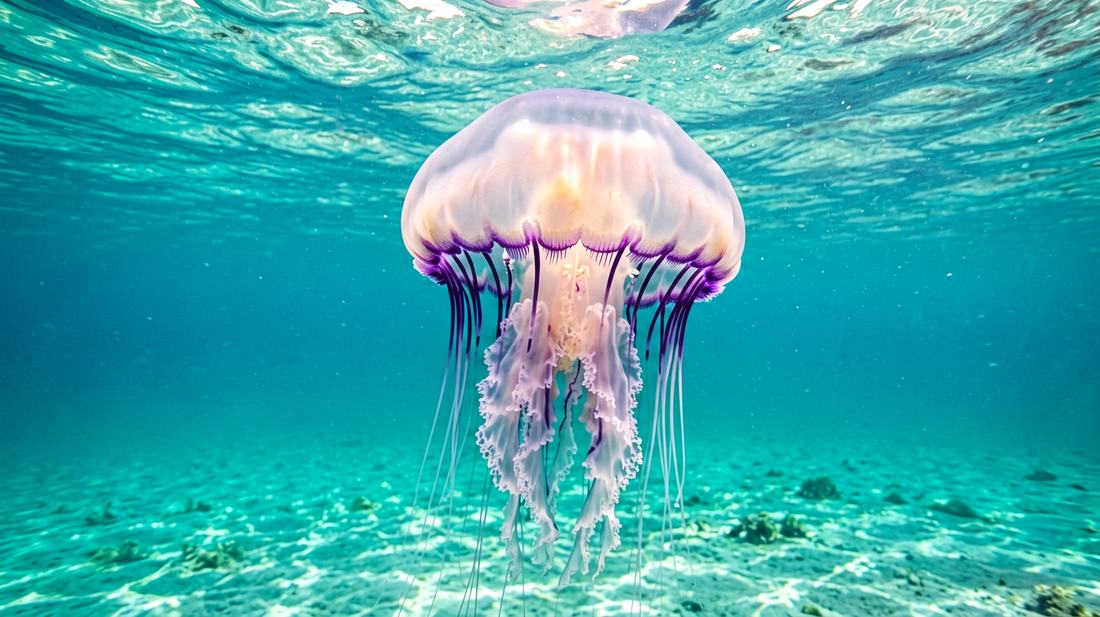
Rhizostoma pulmo | Barrel Jellyfish
Species Profile · Rhizostomatidae
Barrel Jellyfish
The biggest jellyfish in British and Mediterranean water: a drifting giant with eight frilly arms and no tentacles.
IUCN: Not Evaluated
Range
Bell
Weight
Life
Status
A giant without tentacles
The barrel jellyfish
The barrel jellyfish is the biggest jellyfish around Britain. It is one of the largest in the Mediterranean. Its bell can grow as wide as a dustbin lid. This won it the name dustbin-lid jellyfish. A big one weighs about as much as a bag of cement.
It has no long stinging tentacles at all. Eight thick, frilly arms hang under the bell. They are packed with tiny mouths. In most years it drifts hidden offshore. In warm summers it appears by the thousand along coasts and shores.
Swimmers often worry about it. Its sting is mild and rarely breaks our skin. It is a soft giant of the plankton. It is a top food of the leatherback turtle.
Family tree
Among the true jellyfish
The barrel jellyfish is in the class Scyphozoa. This is the group of true jellyfish. It is in the order Rhizostomeae and the family Rhizostomatidae. Its closest kin in European waters is the Moon Jellyfish. It shares the same two-part life cycle. This has a drifting medusa and a fixed polyp.
The two are easy to tell apart. The moon jellyfish is a flat, four-ringed disc with fine tentacles. The barrel jellyfish is a domed, heavy bell. It has no edge tentacles and purple edges. The genus name Rhizostoma means root mouth. This refers to the branching arms that carry the mouths.
Pulmo is Latin for lung. The species was described in 1778. Related forms live in the east Atlantic and the Indo-Pacific. The group is odd among jellyfish. It has lost the central mouth.
Bell, lobes and arms
Built almost entirely of water
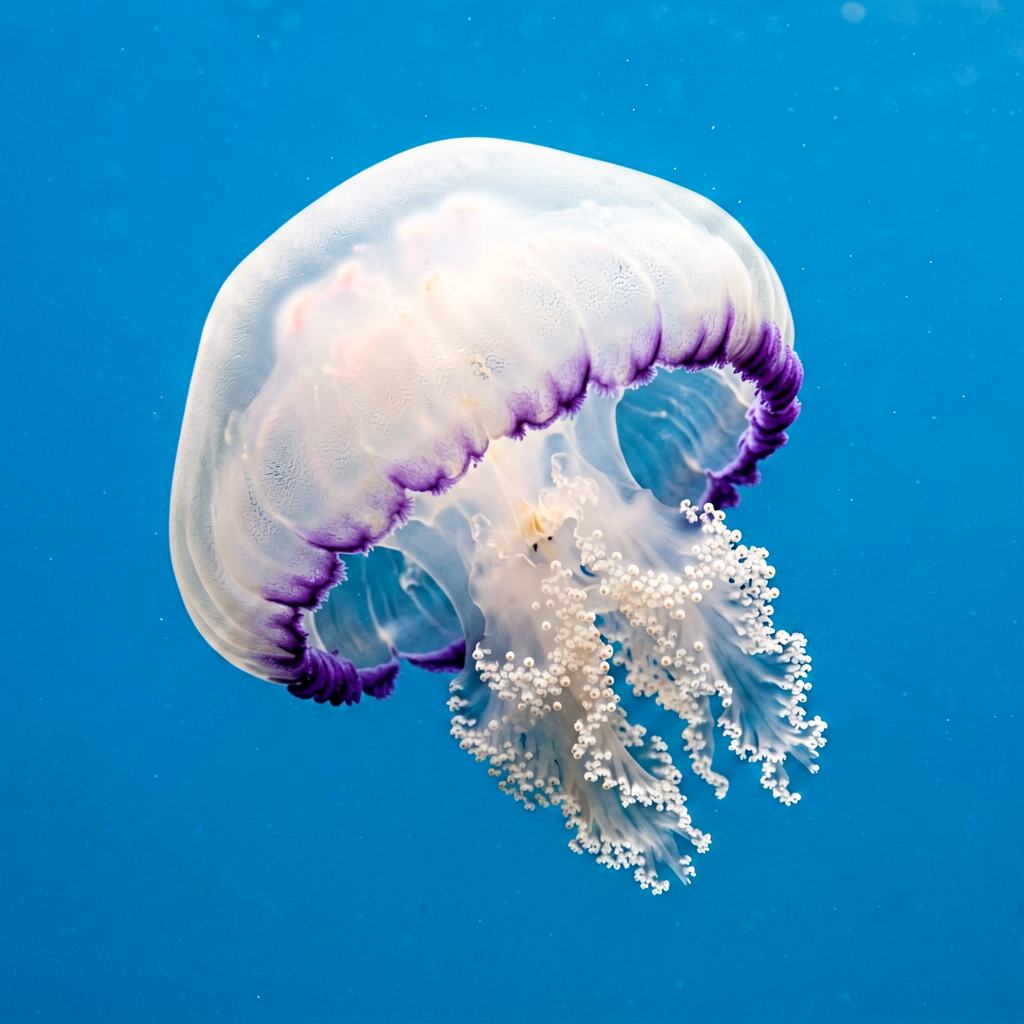
The bell often measures 40 to 60 centimetres across. It sometimes reaches 90 centimetres. Weight can reach 25 kilograms. Some large ones are said to be heavier. The bell is very domed. It is sometimes taller than it is wide. It is thick and firm rather than soft. Round its edge run roughly 80 to 90 lobes. They are fringed in purple or blue.
There are no edge tentacles. Under the bell hang eight stout oral arms. They are very long and tightly frilled towards the base. They end in smooth, un-branched tips. The arms are full of hundreds of small holes. These lead to the gut. The animal can process food without a single central mouth. The colour is milky white or pale blue. There is often dark purple tint on the lobes and arm tips.
The sting cells are weak for a jellyfish. They often cannot pierce our skin. Touch gives at most a mild itch. The body is near 95 per cent water. It holds its shape through the push of the sea round it. It has no bones. The eight arms reach far below the bell. When a jellyfish strands, they collapse into a shapeless mass.
1
2
3
Drifting with the current
Where blooms appear
The barrel jellyfish lives in the north-east Atlantic. It also lives in the Mediterranean, the Adriatic and the Black Sea. Its centre of plenty is the Mediterranean. There it is the largest common jellyfish. It often reaches British and Irish coasts. It reaches the North Sea and the Channel too. It drifts from the top down to about 40 metres.
It takes low salt. So it enters river mouths, coastal lagoons and brackish bays. It swims weakly. Its moves are ruled by currents, wind and tides. In spring and summer it drifts towards the coast. This is when plankton peaks. In warm years it gathers in huge numbers.
Mass strandings follow. They leave pale discs along the tideline. The biggest groups appear in warm, sheltered water. That water has plenty of plankton. In cooler years blooms are patchier and more southern.
What it eats
Filtering the plankton
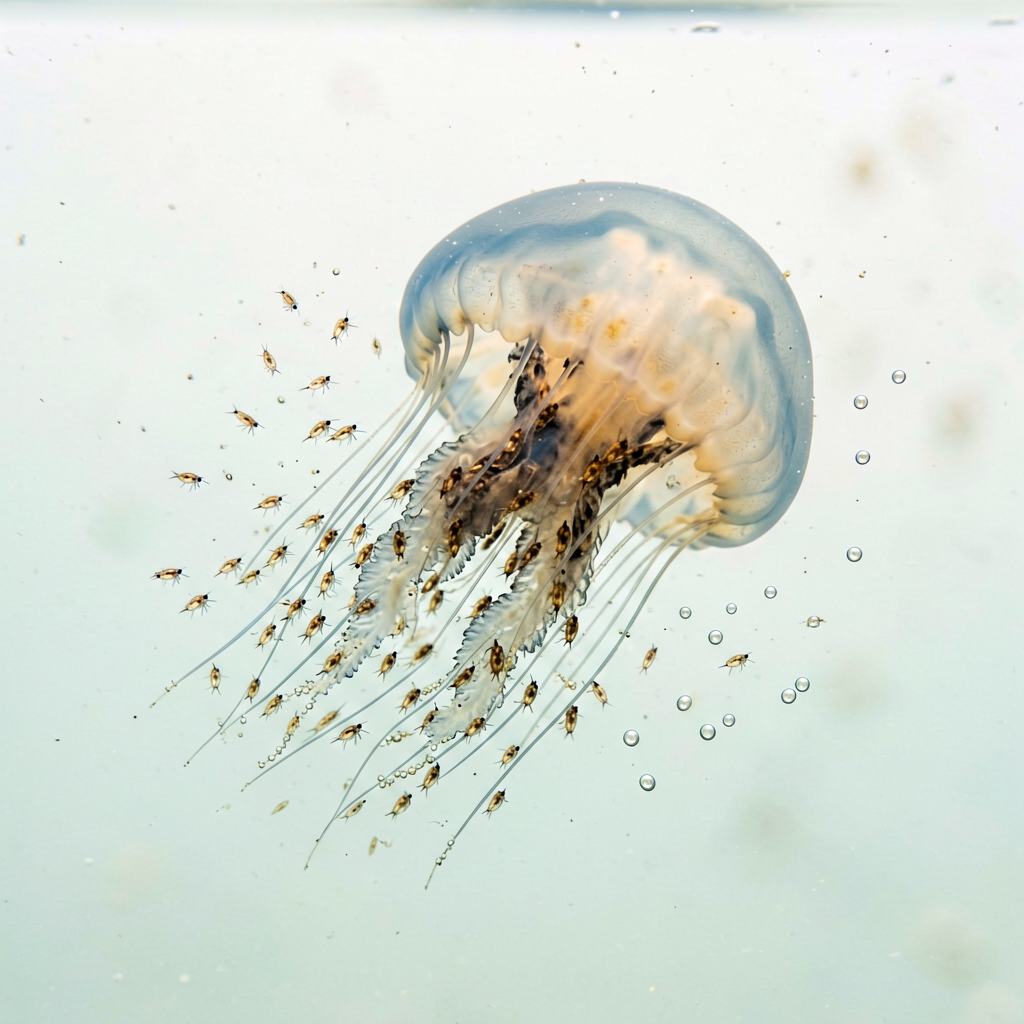
The barrel jellyfish is a filter feeder. It eats some of the smallest animals in the sea. Its main food is zooplankton. This includes copepods such as Calanus and small crustacean larvae. It also includes fish eggs, fish larvae and tiny molluscs. It does not chase its food. The bell pulses slowly, drawing water across the frilly oral arms.
Food bits stick to slime. They are taken through the small holes into the gut. Feeding continues day and night while the animal drifts. The jellyfish can clear a big volume of water. In turn it is eaten by few animals. Its flesh is low in fuel and full of stinging cells. The only big eater is the leatherback turtle.
It lives on jellyfish and takes barrel jellyfish in big numbers. Ocean sunfish also feed on them. Some small fish and crustaceans ride under the bell for shelter. Its stomach holds mostly copepods, larvae and eggs. These are gathered from a wide area as the animal drifts.
Polyp and medusa
A life in two parts
Barrel jellyfish have two sexes. Both free their cells into open water. Eggs meet in the sea. They grow into a tiny swimming larva called a planula. The planula rests on the seabed. It turns into a polyp. The polyp is a small fixed animal that looks nothing like a jellyfish.
It can live for months or years. When things are right, the polyp buds off stacks of young medusae. This step is called strobilation. These tiny jellyfish grow fast through the summer. Most medusae live for one season only. They grow through spring and breed in late summer. Then they die as winter arrives.
That short life shows the boom-and-bust pattern. A strong year class makes huge swarms. The next year may bring very few. Polyps stay on the seabed. They can seed later broods.
Not assessed, not protected
Pressure on the sea
The barrel jellyfish has not been assessed for the IUCN Red List. So it has no set class. That does not mean it faces no threats. Plastic bags and other trash look like jellyfish. Sea turtles and other animals swallow them. Pollution and bad runoff hurt water state. They also affect the plankton that jellyfish eat.
Warming seas may shift bloom timing and range. There is long debate about if jellyfish rise as fish stocks fall. The species is not caught for sale. It is hard to track. Its numbers are poorly known and no plain cover. In practice it gains from wider steps. These are marine saved areas, clean coast water and less plastic waste.
Scientists now ask the public to report strandings. This is one reason the barrel jellyfish is now among the best-known jellyfish in Europe. Beach clean-up groups, museums and wildlife groups collect those notes. The flow of sightings is the main source of news. It shows where and when blooms appear.
Quick hits
Five things to remember
- The barrel jellyfish is also called the dustbin-lid jellyfish because of its size.
- It has no tentacles around the bell. All of its mouths are hidden in eight frilly arms.
- A large one can weigh up to 25 kilograms. Yet it is about 95 per cent water.
- Leatherback turtles travel thousands of kilometres to feed on jellyfish like this one.
- Its sting is so weak that it usually cannot pierce human skin