 By st20113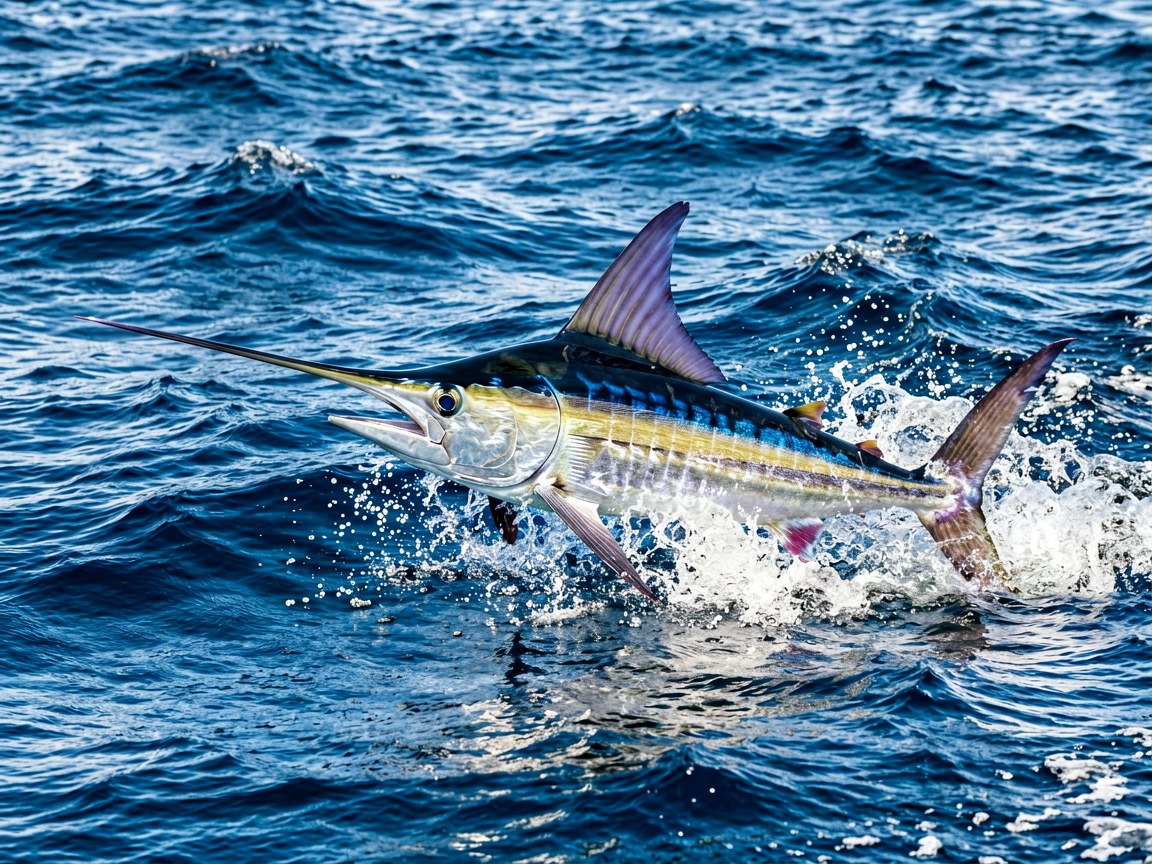
Makaira nigricans | Atlantic Blue Marlin
Introduction
The Atlantic blue marlin, Makaira nigricans, is one of the largest and most iconic billfish, a powerful predator of the open Atlantic prized by anglers and studied for its speed and physiology. Marked by a long spear-like upper jaw, a tall sail-like dorsal fin, and a cobalt back fading to silver, the blue marlin is built for the pelagic realm. Adults migrate across ocean basins, tracking warm currents and the schools of tuna, squid, and small fish they eat. They are among the fastest fish, with bursts over 100 kilometers per hour. Though commercially valuable and long heavily fished, the species is now managed by catch limits and, in many places, promoted as a catch-and-release game fish. As a flagship for ocean health, accurate knowledge of its biology and conservation matters.
Taxonomy
Makaira nigricans is a member of the family Istiophoridae, the billfishes, within the order Perciformes and the scombroid suborder that includes tunas and mackerels. The genus Makaira comes from a Greek word for short sword, referring to the bill; the epithet nigricans means blackish, for the dark blue back. The Atlantic blue marlin is usually treated as separate from the Indo-Pacific blue marlin, though older works lumped them; modern genetics support the split. Close relatives are the white marlin, striped marlin, and swordfish, the last in its own family. Like the [Yellowfin Tuna](https://www.gloencyc.com/tuna-thunnus-albacares/), a powerful scombroid sharing the marlin’s pelagic, migratory tropical life, the marlin is a fast, partly warm-bodied predator roaming huge distances for schooling prey, though the two are distant scombroid branches. Lacepede described it in 1802, and its taxonomy has been revised as Atlantic and Pacific forms were compared.
Physical Characteristics
The Atlantic blue marlin is a large, elongate fish with a robust rounded body and a bill formed by the prolonged upper jaw. Females grow much larger than males: males rarely exceed 160 kilograms and 3.5 meters, while females commonly reach 200 to 400 kilograms and 3 to 4 meters, the largest verified near 820 kilograms and 5 meters. The body wears elongated embedded scales with a single keel-like ridge, and the lateral line is faint. Color is vivid cobalt to blue-black above, silvery white below, and the fish can quickly lighten or darken, as other billfish do. The first dorsal fin is high and pointed; the anal nearly mirrors it; both retract into grooves. The stiff pectorals fold flat to cut drag at speed. Internally, a heat exchanger warms the eye and brain, sharpening vision and coordination in cool water. The narrow crescent tail drives the explosive swimming for which the species is known.
Habitat
The Atlantic blue marlin lives in tropical and warm temperate Atlantic waters from about 45 degrees north to 35 degrees south, including the Caribbean, the Gulf of Mexico, and the western, central, and eastern Atlantic. It is a strictly epipelagic oceanic species, commonest beyond the shelf in water above about 22 to 24 degrees Celsius, ranging through the upper 200 meters and diving deeper to forage. It favors edges of strong currents like the Gulf Stream and North Brazil Current and convergence zones where upwelling gathers prey. Seasonal moves follow sea temperature and prey: in the west, fish go north along the U.S. coast in summer and back to the Caribbean and equator in winter; in the east they range from the Azores and Madeira south to the Gulf of Guinea and off Brazil. Tagging and pop-up tags confirm basin-wide travels of thousands of kilometers. They seldom approach shore except where deep water lies close, and rarely enter water below about 20 degrees Celsius. Adults may make vertical dives of several hundred meters in a single day, likely to exploit deep prey layers and to thermoregulate as they cross temperature gradients.
Diet
The Atlantic blue marlin is an apex predator feeding mainly on epipelagic fishes and squids. Principal prey are tunas and tuna-like fishes such as frigate and bullet mackerel, dolphinfish, flyingfish, sauries, and carangids, with cephalopods like squid important too. It hunts by slashing and stunning prey with its bill, often charging a school to injure several fish before circling back to eat them. This slashing differs from the spear-impalement often imagined; the bill is a whip more than a skewer. Feeding is mostly near the surface and in the upper mixed layer, where schools bunch along current edges and floating objects. The large eyes and retained warmth suit low-light dawn and dusk hunting. Its diet overlaps that of tuna, seabirds, and dolphins, placing it atop a competitive web. Prey shifts drive its migrations, and juveniles eat small planktonic organisms and tiny fish before moving to larger prey.
Reproduction
The Atlantic blue marlin is oviparous, releasing buoyant eggs into open water where fertilization is external, as in tunas and most pelagic teleosts. Spawning occurs in warm water, with major grounds in the Gulf of Mexico, the Caribbean, and the western tropical Atlantic, generally spring through summer when temperatures exceed about 24 to 26 degrees Celsius. A large female can produce millions of eggs a season, offsetting very high larval mortality; the tiny larvae are planktonic and vulnerable to predation and starvation. There is no parental care. Males mature earlier and smaller, at roughly two to three years and 1.5 to 2 meters, while females mature at three to four years and larger sizes. Growth is fast at first, then slows. High fecundity contrasts with the slow maturity of many sharks, giving some resilience, though adults stay vulnerable to targeted and incidental catch. Gulf of Mexico spawning aggregations are key for the western stock and a management focus. Spawning also occurs off the Greater Antilles and along the southern Caribbean shelf, and the tiny larvae are carried by currents into nursery areas along continental margins where they grow rapidly through their first year.
Conservation
The Atlantic blue marlin is listed as Vulnerable by the IUCN, with the western stock historically depleted by decades of overfishing but slowly rebuilding under stricter rules. Main threats are commercial longlines for tuna and swordfish, where marlin are bycatch, and targeted recreational and commercial take for meat and trophies. As a valuable game fish, catch-and-release angling is widespread and promoted for conservation, though survival varies with handling and gear. Bodies like the International Commission for the Conservation of Atlantic Tunas set catch limits and rebuilding plans, and some fisheries improved observer coverage and gear to cut mortality. Climate change is an emerging threat, shifting the ranges of both marlin and prey and possibly mismatching spawning grounds with good conditions. Continued monitoring, quota enforcement, and reduction of illegal, unreported, and unregulated fishing are essential for recovery across its pan-Atlantic range.
Fun Facts
- Female blue marlin grow far larger than males, with the biggest verified specimens over eight hundred kilograms.
- The marlin’s long upper jaw slashes and stuns prey rather than spearing like a harpoon.
- It is among the fastest fish, capable of short bursts above one hundred kilometers per hour.
- Blue marlin can change the brightness of their blue and silver color, likely for communication or camouflage.
- A single female can shed several million eggs a season to offset huge larval losses.