 By st20113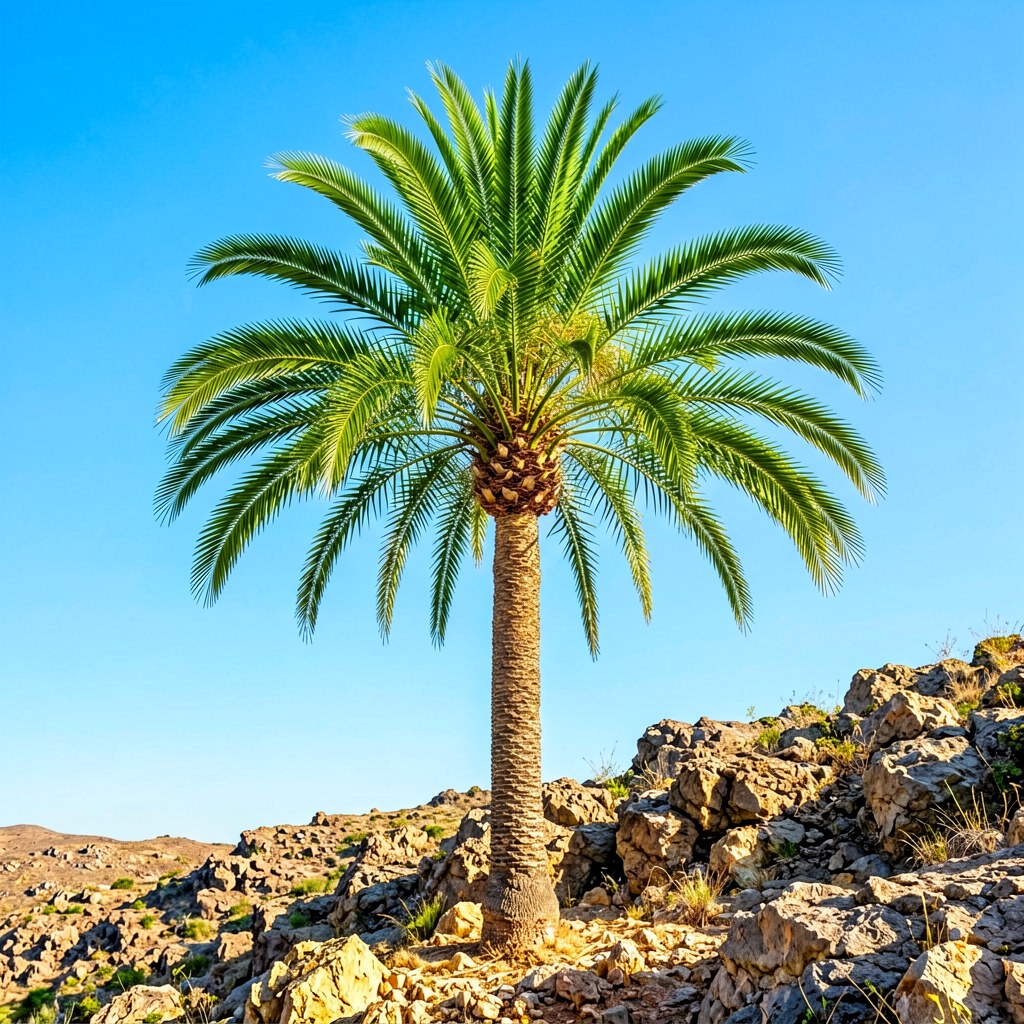
Phoenix canariensis | Canary Island Date Palm
Introduction
The Canary Island date palm (Phoenix canariensis) is a towering evergreen palm celebrated across warm temperate and subtropical regions as one of the most recognizable ornamental trees in the world. Endemic to the Canary Islands off the northwest coast of Africa, this species has been cultivated for more than a century in parks, avenues, and private gardens from the Mediterranean basin to California, Florida, and Australia. Mature specimens form a stout, solitary trunk crowned by a dense fountain of long, arching feather leaves that can dominate a city skyline. Although it produces edible fruits, the small dates are fibrous and less palatable than those of its commercial relatives. In its native range it grows on slopes, ravines, and laurel forest margins, often forming groves that shelter birds and invertebrates. The palm’s longevity, with individuals living well over a hundred years under good conditions, contributes to its status as a living landmark in many towns.
Taxonomy
Phoenix canariensis was formally described by the Belgian botanist Charles Lemaire in 1862, though the plant had been known to European gardeners far earlier through introductions from the islands. It sits within the family Arecaceae, the true palms, and the genus Phoenix, a group of roughly fourteen species of feather-leaved palms distributed from the Atlantic islands through the Middle East to Southeast Asia. Its closest relatives include the date palm (Phoenix dactylifera) and the wild Phoenix sylvestris of the Indian subcontinent; the genus is distinguished by pinnate leaves and a characteristic hastula at the leaf midpoint. Within Arecaceae it shares the subfamily Coryphoideae with several other Old World palms. For readers comparing island palms, the better-known [Coconut Palm](https://www.gloencyc.com/coconut-palm-cocos-nucifera/) belongs to the same family Arecaceae but to a different tribe and is adapted to tropical coastal beaches rather than dry island slopes. Early classifications sometimes confused P. canariensis with P. dactylifera, but cultivation records and fruit morphology separate them clearly. Modern molecular phylogenies confirm the genus Phoenix as monophyletic and place the Canary Island endemic securely among western Palearctic members of the clade.
Physical Characteristics
A mature Canary Island date palm typically reaches heights of 10 to 20 meters, occasionally more in ideal climates, with a trunk that slowly thickens to 60 or 90 centimeters in diameter and becomes ringed with the persistent leaf bases of fallen fronds. The crown supports forty to sixty pinnate leaves, each spanning 4 to 6 meters, held in a graceful upward and outward arch. Each leaf carries eighty to one hundred narrow leaflets arranged in a single plane along a stout rachis, giving the foliage a feathery, plumose appearance. The species is dioecious in the sense that male and female flowers occur on separate plants, with creamy yellow inflorescences enclosed in a large woody spathe. The fruits are oblong dates roughly 2 centimeters long, turning from green to orange-brown and containing a single hard seed. Landscape specimens are often planted with a cleared lower trunk to show the textured, diamond-patterned bark that the old leaf scars leave behind.
Habitat
In its native Canary Islands, Phoenix canariensis occupies a narrow ecological band on the islands of Gran Canaria, Tenerife, La Gomera, La Palma, and El Hierro, where it grows on humid ravine walls, north-facing slopes, and the transitional edges of laurel forests at elevations between 300 and 1200 meters. It favors well-drained volcanic soils and benefits from the cool, moist trade-wind cloud layer that bathes the northern slopes. Although the islands are arid on their southern sides, the palm exploits microclimates where groundwater seeps through fractured basalt. It tolerates coastal salt spray and brief droughts but performs best with regular moisture and full sun. The species seldom establishes in dense forest shade, preferring open or lightly wooded sites where its crown can receive direct light. In urban settings it adapts to compacted soils and irrigation, though poor drainage encourages fatal trunk rot.
Diet
Like all palms, the Canary Island date palm is an obligate autotroph that meets its carbon and energy needs through oxygenic photosynthesis in its fronds. The mesophyll cells of the pinnate leaves host abundant chloroplasts, and the species follows the standard C3 photosynthetic pathway, fixing atmospheric carbon dioxide into sugars during daylight hours using the enzyme RuBisCO. These carbohydrates are transported as sucrose through the phloem-like sieve tubes of the stem to growing tissues, developing inflorescences, and the storage parenchyma at the trunk base. The palm draws water and dissolved mineral nutrients, chiefly nitrogen, potassium, magnesium, and phosphorus, from the soil through an extensive fibrous root system that radiates outward near the surface. Unlike animal consumers, it requires no ingested food; instead mycorrhizal fungi in the root zone frequently assist phosphate uptake in exchange for photosynthate. The plant regulates water loss through stomata on the leaf underside and sheds old fronds to balance nutrient economy.
Reproduction
Phoenix canariensis is dioecious, meaning individual plants are either male or female, and effective seed set requires cross-pollination between neighboring trees by wind and by insect visitors that transfer pollen from male inflorescences to female spathes. Flowering occurs in late spring and early summer, when pendant inflorescences up to 1.2 meters long emerge from the crown and release quantities of yellow pollen. Female plants mature rounded fruits through the summer and autumn, each date enclosing a single lignified seed that requires several months of after-ripening before germination. In cultivation, gardeners rarely raise the palm from seed because of the slow juvenile period of five to eight years before a visible trunk forms; instead, nurseries multiply selected forms by transplanting basal offshoots, or suckers, that arise around the parent base. These clones preserve desirable traits such as compact form or uniformity. Seeds germinate erratically and demand warm soil above twenty degrees Celsius and consistent moisture.
Conservation
Although Phoenix canariensis is abundant in cultivation worldwide, its wild populations are geographically restricted and considered vulnerable by regional authorities because the entire native range lies within a few protected ravines of the Canary Islands. Habitat loss from agriculture, fire, and invasive plants such as Pittosporum undulatum has reduced natural groves, while climate drying threatens the moisture-reliant seedlings. The species is listed in several regional red books and is protected under Spanish environmental legislation that restricts removal of wild plants. The principal threat is not harvest but the fragmentation of habitat and the introduction of the red palm weevil (Rhynchophorus ferrugineus), an invasive beetle whose larvae tunnel the crown and can kill mature trees. Monitoring programs now survey avenues and wild stands for early weevil signs, and sanitation pruning reduces outbreaks in managed landscapes. Community nurseries on several islands also raise local seedlings for restoration.
Fun Facts
- The Canary Island date palm is the official tree of the city of Los Angeles, where thousands line residential streets and municipal boulevards.
- Its trunk is not true wood but a fibrous stem of bundled veins, which is why fallen palms rot rather than snap like oak branches.
- Specimens in the Canary Islands have been estimated at more than six hundred years old, making some older than European contact with the archipelago.
- The sweet sap of related Phoenix palms is tapped to make palm syrup, though P. canariensis is grown mainly for ornament rather than syrup.
- Each mature crown can carry more than fifty fronds at once, and a single leaf may exceed five meters in length when fully expanded.