 By st20113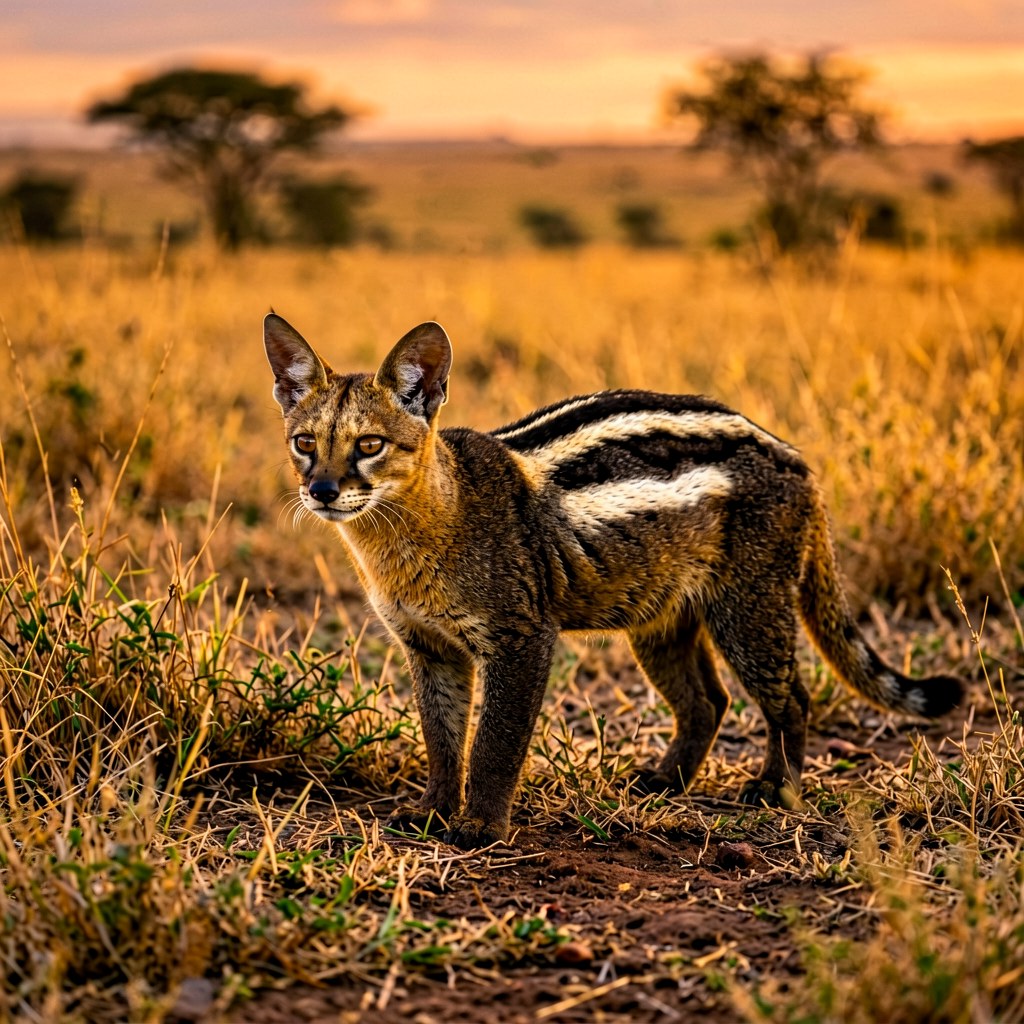
Civettictis civetta | Small Spotted Civet
Introduction
The African civet, widely referred to in regional guides as the small spotted civet, is the largest and most heavily built member of the family Viverridae found on the African continent. This secretive, nocturnal mammal is instantly recognizable by its coarse coat of black and cream blotches, a black facial mask, and a crest of erectile hair running along the spine. Adults measure 67 to 89 centimeters from head to body with a tail of 40 to 67 centimeters, and they commonly weigh between 7 and 20 kilograms. Although civets resemble cats in silhouette, they are more closely aligned with mongooses and genets within the order Carnivora. Largely solitary and crepuscular, the African civet forages along forest edges, riverbanks, and farmland, playing a useful role as both predator and scavenger in its ecosystem.
Taxonomy
The small spotted civet is placed in the genus Civettictis, a monospecific genus within the family Viverridae, and the order Carnivora, the meat-eating mammals. Its scientific name, Civettictis civetta, has been stable for centuries, though earlier naturalists described the animal under several now-synonymous names. Within the broader carnivoran tree it belongs to the cat-like suborder Feliformia, alongside cats, hyenas, and mongooses, and it shares a recent common ancestor with musteloid predators such as the [Fisher](https://www.gloencyc.com/fisher-pekania-pennanti/), another lithe, forest-dwelling carnivore that occupies a similar ecological niche in the northern hemisphere. Unlike the fisher, however, the civet retains a more primitive viverrid skull and a long, flexible body adapted to both climbing and ground foraging. Genetic studies confirm that African civets are distinct from the Asiatic civets of the genus Viverra, despite a superficial resemblance and the shared use of the name “civet.” The species shows little geographic variation across its broad sub-Saharan range.
Physical Characteristics
The African civet has a stocky, elongated body carried on relatively short legs, with a pointed snout, small rounded ears, and a long, black-ringed tail. The coat is coarse and grizzled, consisting of a pale grey to creamy base overlain with irregular black spots and horizontal bands across the neck and shoulders, while a bold black mask surrounds the eyes and muzzle. A prominent crest of long hair runs from the shoulders to the rump and can be raised to make the animal appear larger when threatened. The limbs are dark, almost black, and the feet are equipped with semi-retractable claws suited to digging and climbing. Civets possess a well-developed perineal gland that produces a strong-smelling secretion known as civetone, historically harvested for use in perfumery. Males are noticeably larger and more muscular than females and have a broader head. The dentition is typical of an omnivorous carnivoran, with prominent canines for subduing prey and robust molars for crushing.
Habitat
The small spotted civet occupies a broad spectrum of habitats across sub-Saharan Africa, from dense tropical rainforest and gallery forest to woodland, savanna, and the cultivated edges of human settlement. It shows a clear preference for areas with dense ground cover, plentiful thickets, and access to water, often hunting along riverbanks, forest margins, and the edges of plantations. Although primarily terrestrial, it climbs readily into low branches and shrubs when foraging or resting, and it uses hollow logs, abandoned burrows, and dense vegetation as daytime dens. The species is absent from the driest parts of the Sahara and from the highest montane zones, but it tolerates a surprising degree of habitat modification and is frequently recorded near villages and croplands. Population density tends to be higher in moist, productive environments where insect and fruit resources are abundant year-round. Seasonal movement is limited, though individuals may shift home ranges in response to food scarcity or flooding.
Diet
The African civet is an opportunistic omnivore with a diet that shifts markedly between seasons and habitats. Insects such as beetles, grasshoppers, and termites form a dietary staple, supplemented by fallen fruit, berries, and the pods of various trees, especially during the wet season when plant foods are plentiful. Animal prey includes small rodents, birds, lizards, snakes, frogs, and the eggs of ground-nesting birds, and civets readily scavenge carrion and raid rubbish heaps near villages. They are also known to raid poultry and to feed on maize, coffee berries, and other crops, which brings them into frequent conflict with farmers. Foraging is mostly nocturnal, with the civet using its keen sense of smell to locate food on the forest floor and in low vegetation. Because it consumes large quantities of fruit, the species acts as an important seed disperser for many woody plants, while its predation on insects and rodents helps regulate pest populations.
Reproduction
Breeding in the small spotted civet can occur throughout the year, though in some regions there is a peak during the warmer, wetter months when food is most abundant. After a gestation of roughly 60 to 70 days, the female gives birth in a hidden den to a litter of usually two or three, occasionally one to four, blind and helpless young. The cubs are born with a darker, more striped coat than adults and are weaned after about one month, though they remain with the mother for several additional weeks as they learn to forage. Sexual maturity is reached at roughly one to two years of age, and females may produce more than one litter per year under favorable conditions. There is no fixed pair bond, and males take no part in raising the young. Infant mortality can be high where habitat is fragmented or where domestic dogs and other predators are common. Because the species breeds readily and reaches maturity quickly, it is better able to withstand localized pressures than many slower-reproducing carnivores.
Conservation
The African civet is classified by the IUCN as Least Concern, owing to its extensive range, adaptability to modified landscapes, and generally stable populations across sub-Saharan Africa. It is hunted for bushmeat in parts of its range and was historically trapped for civetone, the glandular secretion once prized by the perfume industry, though synthetic substitutes have greatly reduced this trade. Persecution by farmers protecting poultry and crops remains a localized threat, as does road mortality and the loss of dense thicket cover to agriculture. The species benefits from its tolerance of human-altered environments and from the continued extent of suitable habitat across the continent. Conservation priorities include reducing retaliatory killing through better livestock protection, preserving riparian thickets, and monitoring harvest levels where bushmeat hunting is intense. Because civets also disperse seeds and control pests, their continued presence supports the health of both natural and farmed landscapes.
Fun Facts
- The African civet produces civetone, a strong-smelling glandular secretion once prized as a base note in fine perfumes.
- When alarmed, it can raise the crest of hair along its back to appear suddenly larger and more threatening.
- A single civet may use several temporary dens, moving every few days to avoid predators and parasites.
- Unlike most cats, the civet walks with the soles of its feet flat on the ground, much like a bear.
- Civets help forests by eating fruit and spreading the seeds of many trees through their droppings.