 By st20113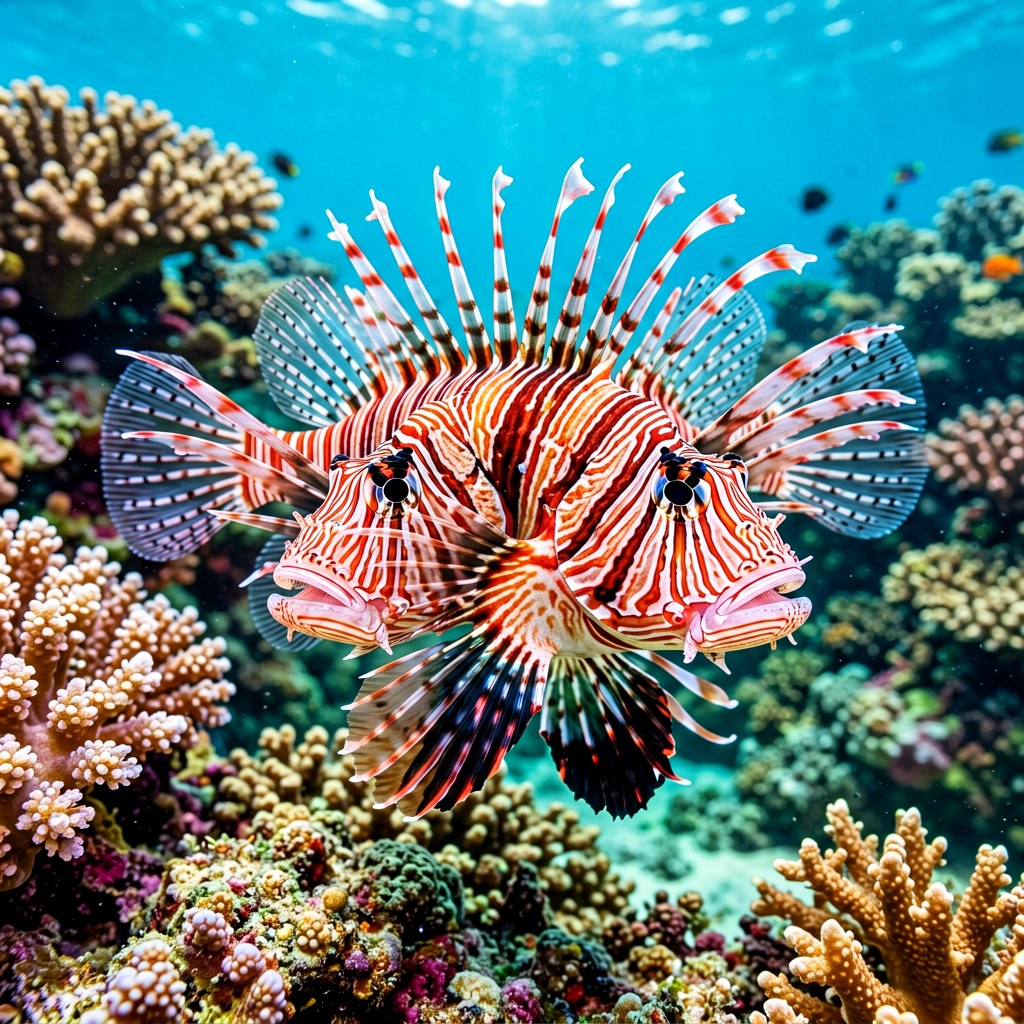
Pterois volitans | Red Lionfish
Introduction
The red lionfish (Pterois volitans) is a strikingly beautiful but ecologically disruptive reef fish in the family Scorpaenidae, native to the Indo-Pacific from the Red Sea and East Africa to the central Pacific. Renowned for its flamboyant finnage, bold red-and-white stripes, and venomous spines, it has become infamous as one of the most damaging marine invasive species ever recorded following its establishment in the western Atlantic and Caribbean in the late twentieth century. In its native range the red lionfish is a normal, if conspicuous, member of reef communities, but in invaded waters it lacks effective predators and competes aggressively with native fish, preying on small reef species and altering ecosystem balance. It is a popular aquarium fish, and the pet trade is the likely source of the Atlantic invasion, probably released near Florida in the 1980s. Capable of rapid reproduction and tolerance of a wide range of habitats, the lionfish has spread from the southeastern United States through the Caribbean to South America.
Taxonomy
Pterois volitans was first described by the Swedish naturalist Carl Linnaeus in 1758, who assigned it to the genus Pterois—from the Greek for “winged”—with the species epithet volitans meaning “flying” or “hovering,” an allusion to its large, sail-like fins. The genus Pterois belongs to family Scorpaenidae, the scorpionfishes, within the order Scorpaeniformes, a diverse group of primarily marine fishes characterized by spiny heads and, in many members, venom glands associated with fin spines. Molecular and morphological studies place P. volitans among the lionfishes of the Indo-Pacific, closely related to Pterois miles (the devil firefish), which is also invasive in parts of the eastern Mediterranean and was long confused with it. A relevant comparative fish of conservation interest is the largetooth sawfish (Pristis pristis), profiled at https://www.gloencyc.com/pristis-pristis-largetooth-sawfish/, which, like the lionfish, is a denizen of warm coastal waters, the sawfish being a critically endangered ray rather than an invasive scorpaenid. Within Scorpaenidae, Pterois species are distinguished by their elongated, separated fin rays and the dramatic display posture they adopt when threatened, making the genus among the most recognizable of all reef fishes.
Physical Characteristics
The red lionfish is a medium-sized fish, typically reaching 30 to 38 centimeters in length in the Atlantic invasion and occasionally larger in its native range, though specimens beyond 45 centimeters are rare. Its body is laterally compressed and clad in reddish to maroon stripes alternating with white or cream bands, a pattern that varies somewhat among individuals. The most distinctive features are the elongated, banner-like pectoral fins, which the fish spreads wide like a fan, and the long, separated dorsal and pelvic spines that project prominently. These spines are equipped with venom glands that deliver a painful, though rarely life-threatening, sting to humans and deter many predators. The head is large with a rounded snout, large eyes, and a slightly upturned mouth suited to gulping prey. Coloration and fin extension serve both camouflage among coral and a threat display: when approached, the lionfish often faces the intruder, orienting its spines toward the threat. Juveniles are small and secretive, with proportionally even larger spines, and they settle into reef, mangrove, and hard-bottom habitats as they grow.
Habitat
In its native Indo-Pacific range, the red lionfish inhabits a broad spectrum of shallow marine habitats, including coral reefs, rocky reefs, lagoons, and mangrove-fringed coasts, typically from the shoreline to depths of about 50 meters, occasionally deeper. It favors complex structures—coral branches, ledges, and rubble—where it can hide by day and hunt by night. In the invaded western Atlantic and Caribbean, it has proven extraordinarily habitat-generalist, occupying not only coral reefs but also mangroves, seagrass beds, offshore hard-bottom, wrecks, and even estuaries, and tolerating a wide range of temperatures and salinities. This flexibility has been key to its rapid spread. Lionfish are often found perched on ledges or among branches during daylight, relying on cryptic coloration, and become more active and wide-ranging after dusk when they forage. They can persist at high densities in invaded areas, sometimes far exceeding native predator biomass on a given reef.
Diet
The red lionfish is a generalized, opportunistic carnivore that feeds on a wide variety of small fish and crustaceans. In the Atlantic invasion it has been recorded eating more than fifty species of prey, including juvenile snappers, grunts, gobies, and blennies, as well as shrimps, crabs, and other invertebrates. It is an ambush and pursuit predator that uses its large pectoral fins to herd prey, then sucks the victim into its mouth with a rapid strike. Its stomach can expand considerably, allowing it to consume prey up to roughly half its own body length. This broad, voracious diet is a major reason for its ecological impact: by depleting small native fishes and herbivores, lionfish can reduce the recruitment of reef fish and, importantly, lessen grazing on algae, indirectly harming coral health. In its native range the same diet is balanced by co-evolved predators and competitors, but in the Atlantic those controls are largely absent. The lionfish’s willingness to eat almost any suitably sized animal contributes directly to its invasion success.
Reproduction
Red lionfish reproduction is built for explosive population growth. The species is gonochoristic, with separate sexes, and in the invaded Atlantic it can spawn year-round in warm waters, with peaks that vary by latitude. Males establish and defend small mating territories on the reef, performing courtship displays in which they circle and posture before females. Females are highly fecund: a single mature female can release tens of thousands of eggs per spawning event, and may spawn every few days during the breeding season, producing upward of two million eggs per year under favorable conditions. Eggs are buoyant and pelagic, hatching into planktonic larvae that disperse with currents for several weeks before settling into suitable habitat. This combination of high fecundity, frequent spawning, and pelagic larvae allows lionfish populations to boom and to colonize new areas rapidly. In the Atlantic, where there are few predators of adult lionfish and little larval mortality from specialist enemies, the species’ intrinsic rate of increase far outpaces that of most native reef fishes, making control difficult once established.
Conservation
In conservation terms the red lionfish presents a paradox: in its native Indo-Pacific it is not considered threatened and is abundant, but across the invaded western Atlantic and Caribbean it is itself the conservation problem. There it is listed among the world’s worst invasive species, implicated in steep declines of native reef fish, reduced grazing pressure on algae, and broader degradation of coral reef ecosystems already stressed by warming, bleaching, and pollution. Because eradication is considered impossible at the current scale, management focuses on localized control: organized spearfishing derbies, targeted removal by divers, encouragement of consumer demand through the “eat the invader” movement, and protection of native predators where possible. Research into biological controls, including specialized parasites or pathogens and trained native predators, is ongoing but cautious. Public awareness, continued removal, and integration of lionfish control into broader reef management remain the main tools. The case of Pterois volitans is a cautionary tale of how the aquarium trade can reshape entire marine ecosystems.
Fun Facts
- The red lionfish can release tens of thousands of eggs every few days, producing over a million eggs a year.
- Its venomous spines deliver an intensely painful sting, though fatalities in healthy adults are very rare.
- It spreads its fan-like pectoral fins to herd small fish before striking with a lightning-fast suck.
- Lionfish in the Caribbean are invaders from the Indo-Pacific, likely released from home aquariums.
- In invaded reefs they can outnumber native predators, dramatically reducing small native fish populations.