 By st20113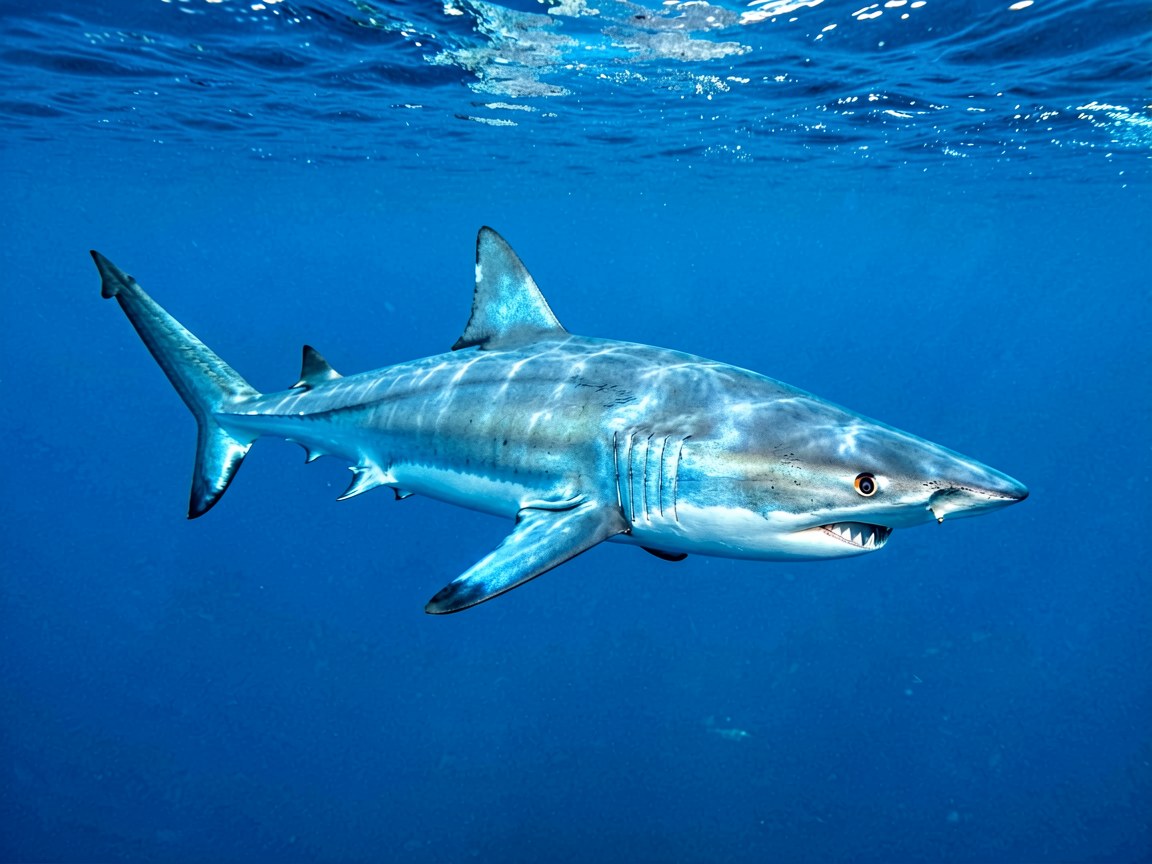
Prionace glauca | Blue Shark
Introduction
Prionace glauca, the blue shark, is one of the most widespread and instantly recognisable sharks in the ocean, a sleek, indigo-blue predator that cruises the open waters of every temperate and tropical sea. Built for endless swimming, it has a slender body, enormous pectoral fins, and a deeply countershaded blue back that fades to a snowy white belly — a camouflage so effective that it seems to vanish against the blue from above and below alike. Despite its fearsome reputation among sharks, the blue shark is a shy, open-ocean fish that feeds mainly on squid and small fish and poses little threat to people. It is also, by sheer numbers, one of the most abundant large animals in the sea, yet it is now among the most heavily fished, caught in vast quantities as bycatch and for the shark-fin trade. Its story is closely tied to that of larger relatives such as the great white shark, for like that icon it is a cartilaginous fish whose survival depends on protections the open ocean has been slow to provide.
Taxonomy
Prionace glauca belongs to the family Carcharhinidae, the requiem sharks, a group of typically slender, active predators that includes many of the sharks most people encounter. The genus Prionace is monotypic, containing only the blue shark, and its name combines Greek roots meaning “saw” and “point,” a reference to its sharp, finely serrated lower teeth and keen outline. It is a true shark — a member of the class Chondrichthyes alongside rays and skates — and, like the great white, its skeleton is made of cartilage rather than bone, keeping it light for a life of constant motion. Blue sharks are placed among the carcharhinids rather than the mackerel sharks, but they share with the great white the basic elasmobranch blueprint: five gill slits, a cartilaginous skeleton, and skin studded with tooth-like placoid scales. Molecular and anatomical work places the blue shark as a specialist of the open ocean, distinct from the coastal requiems, and superbly adapted to a pelagic life few sharks match in range. Like the better-known [great white shark](https://www.gloencyc.com/carcharodon-carcharias-great-white-shark/), it is a cartilaginous fish whose skeleton is cartilage rather than bone, a heritage shared by all sharks and rays.
Physical Characteristics
The blue shark is a study in hydrodynamic elegance. Adults commonly reach two to three metres and may exceed four, with females larger than males, a pattern common in sharks. The body is long and torpedo-shaped, the snout is tapering, and the eyes are large and round — an adaptation for the dim light of the open sea. The most striking feature is colour: a vivid, metallic blue along the back and upper flanks grading through bright blue to pure white underneath, a countershading that hides the shark from predators and prey alike. The pectoral fins are exceptionally long and sickle-shaped, giving lift and glide as the fish cruises, while the crescent tail provides efficient thrust. The teeth are narrow, curved, and finely serrated, ideal for seizing slippery prey rather than shearing great chunks. Skin placoid scales reduce drag and make the hide rough like sandpaper. Blue sharks are built to swim without rest, using a large, oil-rich liver for buoyancy and relying on ram ventilation — water forced over the gills as they move — to breathe.
Habitat
The blue shark is a pelagic, migratory species found in the open oceans and seas of all but the coldest polar waters, typically between about 50°N and 50°S. It prefers temperate and warm temperate latitudes and undertakes vast seasonal migrations, moving toward the poles in summer and retreating toward the equator in winter to stay in comfortable temperatures, often travelling thousands of kilometres. It ranges from near the surface down to several hundred metres, and it associates with oceanic fronts, currents, and upwelling zones where prey concentrates. Unlike coastal sharks, it avoids reefs and shallows, spending its life in the blue water far from land, though juveniles and pregnant females may come nearer coasts in some regions. It tolerates a wide range of salinities and is among the few sharks recorded from both coastal and truly oceanic settings. This immense range makes it hard to study and harder to manage, because a single population spans the jurisdictions and fisheries of many nations at once.
Diet
Blue sharks are active predators and opportunistic feeders whose diet is built around squid, a staple in most oceans, supplemented by small schooling fish such as herring, mackerel, and lanternfish, plus the occasional crustacean, small skate, or carrion. They hunt by cruising and using keen sight and a well-developed sense of smell to locate prey, slashing with their fine teeth. Their long, slender form lets them pursue agile prey in open water, and they are known to follow schools of tuna and dolphins that drive prey upward. As mid-level predators they help keep squid and small-fish populations in check, and in turn they are eaten by larger sharks and, as juveniles, by bony predators and bigger sharks alike. Their broad, mobile diet lets them exploit whatever the ocean offers along their migration routes, a flexibility that supports their enormous numbers — and makes them vulnerable when fishing fleets target the same aggregations.
Reproduction
Blue sharks are ovoviviparous: eggs develop and hatch inside the mother, and the young are born live as free-swimming pups. A single female can carry a remarkably large litter, often 25 to over 100 embryos, though many are lost to sibling cannibalism in the womb, a grisly but common shark strategy that leaves the strongest to be born. Gestation lasts roughly nine to twelve months, after which the mother gives birth to well-developed pups of about half a metre in coastal or warm nursery areas. Females grow faster and larger than males and mature later; males may mature in a few years, females in five or six. This high fecundity evolved to offset heavy natural mortality in the open ocean, but it is no match for industrial fishing, which can remove adults faster than litters replace them. Because blue sharks aggregate by sex and reproductive state and follow predictable migrations, fishing fleets can intercept them efficiently, magnifying the impact on already-stressed populations.
Conservation
The blue shark is listed as Near Threatened to Vulnerable by the IUCN depending on region, and its numbers have fallen sharply in parts of its range despite remaining the most caught shark in the world by volume. The main driver is fishing: it is taken in huge numbers as targeted catch for fins and meat and, even more so, as bycatch in pelagic longline and drift-net fisheries aimed at tuna and swordfish. Its long fins are valuable in the shark-fin trade, and its meat is eaten in many countries. Because it ranges across all oceans, no single nation can protect it alone, and management through regional fisheries bodies has been weak or slowly implemented. Measures that help include catch limits, finning bans requiring fins attached to the body, and bycatch-reduction gear, but enforcement on the high seas is patchy. As a abundant yet heavily exploited open-ocean predator, the blue shark has become a symbol of the broader challenge of conserving life in international waters that belong, effectively, to no one.
Fun Facts
- Its back is a vivid metallic blue that fades to snowy white underneath, a camouflage that hides it in open water.
- It may carry the largest litters of any shark, with over a hundred embryos — though many are eaten by siblings before birth.
- It migrates thousands of kilometres each year, tracking warm water toward the poles in summer.
- Its enormous, sickle-shaped pectoral fins give it effortless glide as it cruises the open sea.
- It is the most heavily caught shark in the world, mostly as bycatch in tuna and swordfish fisheries.