 By st20113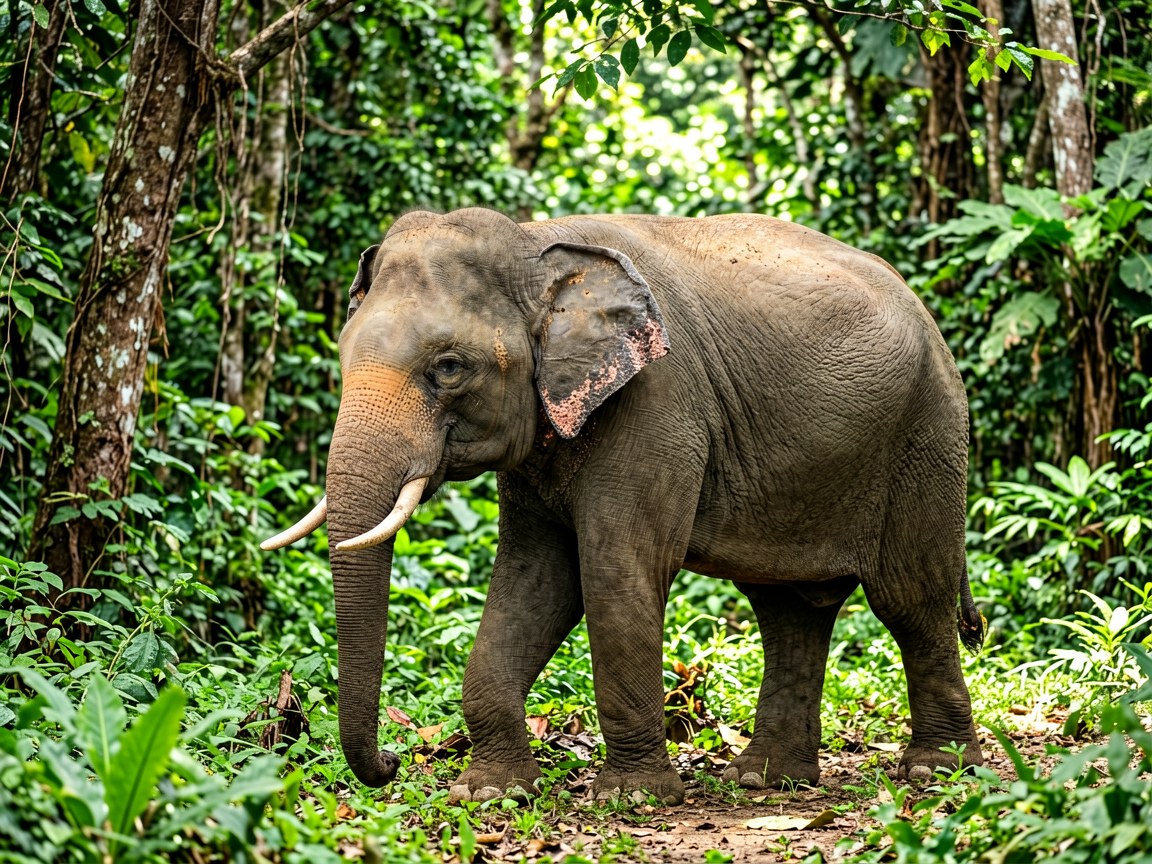
Loxodonta cyclotis | Forest Elephant
Introduction
Loxodonta cyclotis, the African forest elephant, is the smaller and far more secretive of Africa’s two elephant species, a shadow of the better-known savanna giant that slips through the dense rainforests of the Congo Basin. Until recently it was treated as a subspecies of the African elephant, but genetic and anatomical studies now recognise it as a distinct species in its own right. Adapted to life under a closed canopy, it has straighter tusks, rounded ears, and a darker, finer build than its open-country relative, and it plays an outsized ecological role as the gardener of the rainforest: by swallowing fruits and depositing the seeds far from the parent tree, it keeps the forest diverse and regenerating. Yet the forest elephant is also among the most persecuted mammals on Earth, hunted relentlessly for ivory in remote, lawless forests where it is hard to protect. Its fate is bound to that of the other great African elephant species, and to the survival of the rainforests that both depend on and sustain.
Taxonomy
Loxodonta cyclotis sits in the genus Loxodonta, the African elephants, alongside the savanna elephant Loxodonta africana; the two are the only living members of the family Elephantidae in Africa and the closest relatives of the Asian elephants. The species name cyclotis means “round-eared,” pointing to its characteristically rounded ears. Molecular evidence shows the forest and savanna elephants diverged millions of years ago and have exchanged little genetic material since, justifying their treatment as separate species rather than races. Compared with the savanna form, the forest elephant’s skull is narrower, its tusks straighter and more downward-pointing, and its molars have more closely spaced ridges suited to a softer, more varied forest diet. These differences reflect adaptation to two very different worlds — open woodland and dense rainforest — within the same continent. Understanding this split matters for conservation, because the two species face different threats and require different management, and counting them as one hid the forest elephant’s steeper decline. It is one of two living African elephant species, the other being the [African savanna elephant profiled here](https://www.gloencyc.com/african-elephant-loxodonta-africana/), and the two face different threats despite sharing a continent.
Physical Characteristics
The forest elephant is noticeably smaller than the savanna elephant, with males standing around 2.4 metres at the shoulder and weighing roughly two to four tonnes, against the larger savanna bull. Its body is more rounded, its back flatter or even concave, and its ears are small and rounded, an outline that helps it move through dense undergrowth without snagging. The tusks are relatively straight, slender, and angled downward, often reaching the ground; they are prized ivory and are usually present in both sexes, though shorter in females. The trunk, with its two finger-like tips, is used with great dexterity to pick fruits, strip bark, and drink. Skin is darker and sometimes tinged with a reddish clay from forest wallows. Forest elephants are generally less sociable in huge herds than savanna elephants, moving in smaller family groups of related females and calves, a pattern suited to dispersed forest food. Their smaller size and tighter build are classic rain-forest adaptations for negotiating tangled vegetation.
Habitat
The forest elephant inhabits the moist tropical rainforests of the Congo Basin and scattered forest blocks across west and central Africa, from lowland evergreen forest to montane forest at moderate elevations. It prefers intact, mature forest with a mix of fruiting trees, but it also uses forest edges, gallery forest along rivers, and agricultural mosaics where crops are available. Unlike the savanna elephant, it avoids open grassland and depends on the shade, water, and fruit of closed canopy, undertaking seasonal movements that track the ripening of key tree species across the landscape. It needs large, connected tracts of forest: a single animal ranges over hundreds of square kilometres in search of food, and fragmentation by roads and logging blocks these movements and isolates populations. Because it is tied to the forest interior, it is especially vulnerable to deforestation and to the construction of roads that open remote areas to hunters, turning once-safe refuge into accessible hunting ground almost overnight.
Diet
The forest elephant is primarily a frugivore — a fruit-eater — more so than its savanna cousin, and this diet shapes the entire forest. It consumes the fallen fruits of countless tree species, along with leaves, bark, twigs, and minerals from salt licks and swampy wallows. Its large gut passes many seeds intact, and because it ranges widely, it disperses those seeds far from the parent tree, often depositing them in nutrient-rich dung that boosts germination. For numerous tree species whose seeds are too large for birds or monkeys to carry, the forest elephant is the only effective long-distance disperser, meaning its loss cascades into poorer, less diverse forest. It also browses saplings and strips bark, which influences forest structure and composition. In farmland bordering forest it can become a crop pest, raiding cassava, banana, and other crops, bringing it into conflict with people. This diet of fruit and foliage makes the species a keystone: remove it, and the forest’s very ability to regenerate changes.
Reproduction
Forest elephants reproduce slowly, a trait that makes populations painfully slow to recover from hunting. Females typically give birth to a single calf after a long gestation of nearly two years, and they may not conceive again for several more years while they nurse the calf, which stays close to its mother for years. Sexual maturity is reached only around the age of 20 in females, later than in the savanna species, so a female may raise only a handful of offspring in her lifetime. Males compete for mates and, as they mature, periodically enter musth, a state of heightened testosterone and aggression. Calves are born into tight family groups of related females that cooperatively guard and teach them, and the long dependence period lets the young learn the complex spatial knowledge of where food and water lie across the yearly cycle. This slow, invested life history is well suited to a stable forest but disastrous under heavy poaching, where the removal of a few adults erases decades of reproductive potential at a stroke.
Conservation
The forest elephant is classified as Critically Endangered, with populations crashed by as much as 80–90% over recent decades across parts of its range, driven overwhelmingly by the ivory trade. Its remote forest home offered some protection until roads, logging concessions, and armed poaching syndicates penetrated the interior; today even protected areas struggle to shield it. Conservation rests on a mix of anti-poaching patrols, community-based forest management that gives local people a stake in living elephants, and international bans and demand reduction on ivory. Because it is a keystone seed disperser, protecting it also protects the rainforest’s carbon storage and biodiversity, aligning elephant conservation with climate and habitat goals. Transboundary cooperation is essential, since forest elephants ignore national borders as they move between protected blocks. The species’ survival is a test of whether central Africa can reconcile development with the preservation of one of the planet’s most important and most threatened ecosystems.
Fun Facts
- It is a separate species from the savanna elephant, not merely a smaller version, and the two rarely interbreed.
- Its straight, downward tusks are among the hardest, most sought-after ivory in the trade.
- It is the rainforest’s chief gardener, carrying large seeds kilometres from parent trees in its dung.
- Females may not breed until about age 20 and raise only a few calves in a lifetime, so populations recover slowly.
- Its rounded ears and smaller, rounded body are adaptations for moving through dense undergrowth.