 By st20113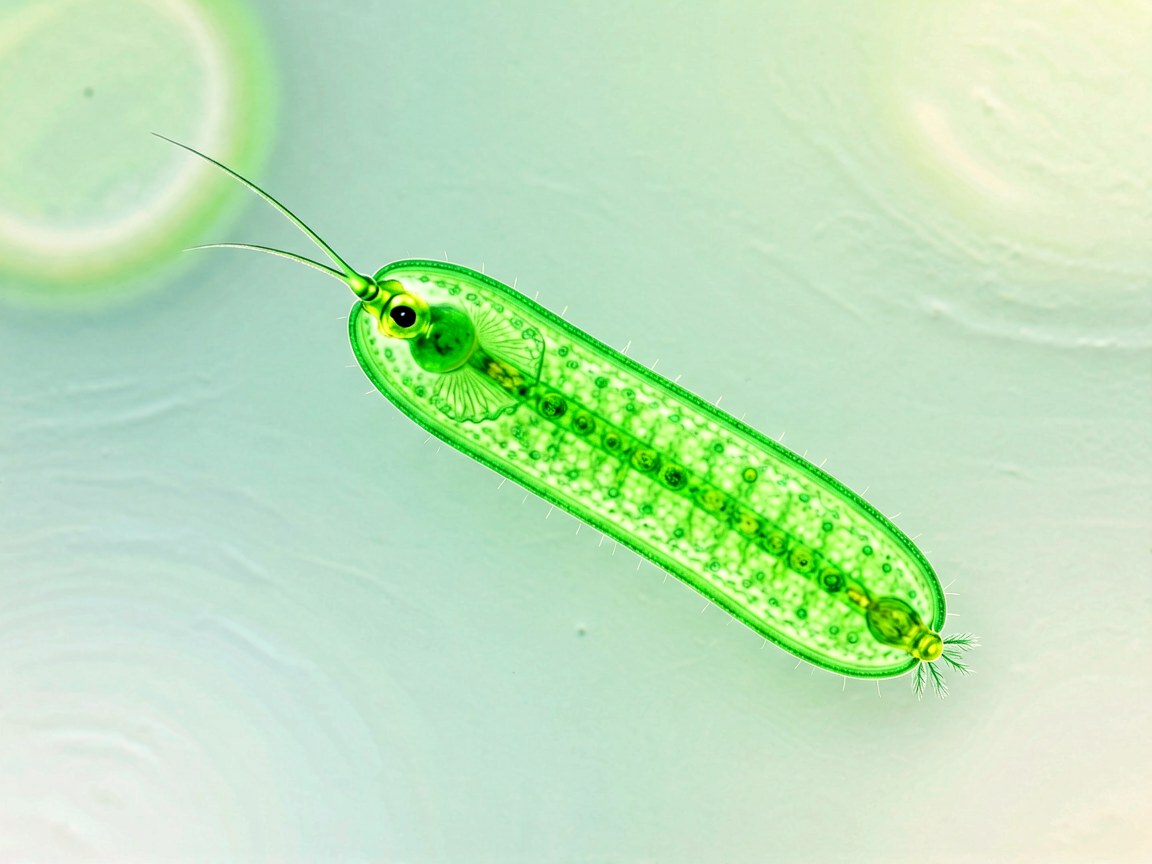
Euglena gracilis | Euglena
Introduction
Euglena gracilis is a single-celled protist that has puzzled biologists for centuries because it blurs the line between animals and plants. Under a microscope it looks like a tiny green spindle with a whiplike flagellum at the front, swimming with a characteristic spinning motion through ponds and ditches. What makes it famous is that it carries chloroplasts and can photosynthesise like a plant, yet it also has a mouth-like pouch and can swallow food like an animal when light is absent. This mix of traits placed it at the centre of the historical debate over where to draw the boundary between the plant and animal kingdoms, and it remains a favourite model organism for studying chloroplasts, metabolism, and cell motility. In large numbers, Euglena can tint stagnant water green or red, and some relatives form spectacular “blood rains” on land. Beyond the lab, certain Euglena species are now cultivated as health foods and as sources of renewable oils, turning a humble pond dweller into a candidate for sustainable industry.
Taxonomy
Euglena gracilis belongs to the genus Euglena, within the phylum Euglenozoa, a diverse group of mostly single-celled eukaryotes that also includes parasitic trypanosomes. The euglenoids are eukaryotes that lack a rigid cell wall and are united by features such as flagella with a distinctive internal structure and a light-sensing eyespot. Euglena’s exact position among the protists was long contested because of its plant-like chloroplast and animal-like feeding; we now understand the chloroplast was acquired by engulfing a green alga in an ancient event of secondary endosymbiosis, after which the alga’s nucleus was lost but its photosynthetic machinery retained. The species name gracilis means “slender,” fitting its elongated form. Its green colour comes from chloroplasts gained long ago by engulfing a green alga, and it relies on the light-capturing chemistry described in our profile of [photosynthesis and the plant energy process](https://www.gloencyc.com/photosynthesis-plant-energy-process/) to power its growth. Within Euglena, E. gracilis is the best-studied member, prized by researchers for its well-characterised metabolism and its ability to grow either in light on photosynthesis or in darkness on organic nutrients, a flexibility that makes it a versatile laboratory workhorse.
Physical Characteristics
A cell of Euglena gracilis is typically 50 to 100 micrometres long, spindle-shaped, and enclosed not by a wall but by a flexible protein pellicle that lets the cell twist and change shape as it swims — a motion called euglenoid movement. A single long flagellum at the anterior end pulls the cell forward with a spiral beat, while a second, shorter flagellum lies within the reservoir and is not used for swimming. Near the base of the flagellum sits an eyespot, or stigma, a red patch of pigment that shades a light-sensitive swelling and helps the cell steer toward optimal light for photosynthesis. The green colour comes from numerous disc-shaped chloroplasts containing chlorophyll a and b, the same pigments found in land plants. A contractile vacuole pumps out excess water, maintaining internal balance in the freshwater environment. The cell also contains a paramylon-storing body, a starch-like carbohydrate unique to euglenoids, used to stock energy when light or food is abundant.
Habitat
Euglena gracilis thrives in still or slow-moving fresh water rich in organic matter: ponds, ditches, marshes, and the margins of lakes where nutrients accumulate. It tolerates low oxygen and can exploit the mix of light and decaying material typical of such habitats, which is why it often blooms in mildly polluted or eutrophic water. Because it can both photosynthesise and ingest food, it colonises environments where conditions fluctuate — bright by day, dark or nutrient-rich after rain — better than specialists that depend on only one strategy. It grows best in warm, reasonably lit water but can survive dim periods by switching to heterotrophy, absorbing dissolved organic compounds through its cell surface. In culture it is famously easy to maintain, which is one reason it became a standard laboratory organism; in nature its populations can explode so rapidly that the water turns visibly green, only to crash when conditions shift or grazers catch up.
Diet
Euglena gracilis is a mixotroph, combining two ways of making a living. In light it is a photosynthesizer: its chloroplasts capture sunlight and fix carbon dioxide into sugars, exactly as described for plants, storing surplus energy as paramylon. In darkness, or when light is insufficient, it becomes a heterotroph: it absorbs dissolved sugars and amino acids directly through its pellicle and, if a suitable particle enters its gullet-like cytostome, it can ingest it. This flexibility is an ecological insurance policy — the cell need not die when a pond is shaded or when its chloroplast is disabled. Laboratory strains are routinely grown either photoautotrophically in lit flasks or heterotrophically in the dark on acetate, and the choice changes the cell’s chemistry, including the oil content that interests biofuel researchers. By straddling plant and animal nutrition, Euglena turns variable ponds into a stable home.
Reproduction
Euglena gracilis reproduces asexually by longitudinal cell division, one of the simplest and fastest ways for a single cell to multiply. The cell first duplicates its organelles — including the chloroplasts, the eyespot, and the flagellar apparatus — and then divides down its long axis, each daughter receiving a full set of parts and a newly built flagellum. Under favourable warm, lit, nutrient-rich conditions, division can occur roughly once a day, allowing a population to surge from a few cells to millions within a week, which is why a clear pond can turn green almost overnight. Sexual reproduction has not been convincingly demonstrated in E. gracilis, and the species relies on this efficient clonal splitting to persist and spread. When conditions deteriorate, some cells form resistant cysts with thickened walls that survive drying or cold and later germinate when water returns, an adaptation that lets the lineage weather the boom-and-bust rhythm of temporary pools.
Conservation
As a microscopic, fast-reproducing protist, Euglena gracilis is in no danger of extinction; its conservation relevance runs the other way. It is a sensitive bioindicator: its presence and abundance track water quality, organic enrichment, and light availability, and it is used in toxicity tests that measure how chemicals affect cell growth and movement. At the same time, the species is cultivated deliberately, both in research and in commerce, for its protein, vitamins, and paramylon, and some related Euglena are farmed at scale as nutritional supplements and as feedstock for biofuels. The main “risk” surrounding it is not loss but management — preventing culture contamination and understanding how large-scale pond cultivation affects local water bodies. Far from needing protection, Euglena is a species humanity is learning to harness, and its hardiness makes it a dependable partner for experiments in sustainable biotechnology.
Fun Facts
- It can both photosynthesise like a plant and eat like an animal, switching strategies with the light.
- The green chloroplast was gained by engulfing a green alga long ago, then keeping only its solar machinery.
- A red eyespot at the cell’s front helps it steer toward the best light for photosynthesis.
- It has no rigid cell wall, so it swims by twisting its flexible body in a distinctive spiral.
- Populations can multiply so fast in a sunlit pond that the water turns visibly green within days.