 By st20113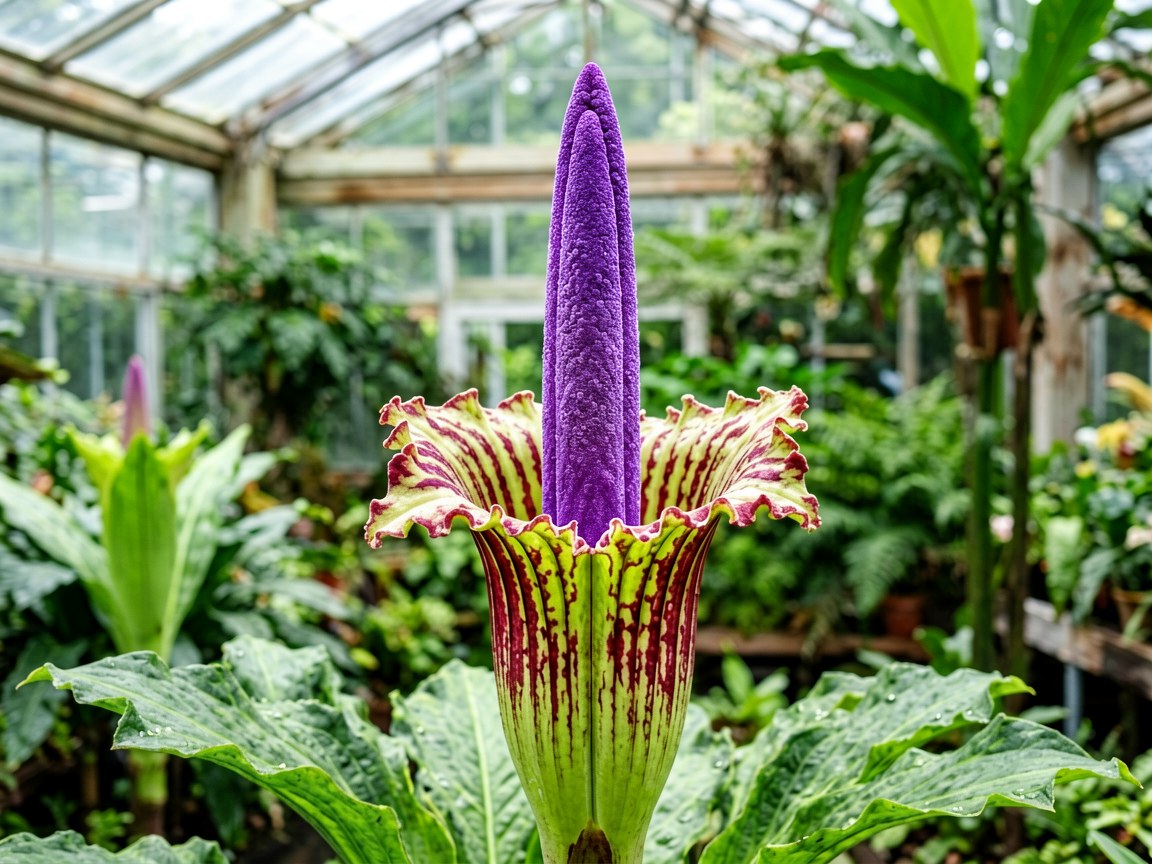
Amorphophallus titanum | Titan Arum
Introduction
Amorphophallus titanum, commonly called the titan arum or corpse flower, is famous for producing the largest unbranched inflorescence in the plant kingdom, a towering structure that can exceed three meters in height. Native to the rainforests of western Sumatra, it draws crowds to botanical gardens around the world whenever it blooms, an event that may happen only once every several years. The plant earns its gruesome nickname from the powerful odor of rotting flesh it releases to attract pollinating carrion beetles and flies. Although the giant spadix looks like a single flower, it is actually a compound cluster of hundreds of tiny flowers wrapped by a skirt-like spathe. Its dramatic life cycle, massive size, and rare blooming make it one of the most celebrated unusual plants in cultivation.
Taxonomy
Amorphophallus titanum belongs to the family Araceae, the arum family, within the genus Amorphophallus, which contains more than two hundred species of tropical tuberous plants. The genus name combines Greek roots meaning “misshapen” and “phallus,” a reference to the shape of the inflorescence, while the species name titanum nods to its titanic proportions. It is most closely related to other aroid genera that also produce a spadix and spathe, though none rival its scale. The titan arum is a flowering angiosperm, and like the process described in our article on [Photosynthesis](https://www.gloencyc.com/photosynthesis-plant-energy-process/), it depends on light captured by its single enormous leaf between blooms to store the energy needed for its next spectacular flowering.
Physical Characteristics
Between blooms the plant consists of a single leaf, often mistaken for a small tree, that can stand three to four meters tall on a branched stalk resembling a trunk. This leaf is attached to a massive underground corm, a swollen storage organ that can weigh more than a hundred kilograms and ranks among the largest in the plant world. When flowering, the spadix rises from the corm topped by a frilled green-and-maroon spathe that unfurls to reveal a purple-black interior. The spadix itself is a fleshy spike bearing male flowers above and female flowers below, separated by a ring of sterile hairs. The whole inflorescence generates heat through thermogenesis, raising its temperature to near human body heat to help volatilize the scent. The corm, leaf, and inflorescence together represent an extraordinary concentration of biomass in a plant that spends most of its life seemingly inactive.
Habitat
The titan arum grows naturally in the humid lowland rainforests of Sumatra, particularly in the foothills of the Barisan Mountains, where it lives in gaps and disturbed forest edges rather than dense closed canopy. It prefers warm, shaded, and consistently moist conditions with well-drained soils rich in organic matter. In the wild it is uncommon and localized, often found at elevations between two hundred and twelve hundred meters. Because it is a forest understory plant, it is adapted to dappled light and high humidity, conditions that botanical gardens try to mimic in their tropical houses. Habitat loss from logging and agricultural expansion has reduced its natural range, making wild populations increasingly scattered.
Successful cultivation mirrors the Sumatran forest floor: a coarse, free-draining mix, humidity above eighty percent, and temperatures that stay between twenty-five and thirty degrees Celsius by day with only a slight drop at night. Growers keep the corm barely moist while the leaf is active and withhold water almost entirely during the leafless rest, mimicking the dry season that triggers blooming. Too much moisture around the corm invites rot, the most common cause of failure in collections. In its natural habitat the plant also experiences a distinct wet and dry rhythm, and the timing of that rhythm appears to be what the corm “remembers” when deciding whether to flower again.
Diet
Amorphophallus titanum is a typical photosynthetic plant, producing sugars in its leaf using sunlight, water, and carbon dioxide during the long vegetative phase between blooms. The giant leaf is the engine of the plant, funneling energy into the corm so the corm can later power a flowering event that costs an enormous amount of stored carbohydrate. The plant is not carnivorous despite its smell; the carrion odor is purely a pollinator attractant, not a trap. During flowering it does not photosynthesize meaningfully because the leaf has died back, so it lives entirely off reserves. After the inflorescence collapses, a new leaf usually emerges to rebuild those reserves over months or years before the next bloom is possible.
Reproduction
Flowering is rare and unpredictable, often separated by seven to ten years, and a given plant may produce only a few inflorescences in its lifetime. The spadix heats up and emits its rotting odor for roughly twenty-four to forty-eight hours, synchronizing the release of female flowers first and male flowers a day later to discourage self-pollination. Pollinators such as carrion beetles and flesh flies are lured by the smell and warmth, crawling among the flowers and transferring pollen from one plant to another. In cultivation, hand pollination is often used because the brief female window rarely overlaps with a male window on the same plant. Successful pollination yields bright orange berries, each containing a single seed. The energy cost of producing such an inflorescence is so high that the plant must rest for years afterward to recover.
Energetically, a single bloom is a gamble: the corm can lose a large fraction of its stored starch during the few days the inflorescence is active, which is why the plant must rebuild for years afterward. Researchers tracking individual plants have shown that only corms above a certain size attempt to flower, and smaller plants divert energy to leaf growth instead. The heat-producing spadix burns through carbohydrate at a rate comparable to a small warm-blooded animal, all to volatilize scent compounds efficiently. This brief, costly spectacle explains both the rarity of blooms and the excitement they generate when one finally appears in a garden.
Conservation
The titan arum is listed as Endangered by the IUCN, with its wild Sumatran populations declining due to deforestation for palm oil plantations, timber, and settlement. Because it is so localized and slow to mature, the loss of forest fragments directly threatens remaining colonies. Botanical gardens worldwide participate in conservation by cultivating genetically diverse collections, sharing seed, and coordinating pollination to maintain ex-situ populations. Several Indonesian institutions are also working to protect natural habitat and study wild populations. Although the plant is not generally traded as a wild-collected specimen at scale, its future depends on preserving Sumatran rainforest. Public fascination with its blooms has become a powerful tool for fundraising and education about tropical habitat loss.
Fun Facts
- The titan arum’s inflorescence can top three meters, the tallest unbranched flower structure known.
- Its bloom smells like rotting meat, which is why it is nicknamed the corpse flower.
- The plant heats its spadix to near body temperature to help spread the odor to pollinators.
- It may wait a decade between blooms, then collapse and rest for years afterward.
- The underground corm can grow heavier than a grown adult human and stores the energy for each spectacular flowering.