 By st20113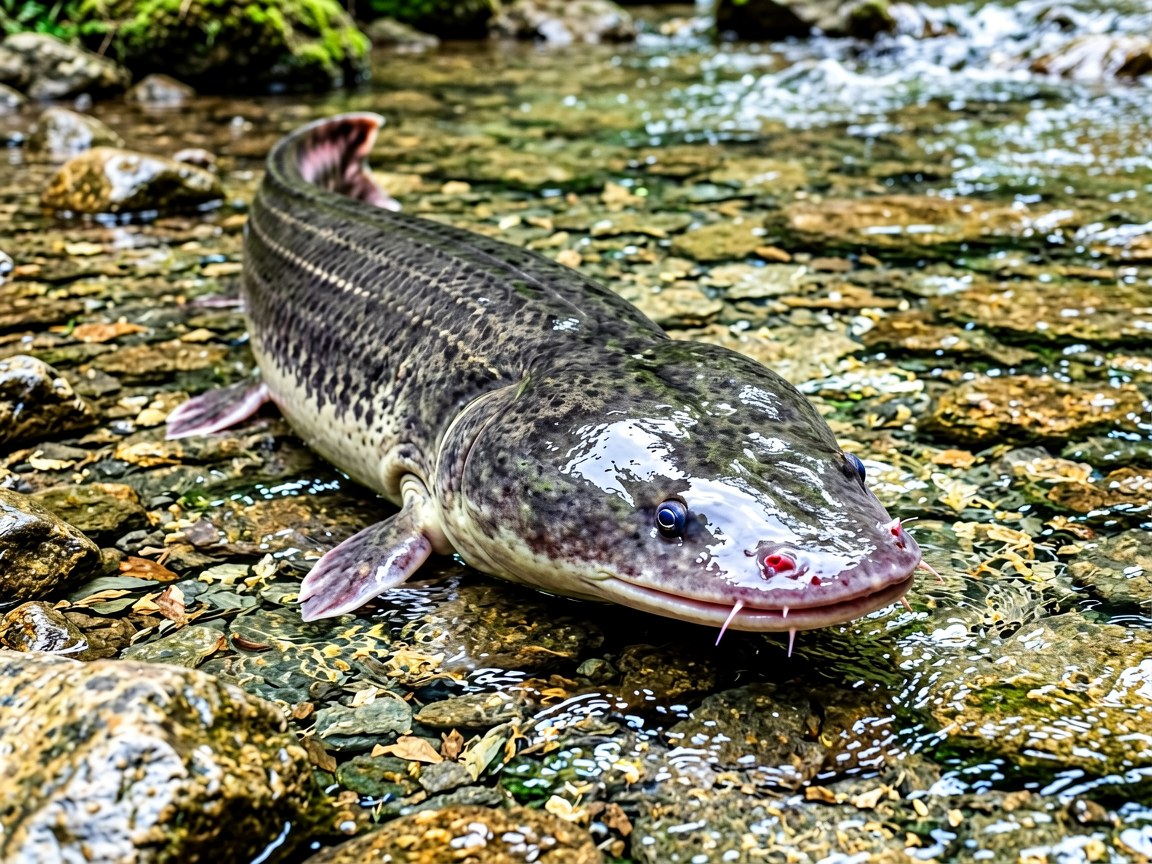
Andrias davidianus | Chinese Giant Salamander
Introduction
Andrias davidianus, the Chinese giant salamander, is the largest amphibian in the world, reaching lengths of well over a metre and weights exceeding 25 kilograms. Endemic to rocky, fast-flowing streams and lakes of central and southern China, it is a relic of an ancient lineage that has changed little since the age of the dinosaurs. Despite its size, it is a secretive, entirely aquatic animal that hides under stones by day and hunts at night. Once abundant, it has suffered catastrophic decline from overharvest for the luxury food trade and habitat degradation, and today wild populations are fragmented and endangered. Captive-breeding farms now hold far more animals than remain in nature, creating a complicated conservation picture in which farmed stock and wild recovery must be carefully managed.
Taxonomy
Andrias davidianus belongs to the family Cryptobranchidae, the giant salamanders, within the order Urodela (the salamanders and newts). It is a close relative of the Salamandra salamandra (Fire Salamander) and other caudates, but it represents a far more primitive body plan. The genus Andrias contains only a few species, including the closely related Japanese giant salamander; the name honours the missionary and naturalist Armand David, who sent the first specimens to Europe. Cryptobranchids are sometimes called “living fossils” because their broad, flat-headed form closely matches fossil salamanders from over 150 million years ago. Genetic studies show the Chinese species is distinct from its Japanese cousin, and that many “wild” Chinese animals today carry farm-origin genes.
Physical Characteristics
The Chinese giant salamander has a broad, flattened head, tiny eyes with poor vision, and a long, laterally compressed tail that powers it through water. Its body is wrinkled and mottled brown, grey, or black, providing camouflage against river rocks. Lacking gills as an adult in the strict sense, it breathes mainly through loose, finely folded skin and a pair of gill slits, absorbing oxygen directly from well-oxygenated water—one reason it needs cool, fast, clean streams. The limbs are short and stubby with four toes on the forefeet and five on the hind. A distinctive feature is its lateral skin folds, which increase surface area for respiration. The animal’s skin exudes a sticky mucus, and it can produce a vocalisation described as a crying or barking sound, unusual among salamanders.
Habitat
This species is tied to clear, cool, oxygen-rich rivers and mountain streams, typically at altitudes from a few hundred to over 1,500 metres, though it has also been found in some lakes and reservoirs. It requires rocky substrates with crevices and boulders for shelter and clean, flowing water with stable temperatures, usually below about 20°C. It is entirely aquatic and avoids strong currents only by tucking under stones, emerging at dusk to forage along the bottom. Destruction of riparian cover, dam construction, and water pollution degrade its habitat rapidly, because the animal cannot tolerate warm, stagnant, or silt-laden water. Historically widespread across the Yangtze, Yellow, and Pearl river basins, it is now confined to scattered, often protected headwater streams.
Across its Chinese range the giant salamander historically occupied clear tributaries of the Yangtze, Yellow, and Pearl river systems, favouring stretches with riffles, pools, and abundant boulders that offer both shelter and hunting perches. It selects sites where summer temperatures stay cool and the flow remains steady year-round, because warm or stagnant water quickly stresses its skin-based respiration. Seasonal floods can displace animals downstream, and they may move short distances overland on wet nights between connected pools, though they are poor travelers on land. Today the most viable wild populations survive in protected reserves and remote headwater streams in provinces such as Shaanxi, Sichuan, and Hunan, where ranger patrols and captive-release programmes aim to keep viable breeding groups in clean, free-flowing water.
Diet
The Chinese giant salamander is a patient ambush predator that eats almost anything it can fit into its wide mouth. Its diet includes fish, frogs, crabs, shrimp, insects, and aquatic snails, which it sucks in with a sudden snap aided by a suction created when it opens its jaws. Because its vision is poor, it locates prey mainly by sensing vibrations and pressure changes in the water through sensory cells along its body. It is nocturnal and sluggish, expending little energy and able to go long periods between meals. In captivity, individuals have been known to fast for months. Juveniles feed on smaller invertebrates and gradually shift to fish and crustaceans as they grow, becoming the apex predator of their stretch of stream.
Beyond fish and crustaceans, large adults will take frogs, aquatic snails, and even small mammals or birds that venture to the water’s edge, reflecting an opportunism shaped by the scarcity of easy meals in cool streams. Captive studies show the salamander can locate prey in total darkness using the pressure-sensitive lateral line along its body and by detecting the faint electric fields some prey generate, a sense shared with many amphibious hunters. It is a sit-and-wait predator rather than a chaser, often remaining motionless for hours with only its head protruding from a rock crevice. This low-energy lifestyle suits an animal in cold water where metabolism is slow, and it explains why wild giant salamanders can survive long winters with little food. In spring, when meltwater brings migrating fish, they feed most actively and rebuild condition lost over the cold months.
Reproduction
Breeding takes place in late summer to autumn, when males claim underwater burrows and attract females. After the female lays strings of hundreds of eggs in the sheltered cavity, the male guards them—a rare case of paternal care among amphibians—fanning them with his tail to keep them oxygenated until they hatch. The larvae are gilled and aquatic, metamorphosing into the adult form over one to two years as they lose their external gills. Sexual maturity is slow, reached only at five to seven years or more, which makes populations slow to recover from losses. In the wild, spawning success depends on cool, undisturbed water and secure nesting sites, both of which have become scarce across much of the species’ range.
Conservation
Andrias davidianus is listed as Critically Endangered by the IUCN. Centuries of harvest for meat—valued as a delicacy and in traditional medicine—drove wild numbers down by an estimated 80 percent or more in recent decades. Massive aquaculture now farms the species, but escapees and released farmed animals can spread disease and dilute wild genetics, complicating recovery. Conservation responses include strict protection under Chinese law, captive-breeding for reintroduction, and the establishment of reserves around key river systems. Successful reintroduction requires not only stocking but also restoring clean, free-flowing habitat and curbing illegal capture, making the giant salamander a flagship for the health of China’s freshwater ecosystems.
Fun Facts
- It is the world’s largest amphibian, growing longer than a human is tall.
- Despite its size, it breathes mostly through its wrinkled skin, not lungs.
- The male guards the eggs in a burrow, a rare form of fatherly care in salamanders.
- It can make a crying or barking sound, unusual for a salamander.
- Once common, it is now Critically Endangered after massive overharvest in China.