 By st20113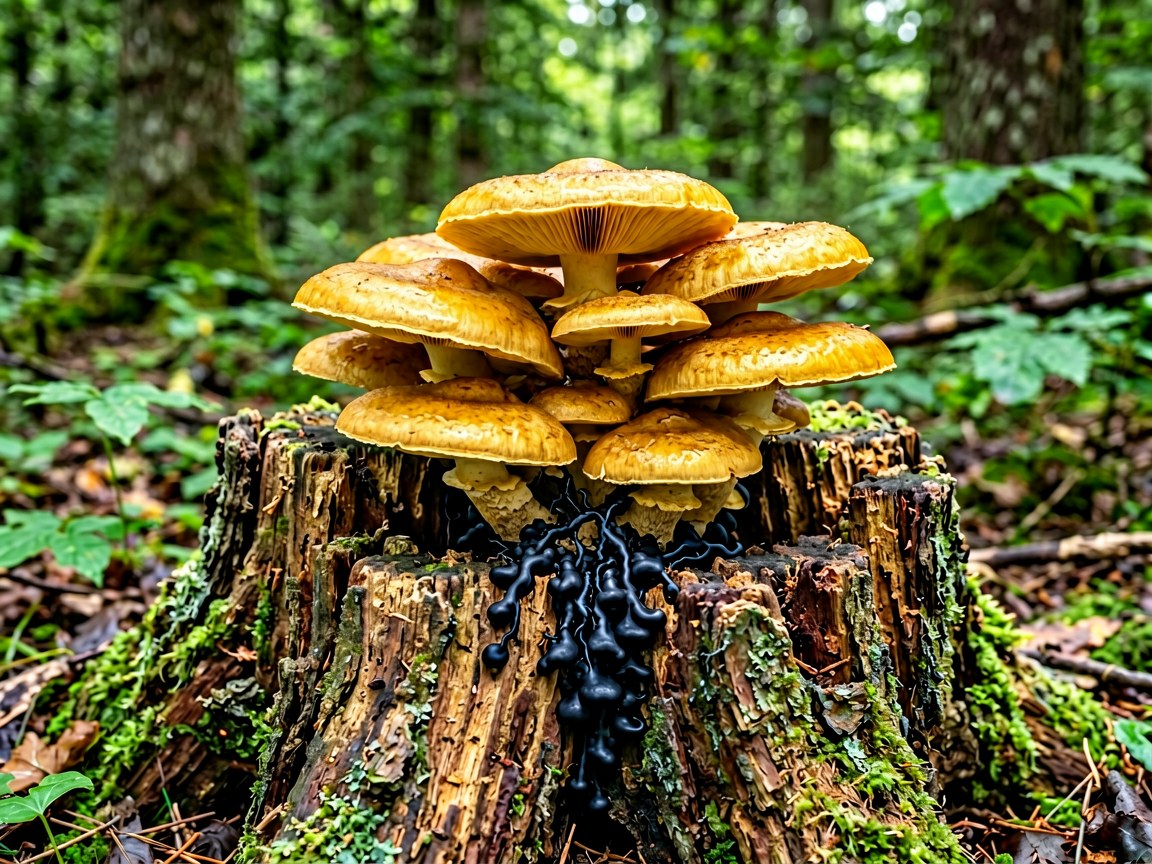
Armillaria ostoyae | Honey Fungus
Introduction
Armillaria ostoyae, the honey fungus or dark honey fungus, is a wood-decaying basidiomycete found across North America and parts of Europe. It is best known not for its modest golden-brown mushroom but for the colossal underground network it can form: a single individual in Oregon’s Malheur National Forest is estimated to cover roughly 9.6 square kilometres, making it one of the largest and oldest living organisms on Earth. The fungus attacks the roots and lower trunks of trees, causing a root rot that kills a wide range of conifers and hardwoods. Though destructive in forests and orchards, it is also a vital recycler of dead wood, returning carbon and nutrients to the soil. Its honey-coloured caps and black, boot-lace-like root threads (rhizomorphs) make it one of the most recognisable forest fungi to foragers and foresters alike.
Taxonomy
Armillaria ostoyae belongs to the genus Armillaria in the family Physalacriaceae, a group of gilled mushrooms that share a wood-decaying, often parasitic lifestyle. It is closely allied with other Amanita rubescens (Blusher) and fellow saprotrophs in the broader agaric clade, though Armillaria is distinguished by its rhizomorphs and bioluminescent mycelium in some relatives. The genus name Armillaria means “armlet” or “bracelet,” referring to the ring (annulus) on the stem, while “ostoyae” honours the mycologist René de Milly-Ostoya. For decades the species was confused with the European A. mellea, and only molecular work in the late 20th century split the complex into several distinct species, clarifying the true identity of the giant clones.
Physical Characteristics
The fruiting body of A. ostoyae has a honey- to tan-brown cap, typically 3–15 cm across, with a darker central umbo and faint scales when young. Gills beneath the cap are white to creamy and run down the stem, which bears a membranous ring left from the partial veil. The most telling feature, however, is hidden: the stem base shows a black, cord-like rhizomorph, a rooted thread of aggregated hyphae that grows through soil and rotting wood. Clusters of mushrooms emerge from a shared root system in autumn. Microscopically, the flesh is tough and the spores are white. In the dark, the mycelium of some Armillaria species glows faintly, a phenomenon long noted by foresters and the source of many folk tales about “fox fire” on decaying logs.
Caps of mature mushrooms are convex when young and flatten with age, often developing dark fibrils and a sticky sheen in wet weather; the colour deepens from honey-yellow at the margin to chestnut brown toward the centre. The gills are decurrent and release white spores that, under a microscope, appear smooth and ellipsoid. Below ground or within wood, the mycelium forms bright white sheets and the rhizomorphs can be as thick as bootlaces, branching through soil and even penetrating intact bark to reach new roots. These rhizomorphs are waterproofed with a melanin-like coating that lets them survive dry soil and travel metres from the parent colony. In culture the fungus grows rapidly, a trait that helps it colonise fresh stumps soon after a tree is felled or blown down.
Habitat
Honey fungus occupies temperate and boreal forests, orchards, and woodland edges wherever suitable woody hosts and moist soils occur. It thrives in established plantations and long-unchanged woodlands, because its persistent rhizomorph networks survive for years in the root systems of dead and dying trees. In North America it ranges from the Pacific Northwest through the Rockies to the east, favouring well-drained sites; in Europe it is common but usually less expansive. The fungus prefers partial shade and moderate moisture, and it colonises both living trees and stumps, allowing it to persist through cycles of death and regrowth. Its ability to spread underground means a single clone can dominate a site for centuries, long outliving the individual trees it kills.
Diet
Armillaria ostoyae is both a parasite and a saprotroph, able to kill living trees and then decompose their wood. It enters through wounds or directly through roots, using rhizomorphs to bridge gaps in soil and penetrate bark. Inside the host it produces white, fan-shaped sheets of mycelium (the “mycelial fan”) between bark and wood, secreting enzymes that digest cellulose and lignin. The fungus starves the tree by disrupting water and nutrient transport in the roots, leading to crown dieback and eventual death. Once the tree dies, A. ostoyae continues as a decomposer, recycling the lignin-rich timber. This dual strategy lets it thrive where pure parasites or pure rotters would fail, and explains why it is such a successful and long-lived forest organism across huge areas.
The enzymes Armillaria secretes include lignin peroxidases and cellulases that can break down the toughest components of wood, which is why it can persist on a stump long after the tree has died. It is unusually aggressive among decay fungi because the rhizomorphs actively forage through soil, seeking new hosts rather than simply waiting for contact, a behaviour more like a predator’s than a typical saprotroph’s. In gardens and orchards it may also attack living roots through pruning wounds and graft unions, where the bark is broken. Although it weakens and eventually kills the host, the process is slow, often taking several years, during which the tree may show only gradual thinning of the crown. This slow kill-and-consume strategy lets a single clone dominate a site and explains both its ecological success and its reputation as a stubborn orchard pest.
Reproduction
Like most mushrooms, A. ostoyae reproduces by spores produced on the gills of its caps. Millions of microscopic basidiospores are released from each cluster and dispersed by wind, though only a tiny fraction land in a spot where they can germinate and contact suitable wood. Individuals also expand vegetatively through rhizomorphs, which grow outward through soil and infect new roots, effectively cloning the parent fungus over hectares. Because the fruiting bodies arise from a shared underground network, an entire “fairy ring” of mushrooms may be one genetic individual. Mating in Armillaria is controlled by a complex compatibility system, and successful fusion of compatible mycelia is required before a new clone can establish and begin producing its characteristic boot-lace threads.
Conservation
Armillaria ostoyae is not threatened; indeed, it is abundant and in some contexts a serious pest. Its conservation interest is inverted: foresters manage it as a pathogen of timber, orchard, and nursery trees, using stump removal, resistant species mixes, and soil solarisation to limit losses. At the same time, the fungus plays an essential ecological role in breaking down dead wood and sustaining forest nutrient cycles, and the record-breaking Oregon clone is valued as a scientific curiosity and a symbol of the hidden scale of fungal life. There are no red-list concerns for the species itself, but its giant individuals are vulnerable to destroying the very forests that make their size possible, so balanced management matters more than protection.
Fun Facts
- A single honey fungus in Oregon may be the largest organism on Earth, covering nearly 10 square kilometres.
- It spreads through black, boot-lace-like root threads called rhizomorphs.
- The mycelium of some Armillaria relatives glows faintly in the dark, inspiring “fox fire” legends.
- It both kills living trees and then decays their wood, acting as parasite and recycler.
- Despite its reputation as a pest, its mushrooms are edible when cooked, though some people react badly.