 By st20113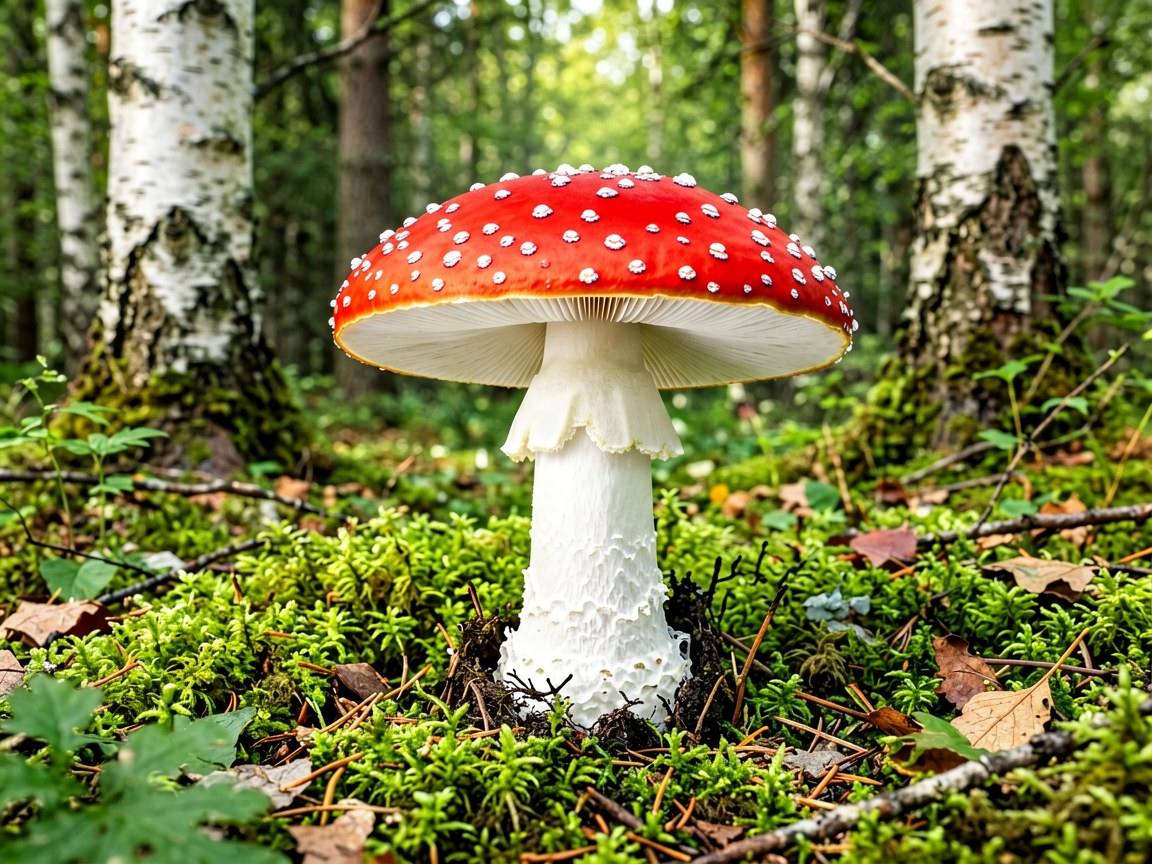
Russula emetica | The Sickener
Introduction
Russula emetica, commonly called the sickener, is one of the most vivid fungi of the northern forest floor: a small to medium mushroom capped in pure, almost startling red, with white gills and a white stem. It is a classic member of the brittle gill family, Russulaceae, a group united by flesh that snaps rather than fibres when broken, because the tissue is packed with spherical cells instead of long threads. The sickener is a mycorrhizal species, living in partnership with birch on acid soils, and it fruits from summer into late autumn. Its common name is a blunt warning: it is strongly acrid and will cause vomiting if eaten, though it is not among the deadliest fungi. For foragers it is a useful lesson in caution, because its cheerful colour can tempt the unwary. Despite its toxicity, it is a harmless and beautiful part of the woodland ecosystem, feeding no one directly but contributing to the nutrient web through its partnership with trees. It is found across the boreal and temperate northern hemisphere wherever birch grows, from lowland heaths to mountain birch woods, and its fruiting is closely tied to wet, mild autumns. For the beginner it is also a teaching species: its brittle flesh and peeling red skin make the genus easy to recognise even when the exact species is not, and its fierce taste is a built-in safety lesson that no wild mushroom should ever be bitten on a whim.
Taxonomy
The sickener sits in the large genus Russula, which contains several hundred species worldwide and is notorious for being difficult to identify to species level without microscopy. Its epithet emetica is Greek for “provoking vomiting”, a direct reference to its effect. It is placed alongside other bright-capped, brittle-fleshed allies, and it shares the mycorrhizal lifestyle with many forest fungi — in the same way that the fly agaric forms associations with tree roots, R. emetica exchanges sugars for minerals with birch. Within Russulaceae the genus is distinguished from Lactarius by lacking latex when cut. Several similar red Russulas exist, and the sickener is best confirmed by its peeling cap skin, pure white gills and stem, and an intensely hot taste so fierce that a tiny nibble on the raw flesh is unforgettable.
Physical Characteristics
The cap is 4–12 cm across, at first domed then flattening and often developing a central depression with age; its surface is a clean scarlet to crimson that fades in strong sun, and the cuticle peels easily from the margin inward. Beneath is a layer of pure white gills that are crowded, brittle and forked toward the stem. The stem is 4–8 cm tall, white, smooth and cylindrical, sometimes staining slightly with age but never developing a ring or cup. Flesh throughout is white and exceptionally brittle, breaking like chalk, and it has no milky juice. The spore print is cream to pale yellow, and under the microscope the spores are ornamented with small warts. The overall impression is of a toy-like red-and-white mushroom, which is precisely why it catches the eye on a mossy forest floor.
Habitat
The sickener is a species of acidic, often damp woodlands, showing a strong preference for birch but also recorded with pine and spruce on suitable soils. It appears on mossy forest floors, in heathland with scattered trees, and along bog margins where birch grows, fruiting from mid summer through late autumn after warm wet weather. It favours unimproved, low-nutrient sites and is common across northern and central Europe, and into North America and Asia within the boreal zone. Like many mycorrhizal fungi it is tied to the presence of its partner tree, so it will not be found in treeless grassland or on alkaline chalk where birch and heath fail. A single mycelium can fruit in the same spot for several years, producing rings or arcs of mushrooms as the underground network expands.
Diet
The sickener is not a decomposer in the usual sense but an ectomycorrhizal symbiont. Its underground threads (hyphae) sheathe the fine roots of birch and penetrate between the root cells, forming a living interface where the fungus passes soil minerals — especially phosphorus and nitrogen — to the tree, while the tree supplies the fungus with sugars made in its leaves by photosynthesis. This exchange means the mushroom is, indirectly, solar-powered: the carbon in its flesh originated as tree sugar. The fungus does not “eat” other organisms; instead it forages the soil with a far larger absorptive surface than the tree alone could manage, and the partnership lets both survive on poor, acidic ground. The acrid compounds in the flesh are a defence against being grazed by insects or mammals, protecting the fruiting body long enough to release its spores.
Reproduction
As with all mushrooms, reproduction is by spores. The gills are lined with millions of club-shaped cells (basidia), each hurling out tiny white spores that drift down and are dispersed by air currents. A single cap can release billions of spores over its life. Spores that land in suitable birch root zone may germinate and, if they meet a compatible root, join into a new mycorrhiza, completing the cycle. The mushroom itself is only the brief, visible fruit of a fungus that otherwise lives for years as a hidden network in the soil. Because the partnership is specific, successful establishment depends on the right tree being nearby; without birch or another host the spores simply do not form the necessary relationship, and the species stays confined to its favoured woodland habitats.
Conservation
Russula emetica is common and widespread where its habitat exists, and it is not considered threatened. Its fortunes are tied to the health of birch and heathland woodlands, which are generally stable or recovering in many parts of its range thanks to rewetting of drained peat and the natural spread of birch onto abandoned land. It is sensitive to heavy nitrogen deposition and to the loss of open, acidic woodland floor to dense shade or intensive management, but because it fruits freely and disperses vast numbers of spores, local losses are usually reversed quickly. For the forager the conservation message is simply to admire rather than collect it, since it is inedible and many similar red Russulas demand expert identification before any are considered safe.
Its acrid flesh means it is best left for the fungi to recycle, and most foragers are content to photograph it rather than collect it.
Fun Facts
- The name “sickener” comes from its ability to cause vomiting if eaten, though it is not usually fatal.
- The flesh contains no latex but snaps like chalk because it is made of round cells rather than fibres.
- Its cap skin peels cleanly from the edge inward, a handy identification clue.
- It forms a mycorrhizal partnership mainly with birch, trading minerals for tree sugars.
- A single mushroom can release billions of spores during its short life above ground.