 By st20113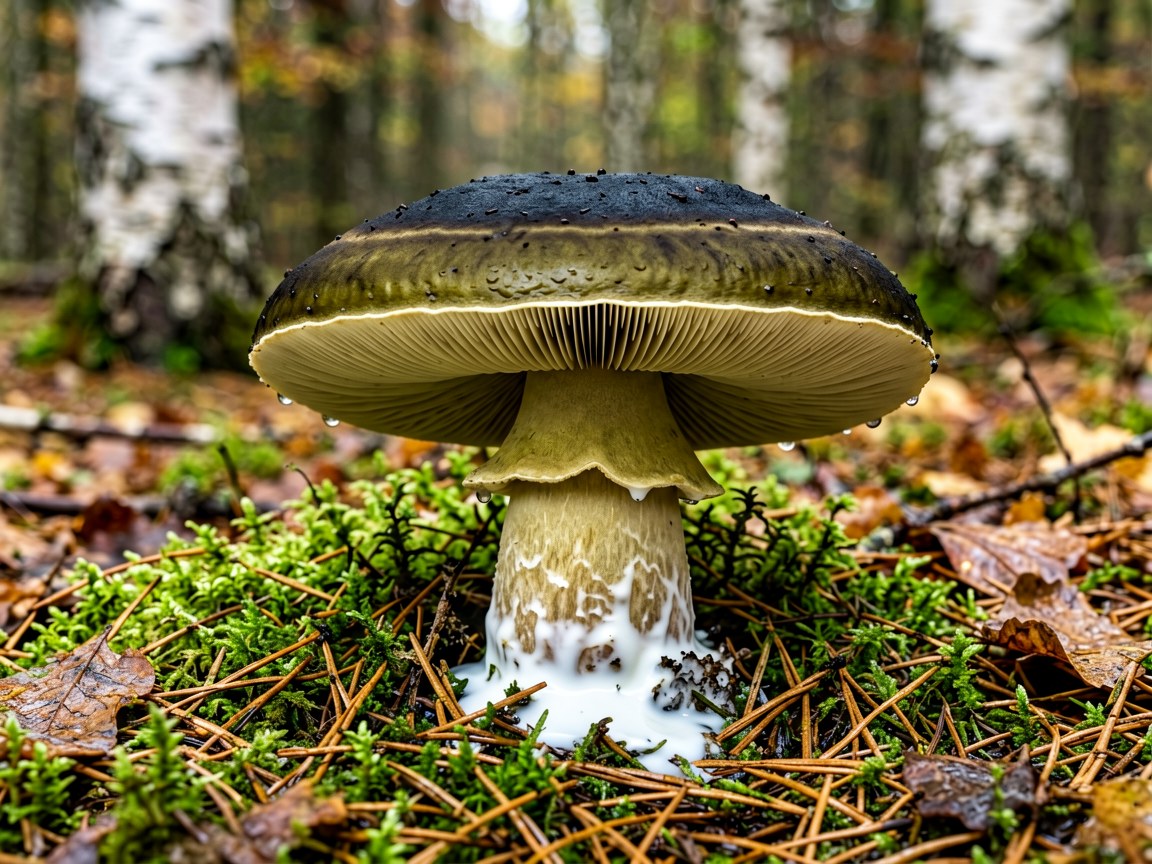
Lactarius turpis | Ugly Milkcap
Introduction
Lactarius turpis, long known to English speakers as the ugly milkcap and now more often called the blackening milkcap or the pepper milkcap, is a stout, dull, rather unprepossessing toadstool of the northern conifer and birch woods, famous above all for the copious white latex that bleeds from its broken flesh and slowly turns greenish or grey on exposure. It is a large, fleshy mushroom with a dark, slimy cap, a paler, often zoned stem, and gills that exude milk when damaged, and it appears in late summer and autumn on acid soils under birch and pine. The name “ugly” is fair comment: the cap is a murky olive-brown to near black, often with a paler, concentric-zoned margin, and it is viscid when wet, while the stem is short and stout and discolours readily. Though not deadly, it is peppery and unpleasant to eat and is of interest mainly to the naturalist and the mushroom hunter learning the milkcaps. It is a member of the large genus Lactarius, the milkcaps, which are defined by their exuding latex, and it sits alongside the gilled fungi rather than the sac fungi, unlike Amanita muscaria, though both are woodland toadstools of autumn.
Taxonomy
The ugly milkcap is a basidiomycete in the family Russulaceae, the brittlegill and milkcap family, and within that family it belongs to Lactarius, a genus of several hundred species worldwide that are united by the presence of latex-bearing vessels in the flesh. The genus name means “milky,” and the specific epithet turpis means “ugly” or “foul,” a blunt description of the fruit body’s appearance. It is a close relative of the brittlegills of the genus Russula, and like them its flesh is brittle because the cells are spherical rather than fibrous. The species is part of a group of dark, zoned milkcaps that grow with trees, and it has sometimes been confused with Lactarius necator, the oak milkcap, from which it is separated by habitat and detail of colour and taste. Older names in the literature include Lactarius plumbeus and, in North America, Lactarius lignyotus in a broad sense, so the working name has shifted over time. The key to the genus is the latex: every Lactarius, when cut or broken, releases a coloured or white juice, and in this species the juice is white at first and stains the gills and flesh dirty green or grey, a feature that helps to identify it among the darker milkcaps.
Physical Characteristics
The cap is three to twelve centimetres across, at first convex and later flattened or slightly depressed in the centre, with a strongly inrolled margin when young; the surface is olive-brown to dark brown or blackish, often with paler, concentric, irregular zones toward the edge, and it is sticky or slimy when moist, becoming dull and dry in dry weather. The gills are crowded, pale cream to buff, often stained greenish where the latex has touched them, and they run a little down the stem. The stem is two to six centimetres tall and one to two and a half centimetres thick, pale buff or greyish, often with faint zones or spots, solid at first and becoming hollow, and it stains brown or grey when handled. The flesh is firm but brittle, white, and exudes a white latex that is at first mild or slightly bitter and slowly turns greenish-grey on exposure to air; the latex stains the gills and the fingers. The spore print is cream to pale buff, and the spores are small, round and warty under the microscope. The whole fungus is heavy for its size and discolours badly when bruised, which is part of its “ugly” reputation.
Habitat
The ugly milkcap is a fungus of acid, nutrient-poor soils and is found in autumn under birch and pine, and occasionally under other trees, in conifer plantations, mixed woods, heaths and mossy clearings. It favours the damp, peaty and sandy grounds where birch and pine grow, and it is often abundant in the needle and leaf litter of such places, sometimes in rings or arcs. It is a mycorrhizal species, forming a mutually beneficial partnership with the roots of its tree partners, through which it receives sugars and in return helps the tree take up water and nutrients from the soil. Across the cool temperate north it ranges through Europe, into Asia and across northern North America, and it is a characteristic fungus of the birch-pine woodlands of late summer and autumn. It fruits from late summer into late autumn, often after rain, and it is common enough to be a standard find on forays in its habitat. It avoids calcareous and richly fertilised ground, so it is a useful indicator of acid, unimproved woodland soils.
Diet
As a mycorrhizal fungus, the ugly milkcap feeds both itself and its tree partners: the underground mycelium explores the soil for water and mineral nutrients, which it passes to the tree, and in return the tree supplies the fungus with carbon compounds made by photosynthesis in its leaves. This partnership means the fungus is not a decomposer of litter in the usual sense, though its mycelium also helps to break down organic matter in the soil. The white latex that gives the genus its name is a defence against being eaten; it is bitter and peppery and deters slugs, insects and mammals from consuming the fruit body, and in this species it also discolours on contact, perhaps as part of the same chemical defence. As food for people the ugly milkcap is not recommended: it is peppery and acrid, and while not fatally poisonous it is unpleasant and can cause digestive upset, so it is generally left in the field. A few northern culinary traditions salt or ferment milkcaps, but this species is not among the esteemed ones, and most field guides advise against eating it.
Reproduction
The spores are produced on the gills and are released into the air when the weather is damp and mild; they are carried by the wind to the soil, where they must meet a compatible mate and, crucially, a suitable tree root to form the mycorrhizal partnership that allows the fungus to fruit. Once established, the mycelium can persist for years in the soil beneath its tree partners and produces caps annually in the autumn. The fruit bodies appear in loose groups or scattered, sometimes in fairy rings, and they are short-lived, decaying quickly once the spores are shed and the weather turns cold. The latex plays a role in protecting the developing and mature cap from being eaten before it can release spores. Because the fungus depends on living trees, its reproduction is tied to the health of the woodland: a felled plantation may fruit for a year or two on old mycelium but will not be recolonised once the roots rot away, so the mushroom is, in a sense, a recorder of living woodland.
Conservation
The ugly milkcap is common and widespread across the northern conifer and birch woods and is not considered threatened; it is a familiar and abundant autumn fungus in its habitat and a regular entry in fungal surveys. Its main sensitivity is to the loss of its acid woodland and heathland habitats and to the conversion of native birch and pinewoods to other land uses, but because it is so tolerant of plantation forestry it remains common even in managed landscapes. It is not legally protected and there is no conservation action aimed specifically at it. It is, however, a useful indicator species: its presence signals acid, unimproved soils and living birch or pine mycorrhiza, and its abundance tells an ecologist that the woodland’s fungal community is intact. For the forager it is chiefly a lesson in the milkcap group, teaching the habit of checking the latex and its colour change, a skill that carries over to identifying both edible and toxic relatives.
Fun Facts
- The white latex that bleeds from a cut turns greenish-grey on exposure, a chemical change that helps identify it.
- “Turpis” means ugly, an honest description of its dark, slimy, discolouring cap.
- It is mycorrhizal, feeding a birch or pine tree in exchange for sugars made in the tree’s leaves.
- Its peppery latex is a defence that deters slugs and mammals from eating the mushroom.
- Despite the name, it is not deadly, only bitter and acrid, and it is best left for the naturalist to admire.