 By st20113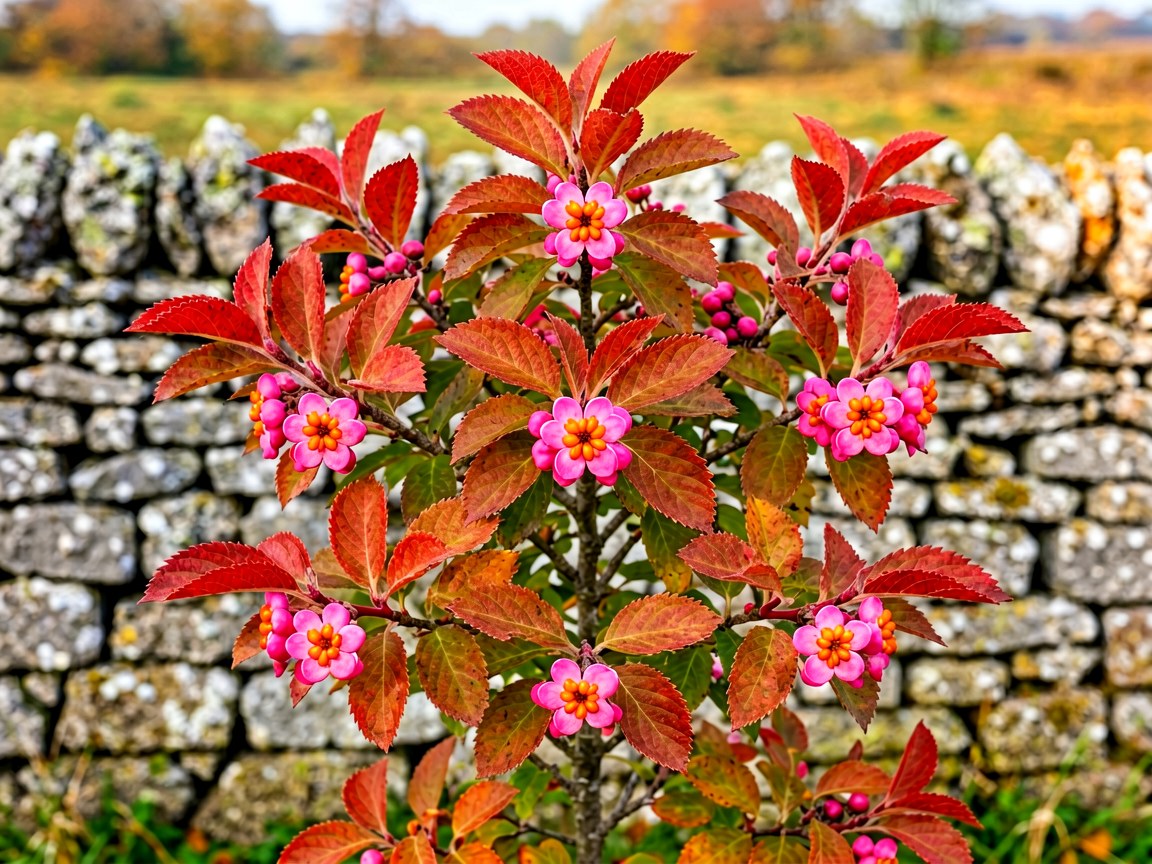
Euonymus europaeus | Spindle
Introduction
Euonymus europaeus, the spindle tree, is a deciduous shrub or small tree of the staff-vine family (Celastraceae) native to much of Europe, from the British Isles and Iberia eastwards to the Caucasus and western Russia. It is most often found as a many-stemmed bush two to six metres tall, though on sheltered sites it can grow into a slender tree reaching as much as ten metres. Spindle is best known for its striking autumn display: the four-lobed, shrimp-pink fruits split open to reveal bright orange seeds, set against leaves that have turned from green to a vivid scarlet or crimson, making it one of the most colourful native shrubs of the European countryside. It is a plant of hedgerows, woodland edges, scrub and chalk or limestone slopes, favouring well-drained, base-rich soils. Historically it was put to practical use because of its very hard, fine-grained wood, which was cut into spindles for spinning, giving the tree its English name, while various parts were used in traditional medicine despite being strongly purgative and toxic. Like other green shrubs it depends on the fundamental process of Photosynthesis to build the sugars that feed its wood, flowers and spectacular seeds.
Taxonomy
Spindle is the type species of the genus Euonymus, a large genus of shrubs, small trees and woody climbers with more than a hundred species spread across the temperate and subtropical regions of the Northern Hemisphere and extending into the mountains of Southeast Asia. The genus name is derived from a Greek word for a plant held sacred to a divinity, while the specific epithet europaeus simply means “European.” Within Europe, E. europaeus is the common native representative, though related species such as the evergreen Euonymus japonicus and the climbing Euonymus fortunei are widely grown as ornamentals and have naturalised in places. The spindle is placed in Celastraceae alongside bittersweet (which is unrelated to the nightshade of the same name) and a number of tropical and subtropical woody plants. A number of forms and subspecies have been described across its range, differing in fruit colour, leaf shape and ultimate size, and horticultural selections with particularly intense autumn colour or compact growth are available in the nursery trade under names such as ‘Red Cascade’ and ‘Aldenhamensis.’
Physical Characteristics
Spindle is usually a much-branched, upright deciduous shrub with smooth, thin, grey-green bark marked by faint corky lines, and slender twigs that are distinctly four-sided or winged when young. The leaves are opposite, oval to lance-shaped, three to nine centimetres long, with finely toothed margins and a short pointed tip; they are dull green and hairless above, paler beneath, and turn brilliant red, pink or purple in autumn. The flowers, produced in late spring, are small, four-petalled and greenish-white, carried in loose clusters of three to eight in the leaf axils; individually inconspicuous, they are rich in nectar and attractive to insects. The fruit is the plant’s signature feature: a rounded, four-lobed capsule, about one to one and a half centimetres across, that starts green, ripens to a startling pink or magenta, and then splits open along four seams to expose the seeds, each wrapped in a fleshy, bright orange-red aril. The wood is exceptionally dense, pale cream, finely textured and takes a smooth finish, qualities that made it historically valuable for small turned objects.
Habitat
Spindle favours well-drained, calcareous or neutral soils and is particularly characteristic of hedgerows, woodland margins, scrub, coppices and the scrubby slopes of chalk and limestone downland. It tolerates a measure of shade and is commonly found at the edge of deciduous woodland, in hazel and hawthorn scrub, and along field boundaries where it can form part of a dense, layered hedge. Across lowland and upland Europe it ranges from sea level to moderate mountain elevations, avoiding the wettest and most acid peaty ground as well as the driest, most exposed sites. It grows best where light is plentiful but competition from vigorous grasses is limited, and it responds well to coppicing and hedge laying, which encourage bushy regrowth and more prolific fruiting. Although native to Europe, it has been introduced as an ornamental well beyond its range and in some regions, including parts of North America, it has escaped cultivation and is regarded as an occasional invasive, spreading into open woods and roadsides where it can form thickets.
Diet
As a photosynthesising shrub, spindle makes its own food from light, carbon dioxide and soil minerals and takes nothing from other living organisms, neither carnivore nor parasite. Its flowers, however, are an important resource for insects: they produce nectar and pollen that attract a range of small bees, hoverflies, beetles and other generalist pollinators during the late spring flowering period, and these visitors effect the cross-pollination the plant relies on. The foliage is eaten by the caterpillars of several moth species, notably the spindle ermine moth whose larvae can occasionally defoliate whole bushes in midsummer, and by various leaf-eating beetles. The seeds, encased in their colourful arils, are taken by birds, especially thrushes and robins, though the aril is the only palatable part and the seed itself usually passes through unharmed, aiding dispersal. Mammals generally avoid the plant because of its toxic compounds, and grazing livestock rarely browse it, which helps it persist in grazed hedgerows where more palatable shrubs are kept low.
Reproduction
Spindle reproduces by seed and, less commonly, by suckering from the base. The greenish flowers open in late spring and are insect-pollinated, with each fertilised flower developing into the characteristic four-lobed capsule. The fruit ripens through late summer and autumn, and at maturity the capsule turns pink and dehisces, curling back to expose the orange arils and the seeds within. The seeds have a hard coat and require a period of cold stratification to germinate, so they typically lie through the winter and sprout the following spring, often some distance from the parent after being carried by birds. Natural regeneration is steady but not rapid, and in hedgerows the plant more often persists and spreads by sending up new shoots from the base, forming a clump over time. In cultivation, named forms are propagated by semi-ripe cuttings taken in summer or by layering, since seedlings may not come true and take several years to flower; the plant also responds well to hard pruning, which stimulates the vigorous young growth that fruits most heavily.
Conservation
Across its native European range spindle is common and secure, with no continental conservation status of concern, and it remains a familiar component of traditional hedgerows and woodland edges. Its populations are nonetheless affected by the loss and neglect of hedgerows, the removal of scrub in “tidied” countryside, and the loss of calcareous grassland and downland to agriculture and development. Because it is widely planted in conservation and amenity hedging for its wildlife value and autumn colour, it continues to be abundant in the managed landscape. It is not legally protected over most of its range, though agri-environment schemes that pay for hedgerow management indirectly benefit it. Outside Europe it is treated with more caution: in parts of North America it is listed as an invasive or watch species, and landowners there are sometimes advised to control it, a reminder that a treasured native in one continent can be a problem in another. For most of its home range, however, spindle needs no special conservation action beyond the retention of the varied, semi-natural habitats it favours.
Fun Facts
- The wood of spindle is so hard and even-grained that it was traditionally turned into spindles for spinning wool, knitting needles, pegs and the handles of small tools, which gave the tree its English name.
- The vivid pink fruit that splits to show orange seeds is sometimes called “burning bush” in autumn, though that name is shared with unrelated plants.
- All parts of the plant are toxic if eaten, especially the seeds and bark, which act as a strong purgative; it was nonetheless used in old herbal medicine in carefully controlled doses.
- The spindle ermine moth can cover a bush in white webbing and strip its leaves, yet the plant usually recovers fully and fruits normally the same autumn.
- In autumn the combination of red leaves and pink-and-orange fruit makes spindle one of the most photographed native shrubs in European hedgerows.