 By st20113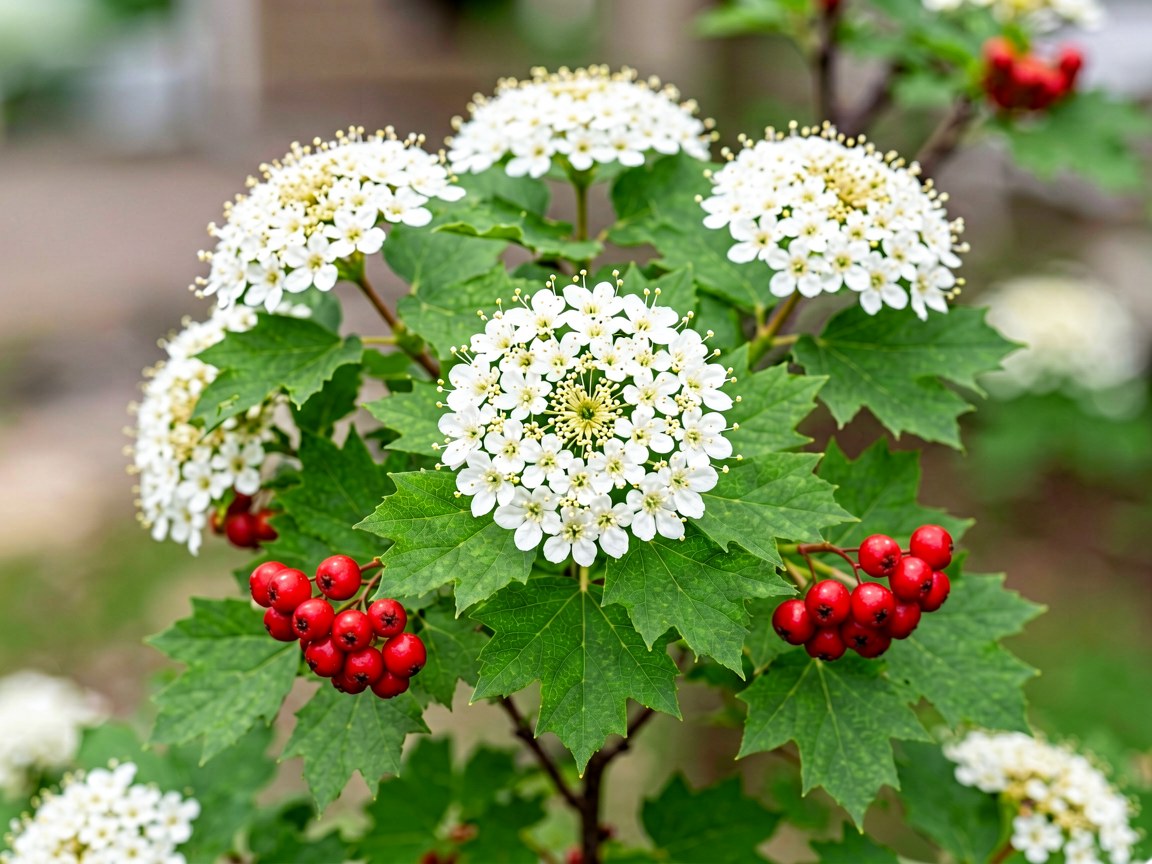
Viburnum opulus | Guelder Rose
Introduction
Viburnum opulus, widely known as the guelder rose, is a deciduous shrub of the moschatel family (Adoxaceae, formerly placed in Caprifoliaceae) that grows naturally in Europe, northwest Africa, and western and central Asia. Despite the common name, it is not a true rose at all, and the “guelder” part refers to the Dutch province of Gelderland, where a cultivated, sterile form became especially popular. In the wild it is a familiar sight in damp woods, along riverbanks, in fens and hedgerows, where its layered branches and broad leaves form a loose, rounded thicket up to four or five metres tall. Guelder rose is valued in the landscape for two contrasting floral displays: flat, lacy clusters of small fertile flowers surrounded by a ring of large, showy, sterile ones that look like a single bloom, followed in autumn by heavy drooping clusters of translucent red berries. It is a useful plant for wildlife, supporting a wide range of insects, birds and mammals, and it has a long history of use in folk medicine, though its raw parts are mildly toxic. Like many woody plants, its growth and flowering are ultimately driven by the broader process of Photosynthesis, which captures the light energy that fuels every leaf and berry.
Taxonomy
The guelder rose sits in the genus Viburnum, a large and widespread group of shrubs and small trees containing several hundred species distributed across the temperate and subtropical Northern Hemisphere, with outliers in the mountains of South America and Southeast Asia. Within the genus it belongs to a group of species with lobed, maple-like leaves and ball-shaped or flat flower heads, close relatives of which include the American Viburnum trilobum (often treated as a variety of V. opulus) and the southern European Viburnum lantana. The specific epithet opulus was historically applied to maple-like plants, a reference picked up in the old name “water maple” once used for this shrub. The most familiar garden form, Viburnum opulus ‘Roseum’ (also sold as ‘Sterile’ or as the old cultivar ‘Snowball bush’), produces only the large sterile outer flowers and no fruit, having been selected over centuries for its spherical white blossom heads. Cultivars such as ‘Compactum’ and the reddish-leaved ‘Aureum’ are also grown. In scientific literature and herbaria the plant is sometimes still found under the synonym Viburnum opulus var. roseum, reflecting its long horticultural separation from the wild type.
Physical Characteristics
Guelder rose is a suckering, deciduous shrub that typically reaches three to five metres in height, occasionally more in favourable sites, with a spread of similar dimension and a loosely arching, open habit. The bark is grey-brown and lightly marked with lenticels, while young twigs are green and somewhat angular, becoming grey and corky with age. The leaves are opposite, three-lobed and coarsely toothed, superficially resembling those of a maple (Acer), with a broadly triangular outline, a pointed tip and a heart-shaped base, and measure six to twelve centimetres across; they are dark green and slightly wrinkled above, paler and softly hairy beneath, and turn a rich crimson, purple or gold in autumn. The inflorescences are flat-topped cymes, eight to twelve centimetres wide, made up of a central mass of small, five-petalled, creamy-white fertile flowers ringed by a margin of larger, four-lobed sterile flowers that are themselves infertile but visually dominant. The fruit is a fleshy drupe, bright glossy red, about eight millimetres across, hanging in pendulous clusters and each containing a single flattened stone. The whole plant carries a faint, unpleasant smell when bruised, a trait reflected in the old name “stinking elder” once applied to it.
Habitat
Guelder rose shows a strong preference for moist, fertile soils and is most at home where the ground does not dry out for long. It occurs naturally in damp deciduous woodland, along the margins of streams, rivers and ponds, in alder carr and willow scrub, in fens, wet meadows and on the edges of reed beds, and frequently in tall hedgerows and scrub where the soil is deep and base-rich. It tolerates both full sun and partial shade, growing most vigorously at the woodland edge or in open, watery places where light is plentiful but competition from grasses is limited. Across its European range it follows river valleys and damp lowland landscapes, extending into montane scrub at moderate elevations in southern mountains. Although it can persist on calcareous clays and loams it performs best where there is a reliable supply of moisture, and it is often one of the first shrubs to colonise disturbed wet ground, spreading by suckers to form loose clones. It is hardy to severe frost and is widely planted beyond its native range as an ornamental, where it naturalises readily in suitably damp gardens and parks.
Diet
As a green plant, guelder rose is autotrophic, manufacturing its own food from carbon dioxide, water and sunlight through photosynthesis and drawing mineral nutrients from the soil through a fibrous, suckering root system. It makes no use of animal prey and is not parasitic; its diet, in the broad sense, is wholly inorganic. The nectar and pollen of its flowers, however, support a varied animal diet: the small fertile flowers are visited by a wide range of insects includinghoverflies, solitary bees, butterflies, beetles and occasional wasps that take nectar and in doing so carry pollen between heads. The showy sterile outer flowers offer no reward and exist only to draw pollinators toward the fertile centre. Later in the year the berries become food for birds such as fieldfares, redwings, robins, thrushes and bullfinches, as well as small mammals including mice and voles, and even foxes have been recorded eating fallen fruit. The leaves are eaten by the caterpillars of several moth species, including the viburnum beetle and various native Lepidoptera, so the plant itself forms part of the diet of many invertebrate herbivores.
Reproduction
Guelder rose reproduces both sexually by seed and vegetatively by suckering. The flat flower heads bloom in late spring to early summer, and because the sterile margin flowers are scentless and nectarless, they serve purely as visual lures; the fertile central flowers produce both nectar and pollen and are the ones that set fruit. Pollination is carried out by a wide variety of generalist insects, and a single head can yield numerous berries. Each drupe contains one hard stone, and the seeds inside have a double dormancy requiring both warm and cold stratification before they will germinate, which explains why seedlings appear slowly and irregularly in the wild. Birds that eat the fruits disperse the stones, often over considerable distances from the parent, and the resulting plants may not flower for several years. Vegetative spread through suckers is, in practice, the more reliable means of increase: roots send up new shoots some distance from the parent, gradually building a thicket. In cultivation the sterile cultivars are increased only by cuttings or layering, since they set no seed at all.
Conservation
Within its native European range guelder rose is common and is assessed as a species of least concern, with no global conservation threat. Its main vulnerabilities are habitat loss through drainage of wetlands, the straightening and clearing of riverbanks, and the intensification of hedgerow management that removes the scrub layer it favours. Because it spreads readily and is widely planted, it is not considered at risk in most countries, and in some places outside its native range it has been noted as a minor escapee from gardens without becoming seriously invasive. It remains a valuable component of riparian and wetland planting schemes aimed at stabilising banks, providing cover and supplying autumn fruit for wildlife. In gardens it is prized for season-long interest and is frequently recommended in wildlife-friendly and native-species planting. No special legal protection applies across most of its range, though local planning controls on wetland and hedgerow removal indirectly safeguard many of the habitats it depends upon.
Fun Facts
- The cultivated “snowball” form, Viburnum opulus ‘Roseum’, has been grown in European gardens since at least the sixteenth century and was prized by Tudor and Stuart gardeners for its round white blossom heads.
- The common name “guelder rose” comes from Gelderland in the Netherlands, where the sterile garden form was first popularly cultivated.
- The berries are technically edible when cooked and were once used to make a sharply flavoured jelly, but raw they are mildly toxic and can cause vomiting.
- In folklore the pith from the young stems was hollowed out to make whistles and small pipes, giving rise to the old English name “whistlewood.”
- The stiff, angular twigs and bright autumn colour made the plant a traditional choice for winter decoration, and its clustered red fruit is among the latest to persist into deep winter, feeding birds when little else remains.