 By st20113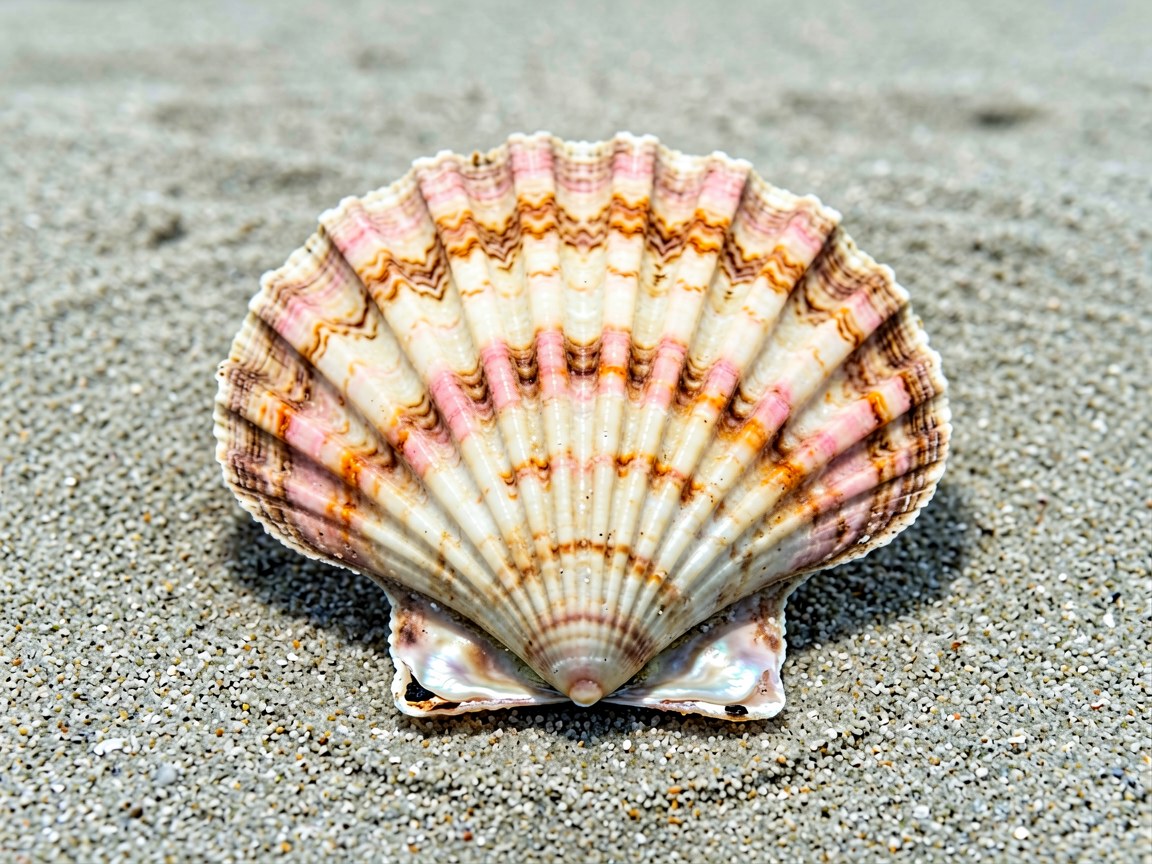
Aequipecten opercularis | Queen Scallop
Introduction
The queen scallop (Aequipecten opercularis) is the smaller, brighter, more colourful cousin of the great scallop, and the only European bivalve that swims freely and energetically through the water by clapping its two valves together. Its shell is a neat, almost circular fan with a pair of unequal ears, or auricles, at the hinge, and it is marked with radiating ribs and coloured in a remarkable range of pinks, oranges, yellows, purples, and browns, so that a heap of fresh queen scallops looks more like a pile of sweets than a catch of shellfish. It supports an important fishery around the coasts of Britain, Ireland, and northern France, where it is taken by dredge and by diver and sold as “queenies”. It is also one of the few bivalves with well-developed eyes: a row of dozens of small, bright, blue-green eyes around the edge of the mantle, which it uses to detect the approach of a predator.
Taxonomy
Aequipecten opercularis is a bivalve mollusc in the family Pectinidae, the scallops, a large and economically important family of free-living, often brightly coloured bivalves found in all the world’s seas. It was formerly known as Chlamys opercularis and before that as Pecten opercularis, and both names appear in older literature and in the fishing industry. Its relatives include the great scallop Pecten maximus, the much larger and plainer species taken by divers and dredgers in deeper water, and the variegated scallop Mimachlamys varia. The genus name means “equal comb”, a reference to the two nearly equal ears at the hinge, and the specific epithet opercularis means “with a lid”, from the shape of those ears. Like other suspension-feeding bivalves such as Mytilus edulis, it feeds by pumping water over its gills, though the mussel is fixed to rock with byssal threads while the queen scallop lies free on the seabed or swims.
Physical Characteristics
The shell is solid but relatively light, almost circular and slightly longer than it is wide, typically five to eight centimetres across, with one valve — the right, or lower, one — distinctly more convex and paler than the other, which is flatter and more strongly coloured. At the hinge there are two ears, or auricles, one on each side of the umbo, the front one larger than the rear and with a distinct notch, or byssal notch, beneath it. Both valves carry about nineteen or twenty strong, radiating ribs, which are rounded and often slightly scaly or spiny, particularly in young shells, and the ribs of the two valves alternate to fit together at the margin. The colour is the striking feature and is enormously variable: shades of pink, red, orange, yellow, purple, brown, and cream, either plain or mottled and banded, and most shells are patterned rather than uniform. Inside, the shell is smooth and white, often with a pinkish or yellowish flush, and there is a single large, central muscle scar — the adductor muscle that closes the shell and is the part that is eaten. The mantle edge carries a fringe of short tentacles and, between them, a row of thirty or more small, metallic blue-green eyes.
Habitat
It lives free on the seabed, not attached, on clean sand, gravel, shell gravel, and firm muddy sand, from the extreme low water mark down to depths of about two hundred metres, and it is most abundant on the coarse, clean grounds of the continental shelf. Young animals often attach themselves by byssal threads to hydroids, shells, or stones, and older ones lie in a slight hollow in the sediment, often partly covered. It is a strong swimmer for a bivalve: by snapping the valves shut and expelling water in jets on either side of the hinge, it can propel itself through the water in a series of erratic jumps, and it does this to escape starfish and other predators. The species is distributed in the eastern Atlantic from Norway and the Faroes south to Iberia, the Canary Islands, and into the Mediterranean, and it is common all around the coasts of Britain and Ireland.
Diet
It is a suspension feeder. Water is drawn into the mantle cavity, passed over the large, folded gills, where cilia and mucus trap the suspended particles, and expelled; the trapped material is sorted on the gills and by the labial palps, and the edible fraction is carried to the mouth while the rest is rejected as pseudofaeces. The diet consists of phytoplankton — diatoms, dinoflagellates, and other microscopic algae — together with bacteria, organic detritus, and the larvae and other small particles suspended in the water. Feeding depends on the animal’s ability to pump a large volume of water, and it is interrupted whenever the animal swims or closes its shell. Because it lives on clean, well-flushed grounds rather than in rich estuarine mud, the concentration of food is modest, and the animal compensates with a high pumping rate. Growth is fast, and most of the animals taken by the fishery are two or three years old.
Reproduction
The sexes are separate in this species, with the male gonad creamy white and the female a bright orange-red, and the two can be told apart at a glance when the shell is opened. Spawning takes place in spring and summer, often in two or more discrete episodes, and eggs and sperm are released into the open water, where fertilisation occurs. Development passes through the trochophore and veliger stages, with the veliger spending three to four weeks in the plankton before it settles onto suitable clean gravel or shell and metamorphoses into a tiny scallop, initially attaching itself with byssal threads. Settlement is highly variable from year to year and depends on temperature, on the timing of the plankton bloom, and on the availability of clean settlement substrate; a good year class can dominate the population for several seasons. The animals are relatively short-lived, with few surviving beyond four or five years, which makes the fishery dependent on regular recruitment.
Conservation
The species is abundant and widespread and is not considered threatened globally, but it is heavily fished, and the management of the fishery is a significant and sometimes contentious issue, particularly in the Isle of Man, the Clyde, and the Irish Sea, where it has been taken by dredge in large quantities for decades. The concerns are the familiar ones: local depletion, the capture of undersized animals, the incidental mortality of animals that pass through the gear, and the damage that towed gear does to the seabed and to the other animals living on it. Because the species is fast-growing and short-lived, it is more resilient than the slower-growing great scallop or the long-lived clams, but populations fluctuate considerably from year to year with the strength of recruitment, and several fisheries are now managed with closed areas, minimum landing sizes, and limits on effort. Its dependence on clean gravel and shell ground also makes it vulnerable to sand and gravel extraction.
Fun Facts
- It has dozens of small, bright blue-green eyes around the edge of its mantle.
- It swims by clapping its two shells together and shooting water out either side of the hinge.
- The shell colour ranges from pink and orange through purple and yellow, and few are alike.
- The male’s roe is creamy white and the female’s bright orange-red, so the sexes are easy to tell apart.
- It is sold as “queenies” and is one of the most valuable shellfish fisheries around the British Isles.