 By st20113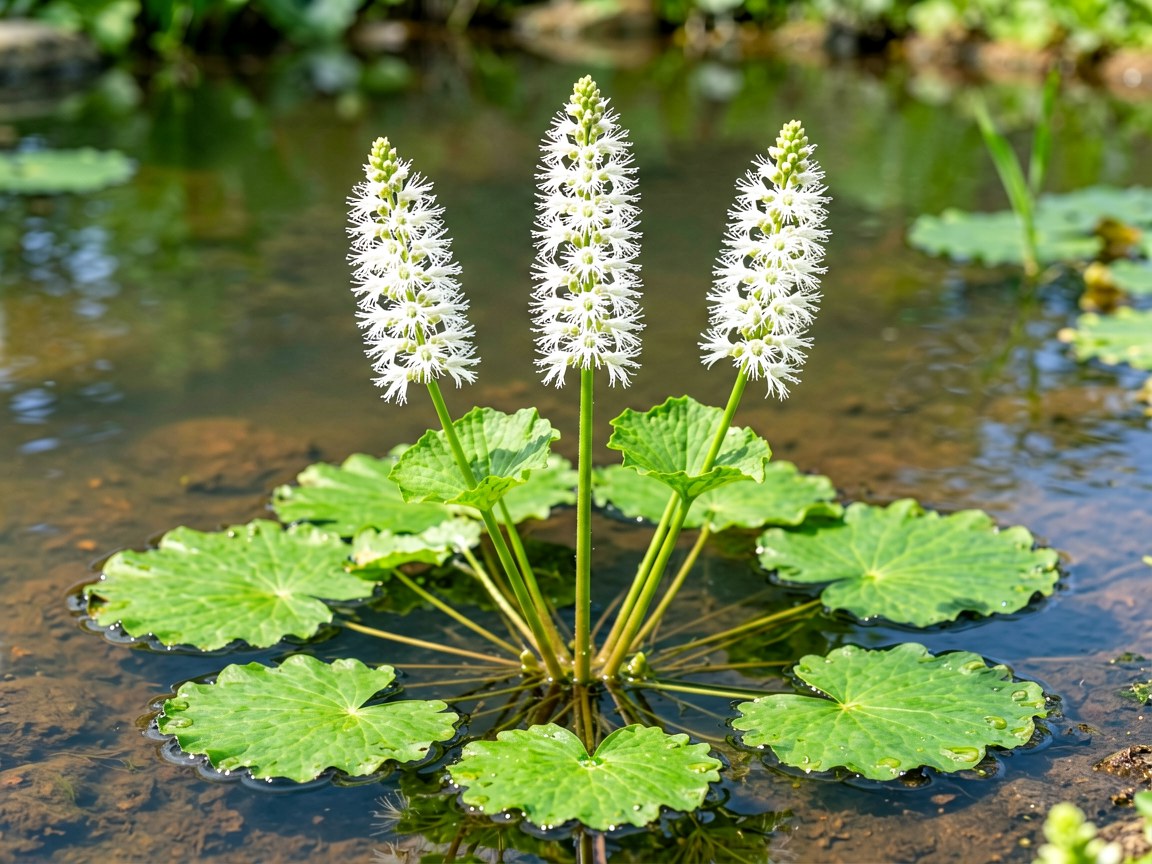
Menyanthes trifoliata | Bogbean
Introduction
Bogbean (Menyanthes trifoliata) is one of the handsomest plants of northern bogs, a waterside perennial with a creeping, spongy stem, handsome three-lobed leaves like those of a broad bean, and short spikes of extraordinary flowers: each blossom is white or faintly pink, and every petal is fringed along its whole face with a dense beard of fine, white, silky hairs, so that the flower head looks as though it has been dusted with frost or spun sugar. It grows in shallow water at the margins of pools and slow streams, in bogs, fens, and wet heath, often with its roots submerged and its leaves held above the surface. It is a plant of cold, acid, nutrient-poor ground, and in Britain it is one of the characteristic and most welcome flowers of the wetter north and west.
Taxonomy
Menyanthes trifoliata belongs to the family Menyanthaceae, the bogbean family, a small group of aquatic and wetland plants that also includes the fringed water lilies of the genus Nymphoides and the Australian swamp plants of Villarsia. The family was formerly included within the gentian family, Gentianaceae, and some older books still place it there, but it is now generally treated separately on the evidence of its morphology and its chemistry. The genus name comes from the Greek for “month” and “flower”, possibly a reference to the flowering time or to the plant’s long season of bloom, and the specific epithet trifoliata means “three-leaved”, from the trefoil leaf. It is the only species in its genus. As a green plant it depends on Photosynthesis, and its thick, creeping, spongy stem is riddled with air channels that supply oxygen to the parts buried in oxygen-poor mud.
Physical Characteristics
The plant is a hairless perennial with a thick, creeping, branched, cylindrical stem, or rhizome, which lies on or just below the surface of the mud or floats in shallow water, rooting at the nodes and capable of spreading for several metres; the stem is spongy and marked with the scars of old leaf stalks, and it is often reddish or purplish. The leaves are alternate and long-stalked, with three broad, oblong to oval leaflets, each four to ten centimetres long, smooth-edged or slightly wavy, dull green above and paler beneath, and each arising from the same point at the top of the stalk, giving the trefoil appearance that gives the species its name. The flower spikes rise above the water on long, stout, leafless stalks, each carrying a loose, erect spike of ten to twenty flowers. Each flower is about fifteen millimetres across, with five petals joined at the base into a short tube and then spreading; the petals are white, often flushed pink or reddish on the outside, and the entire upper surface of each is covered with a dense fringe of long, white, filamentous hairs. There are five stamens and a single style with a two-lobed stigma. The fruit is a rounded capsule containing a number of flattened, glossy, pale seeds. Flowering is from May to July.
Habitat
It grows in shallow, still or slow-moving, base-poor water: the margins of pools and lakes, in bogs, fens, wet heath, the backwaters of rivers, ditches, and the wet hollows of moorland, and it will grow either as an emergent, with its roots in saturated peat or mud and its leaves in the air, or as a floating-leaved plant in water up to half a metre deep. It is a characteristic species of acid, nutrient-poor, waterlogged ground, and it is often found with sphagnum moss, bog asphodel, sundew, and the other plants of wet heath and blanket bog. The species has a circumpolar distribution through the boreal and temperate northern hemisphere, across Europe, Asia, and North America, and it is common in the wetter north and west of Britain and Ireland, becoming local and scarce in the drier lowlands of the south and east.
Diet
Bogbean is autotrophic, photosynthesising in the broad leaflets that are held up above the water on long stalks, and it is adapted to a habitat in which nutrients are extremely scarce. It obtains what it needs from the peat and from the water, and because bogs and wet heaths are among the most nutrient-poor environments in the temperate world, it is a slow-growing plant with modest requirements. Like many wetland species it has extensive internal air channels, or aerenchyma, which run from the leaves down through the leaf stalks and the creeping stem and carry oxygen to the roots buried in anaerobic peat; the thick, spongy rhizome also stores starch. It forms associations with mycorrhizal fungi, although these are often of reduced importance in permanently saturated, acid ground. The leaves and rhizome contain bitter iridoid glycosides, which make the plant extremely bitter and are thought to deter grazing and to protect it from fungal and bacterial attack.
Reproduction
The flowers open from May to July and are distylous: in some plants the style is long and the stamens short, and in others the reverse, with the two arrangements on different individuals. As in the primrose and the purple loosestrife, this promotes cross-pollination between the two forms and makes self-pollination inefficient. The flowers are visited by bees, hoverflies, and other insects, which come for the nectar secreted at the base of the flower; the fringed petals are thought to help guide the insect towards the nectar and to protect it from rain. Once fertilised, the capsules develop and split to release the flattened, glossy seeds, which float and are dispersed by water, and probably also by birds, in whose mud they may be carried. Vegetative spread is at least as important: the thick, branching, creeping stem extends steadily through the peat, rooting as it goes, and a single plant can come to occupy a large area of a bog pool, producing many flowering spikes from what is effectively one individual.
Conservation
The species is widespread and abundant in the north and west of its range and is not threatened at a global level, but it has declined sharply in the lowlands, where the drainage of bogs, fens, and wet heath, the lowering of water tables, and the afforestation of moorland have destroyed most of its habitat. It is a characteristic plant of the wettest, least disturbed ground, and it is one of the species used to identify and assess the quality of bog, fen, and wet heath. Its conservation therefore depends on the protection and rewetting of those habitats: blocking drainage ditches, raising water tables, removing conifer plantations from blanket bog, and preventing the spread of scrub. Where water levels have been restored, bogbean often returns quickly, because its creeping stem allows it to spread and because the buried seed and the surviving fragments respond to better conditions.
Fun Facts
- The petals are fringed with a dense beard of fine white hairs, so the flower head looks frosted.
- The leaves have three leaflets, like a broad bean, which gives the plant its name.
- Flowers come in two forms with long and short styles, which encourages cross-pollination.
- The thick creeping stem is spongy and full of air channels, which carries oxygen to the roots in the peat.
- The plant is intensely bitter and was once used as a tonic and as a substitute for hops.